
Frase vs Surfer SEO: Which Content Tool Fits a Small Creator Blog?
Disclosure: This post contains affiliate links. If you buy through them, we may earn a commission at no extra cost to you. How we make money.
If you write blog posts to support your shop, course, or Pinterest traffic, you’ve probably come across two popular content optimization tools. This Frase vs Surfer SEO comparison looks at how they differ in focus, features, and pricing tiers, and which one might suit a beginner creator or a small team. We based it on both companies’ official pricing and product pages, so you can compare them side by side without wading through hype.
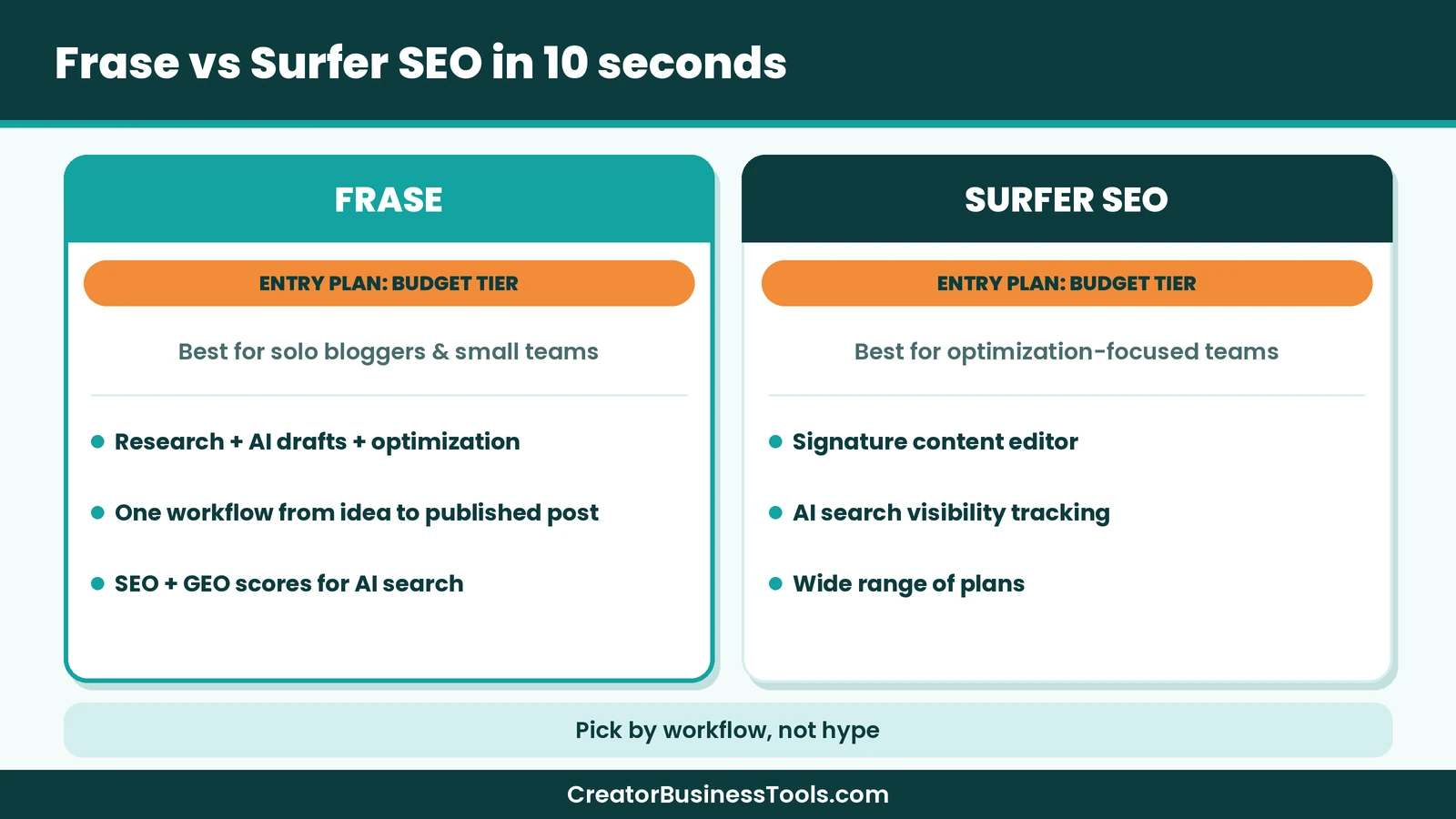
Quick verdict: Frase looks like the friendlier pick for solo creators who want research, AI drafting, and optimization in one place. Surfer SEO seems better suited to teams that care deeply about on-page optimization and tracking brand visibility across AI search tools, with a wide range of plans. Both are probably more than you need if you publish only a handful of posts a year.
Quick picks
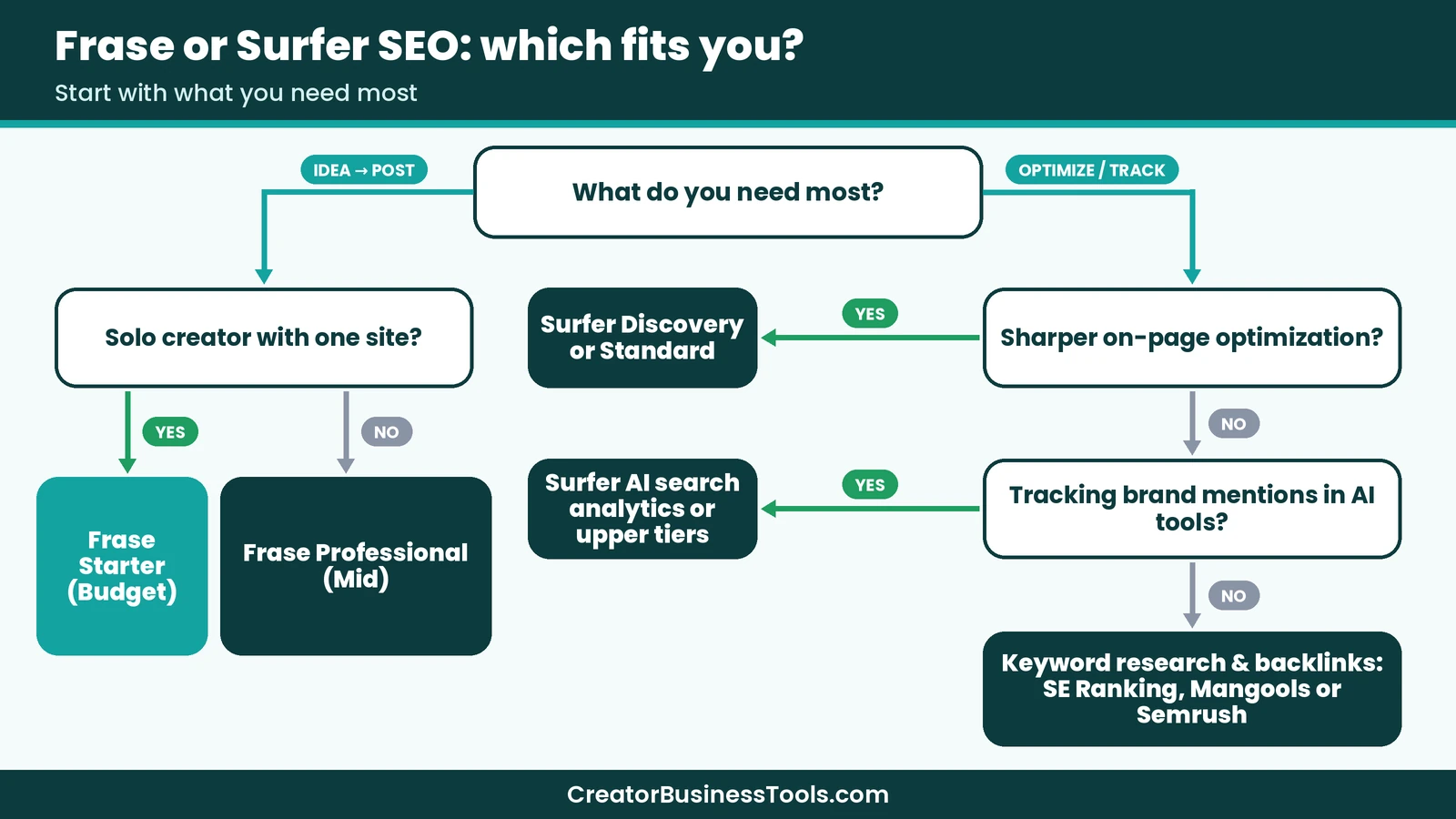
- Best for a solo creator with one blog: Frase Starter. Frase
- Best for teams focused on on-page optimization: Surfer SEO’s mid-range plans. Surfer SEO
- Best for tracking brand mentions in AI tools: Surfer’s AI search analytics features, or Frase’s higher tiers.
- Best if you mainly need keyword data: A dedicated SEO tool such as SE Ranking, Mangools, or Semrush.
Frase vs Surfer SEO at a glance
| Item | Frase | Surfer SEO |
|---|---|---|
| Main focus | Research, AI drafting, SEO and AI-search optimization | Content optimization and AI search visibility |
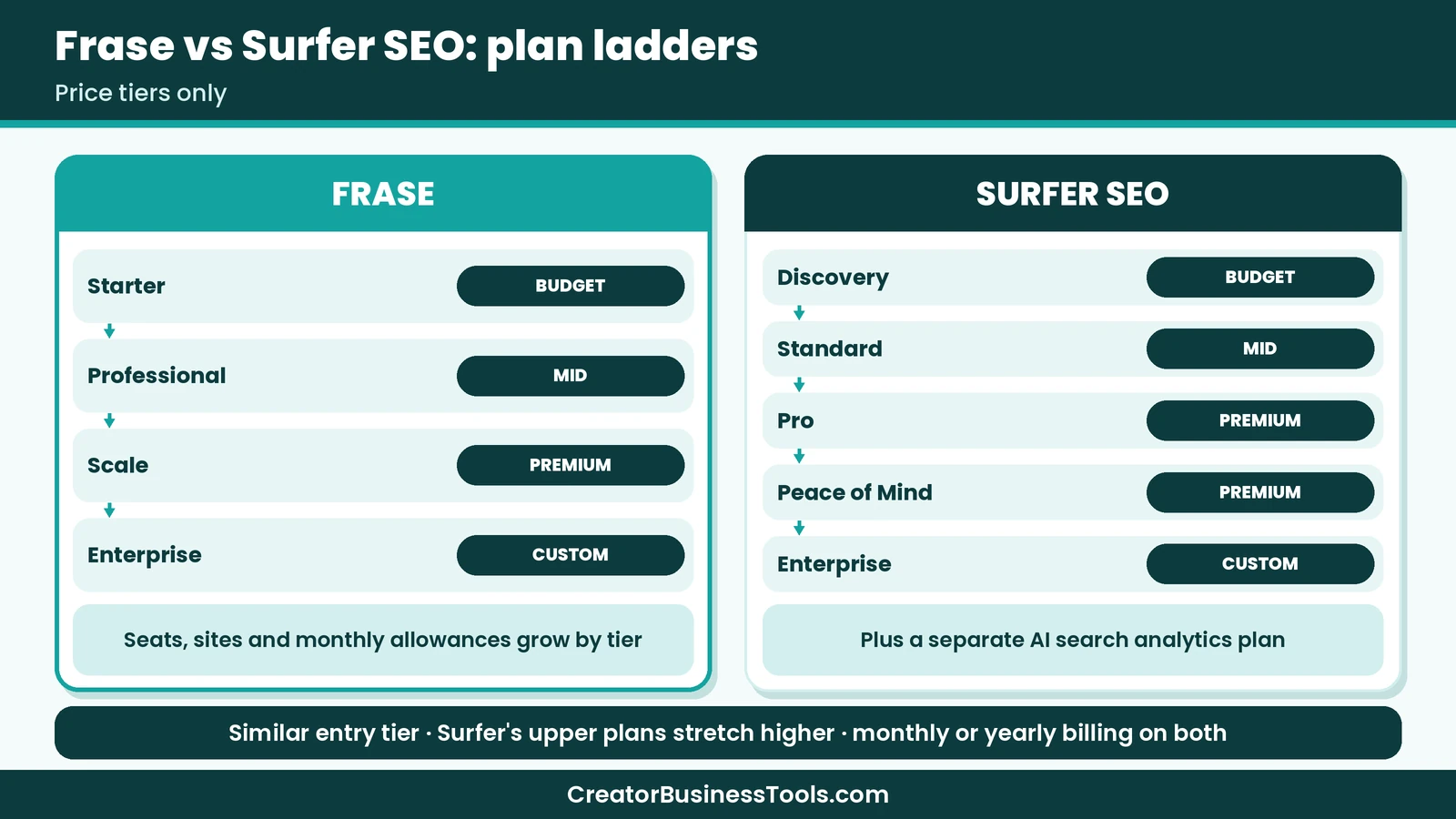
| Entry plan | Starter (budget) | Discovery (budget) |
| Mid plans | Professional (mid-range) | Standard (mid-range) |
| Top self-serve plans | Scale (premium) | Pro and Peace of Mind (premium) |
| Enterprise | Yes | Yes |
| Publishing | WordPress, Webflow, Sanity, Wix, hosted CMS | Integrations vary by plan |
| AI search tracking | Included, expands on higher tiers | Included, plus a separate analytics plan |
What is Frase?
Frase is a content platform that helps you research topics, draft posts with AI, and optimize them for both Google and AI assistants. Its entry plan is built for one person and one site, with a monthly allowance of articles and page audits. It can publish to popular website builders and includes its own hosted CMS as an option.
Frase also offers AI visibility tracking, a feature called Content Guard that watches key pages for ranking declines, and brand voice settings to keep drafts closer to your tone. We cover it in more depth in our Frase review.
What is Surfer SEO?
Surfer SEO is a content optimization platform best known for its content editor, which suggests topics and terms to include based on what’s already ranking. It has grown to cover AI search visibility, with tools to track how your brand appears in AI Overviews, ChatGPT, Gemini, and other assistants.
Surfer’s product line includes a content editor, topical maps, content audits, an AI writer, a plagiarism checker, rank drop detection, and a browser extension. Plans range from an entry tier for drafting and optimizing content up to large plans with API access and premium support.
Frase vs Surfer SEO: key differences
Overall focus
Frase positions itself as an all-in-one content workflow: research, write, optimize, publish, and monitor. Surfer SEO’s roots are in on-page optimization, and its newer plans add brand visibility tracking across AI tools.
If you want one tool to take you from idea to published post, Frase may feel more complete. If you already have a writing process and mainly want sharper optimization and visibility data, Surfer may fit more naturally.
Research and planning
Both tools help you see what top-ranking pages cover. Frase emphasizes topic research and clusters, while Surfer offers topical maps and content audits. For a beginner planning a few connected posts, both can help, though the experience differs.
Writing with AI
Frase includes AI drafting and brand voice settings, plus an optional AI agent that can publish when you allow it. Surfer offers an AI writer and features aimed at making AI text read more naturally. Either way, we’d suggest editing heavily so your posts sound like you.
Content optimization
This is where the two overlap most. Both score your draft against competing pages and suggest missing topics. Surfer’s content editor is often seen as its signature feature, while Frase pairs its SEO score with a GEO score for AI search.
AI search visibility
Both tools track AI visibility. Frase includes it on every plan, expanding the number of assistants on higher tiers. Surfer includes it in its plans and also sells a separate analytics plan focused only on AI search tracking. If AI visibility is your main interest, Surfer’s dedicated option may be appealing.
Team features
Frase’s mid and upper tiers add seats, sites, and client-ready reports. Surfer’s plans add team collaboration and, at the top, API access and priority support. Agencies may want to compare the details closely.
Frase vs Surfer SEO pricing tiers
We’ll avoid exact prices because they can change. Here’s how the tiers line up in general terms. Check each official pricing page before deciding.
Frase
- Starter (budget): One seat, one site, a monthly allowance of articles and audits.
- Professional (mid-range): More seats and sites, a larger allowance, a content calendar, and internal linking suggestions.
- Scale (premium): More seats and domains, larger allowances, and client reports.
- Enterprise: Custom pricing.
Surfer SEO
- Discovery (budget): An entry plan for drafting and optimizing content.
- Standard (mid-range): Adds team collaboration, a plagiarism checker, and rank drop detection.
- Pro (premium): Adds more advanced features such as cannibalization reports and custom voices.
- Peace of Mind (premium): Adds uncapped optimization, API access, and VIP support.
- AI search analytics: A separate plan focused on tracking AI visibility.
- Enterprise: Custom pricing.
At the entry level, the two sit in a similar price tier, while Surfer’s upper plans stretch higher.
Walking through one blog post in each tool
Feature lists only go so far, so let’s imagine how a single post might come together in each tool. Say you sell printable meal planners and want to write a guide called “how to meal plan on a budget.”
In Frase, you might start with research, looking at what the top pages cover and which questions keep coming up. Frase can help you build an outline from those findings, and you could ask it for a first draft in your brand voice. From there, you’d edit the draft, add photos of your planner, and check the SEO and GEO scores to see whether anything important is missing. When you’re happy, you could publish straight to WordPress or another supported platform. Later, Content Guard may flag the post if its Google performance starts to slip.
In Surfer SEO, you might begin by opening the content editor for your target topic. Surfer suggests terms, headings, and topics to include based on competing pages, and gives you a score as you write. If you prefer, you could use Surfer’s AI writer to generate a draft, then edit it in the editor. On team plans, colleagues could collaborate, check for plagiarism, and watch for ranking drops. If AI visibility matters to you, Surfer’s tracking can show how your brand appears in AI assistants over time.
Both routes can produce a solid post. The difference is mostly where you spend your time: Frase spreads its help across the whole journey, while Surfer concentrates much of its strength in the editor and in visibility tracking.
Frase vs Surfer SEO for Pinterest-driven blogs
Many of our readers get most of their traffic from Pinterest, so it’s worth asking whether either tool helps there. Neither one optimizes pins directly. What they can do is make the page a pin points to more complete and more useful, which may help visitors stay, read, and click through to your products. A well-structured post may also start to earn some Google traffic over time, giving you a second source of visitors.
If Pinterest is your main channel and you publish only occasionally, you might not need either tool every month. Some creators subscribe during a focused content sprint, write and optimize a batch of posts, and then pause. Just check each tool’s cancellation and billing terms before planning around that.
What neither tool will do for you
It’s easy to expect a lot from SEO software, so here are a few gentle reality checks:
- They won’t guarantee rankings. Both tools give guidance, not promises. Frase says so plainly on its pricing page, which we appreciate.
- They won’t replace your expertise. The most helpful posts include real experience, examples, and opinions.
- They won’t fix a weak offer. If the product or course behind the post isn’t a good fit, more traffic may not help much.
- They won’t choose your strategy. You still need to decide which topics matter for your business.
- They won’t keep content fresh on their own. Monitoring features can alert you, but someone still has to update the post.
Switching between the two later
If you start with one tool and outgrow it, switching is usually manageable because your posts live on your own website, not inside the tool. You’d lose tool-specific history, such as saved briefs or scores, but your published content stays put. That’s one reason we suggest not overthinking the first choice. Pick the tool that matches your current bottleneck, use it well for a few months, and reassess once your publishing pace or team size changes.
Using either tool alongside a keyword tool
A common, budget-friendly setup for creators looks like this:
- Use a keyword tool to choose topics. Look for questions your audience asks that connect to your products.
- Use Frase or Surfer to plan and optimize. Turn each topic into a well-structured post.
- Promote on Pinterest and email. Create a few pins and mention the post in your newsletter.
- Review and refresh. Every few months, check which posts are growing and which need updates.
This keeps each tool focused on what it does best, rather than expecting one subscription to do everything.
Who should choose Frase?
Frase may be the better fit if you:
- Are a solo blogger or creator with one main site
- Want research, drafting, and optimization in one place
- Like having research, drafting, and optimization in one tool
- Want your entry plan to stop at its limits rather than adding surprise charges
- Are curious about AI search but don’t need deep brand tracking yet
Who should choose Surfer SEO?
Surfer SEO may be the better fit if you:
- Already have a writing workflow and mainly want stronger optimization guidance
- Work on a team that needs collaboration and plagiarism checks
- Want detailed tracking of how your brand appears in AI tools
- Need API access or premium support at the top end
Do you need keyword research too?
Neither Frase nor Surfer SEO is a full replacement for a keyword research and site audit tool. If you’re still figuring out which topics to target, a dedicated SEO tool can be a better first step. We’ve reviewed a few options for creators: SE Ranking as an affordable all-in-one choice, Mangools as a beginner-friendly keyword tool, and Semrush for deeper competitor research.
Many creators end up pairing one keyword tool with one content tool, or starting with a keyword tool and adding a content tool once they publish regularly.
Pros and cons
Frase pros
- One workflow from research to publishing
- Clear plan limits that are easy to understand
- Entry plan avoids surprise overage charges
- SEO and AI-search scores in one view
Frase cons
- Entry plan limited to one seat and one site
- Monthly article allowances may feel tight for heavy publishers
Surfer SEO pros
- Well-known content editor for on-page optimization
- Wide range of plans, including a dedicated AI search analytics option
- Team collaboration and advanced reports on higher tiers
Surfer SEO cons
- Upper plans sit in a higher price tier
- The range of plans can feel complex for a beginner
Our one cautionary tale
When we first got curious about content optimization tools, one of us tried to test two of them in the same week while also launching a small product. Neither tool got a fair shot. We bounced between dashboards, optimized one post twice in different ways, and ended the week with no clear answer. The lesson we took away: test one tool at a time, on one or two real posts, with a clear question you want answered.
How to choose in three simple steps
- Write down your main bottleneck. Is it planning, writing, optimizing, or tracking?
- Test one tool on one real post. Pick an important page and see how each tool’s suggestions change it.
- Check the fit after a few weeks. Look at your publishing pace and how much time the tool actually saved before committing to a longer plan.
FAQ
Is Frase or Surfer SEO better for beginners?
For many solo beginners, Frase may feel simpler because it covers research, drafting, and optimization in one place. Surfer can work well too, especially if optimization is your main focus.
Which tool is cheaper at the entry level?
Both entry plans sit in the budget tier, so the choice usually comes down to workflow rather than price.
Can either tool replace a keyword research tool?
Not fully. Both help with content research, but tools like SE Ranking, Mangools, or Semrush offer deeper keyword and competitor data.
Do both tools track AI search visibility?
Yes. Frase includes AI visibility on its plans, expanding on higher tiers. Surfer includes it in plans and offers a dedicated AI search analytics plan.
Which is better for agencies?
Both have agency-friendly tiers. Frase’s Scale plan includes client-ready reports, while Surfer’s upper plans include API access and premium support. Compare seats, sites, and limits for your client load.
Can I cancel if the tool isn’t a good fit?
Both list monthly options, so you can start monthly while you test. Check each company’s billing and refund terms before subscribing.
Do I need to be an SEO expert to use these tools?
No. Both are designed to give guidance as you write, though a basic understanding of keywords and search intent will help you get more from them.
Conclusion: Frase vs Surfer SEO for creators
In this Frase vs Surfer SEO comparison, the choice mostly comes down to workflow. Frase feels like an all-in-one helper for solo creators and small teams who want to go from idea to published post. Surfer SEO suits teams focused on on-page optimization and detailed AI search tracking, with a wider range of plans. Whichever you lean toward, pair it with solid keyword research and your own voice.
[See Frase's plans](https://www.frase.io/)Get our free SEO starter kit
Want a simple plan for choosing keywords, outlining posts, and optimizing them for Google and Pinterest? Join our email list for our free SEO starter kit for creators. Contact us to request a copy.
Pricing and features from official vendor pages, last checked October 24, 2026.