
Hosting.com vs SiteGround for New Bloggers: Two Shared Paths, Two Official Ladders
Disclosure: This post contains affiliate links. If you buy through them, we may earn a commission at no extra cost to you. How we make money.
This Hosting.com vs SiteGround guide is for new bloggers choosing between two shared hosts, not a managed WordPress platform and not a DIY cloud server. I am comparing Hosting.com — formerly A2 Hosting — with SiteGround, plus Hostinger as a nearby beginner path, using official product and pricing pages. This is not a timed speed test.
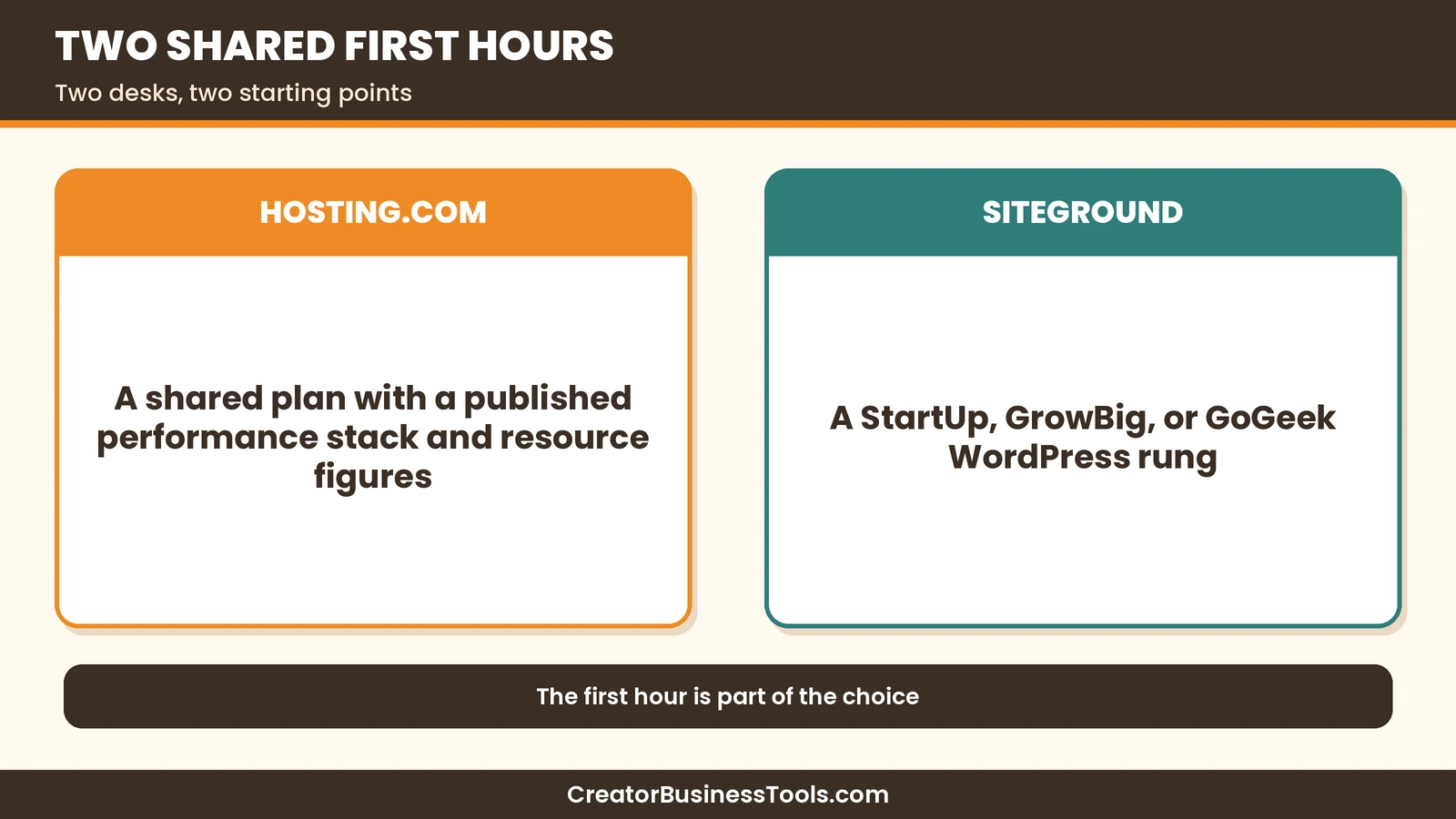
The published Hostinger vs SiteGround guide already compares two beginner-friendly shared paths. This article answers a different first question: do you want Hosting.com’s official shared desk, with a published LiteSpeed and NVMe stack, or SiteGround’s official StartUp-to-GoGeek WordPress ladder?
The reader’s problem: two shared first hours
A new blog needs a plan, a domain path, WordPress, and a first post. Both desks in this comparison can hold that job. They do not tell the same official story.
Hosting.com asks you to pick a shared rung and read official resource figures. SiteGround asks you to pick StartUp, GrowBig, or GoGeek and follow a site-count story built around WordPress. If you pick the wrong first hour, the host is not “wrong” in the abstract. It is simply a heavier or a less familiar desk than the job you wanted.
Three criteria for Hosting.com vs SiteGround
Criterion one: the official unit you buy
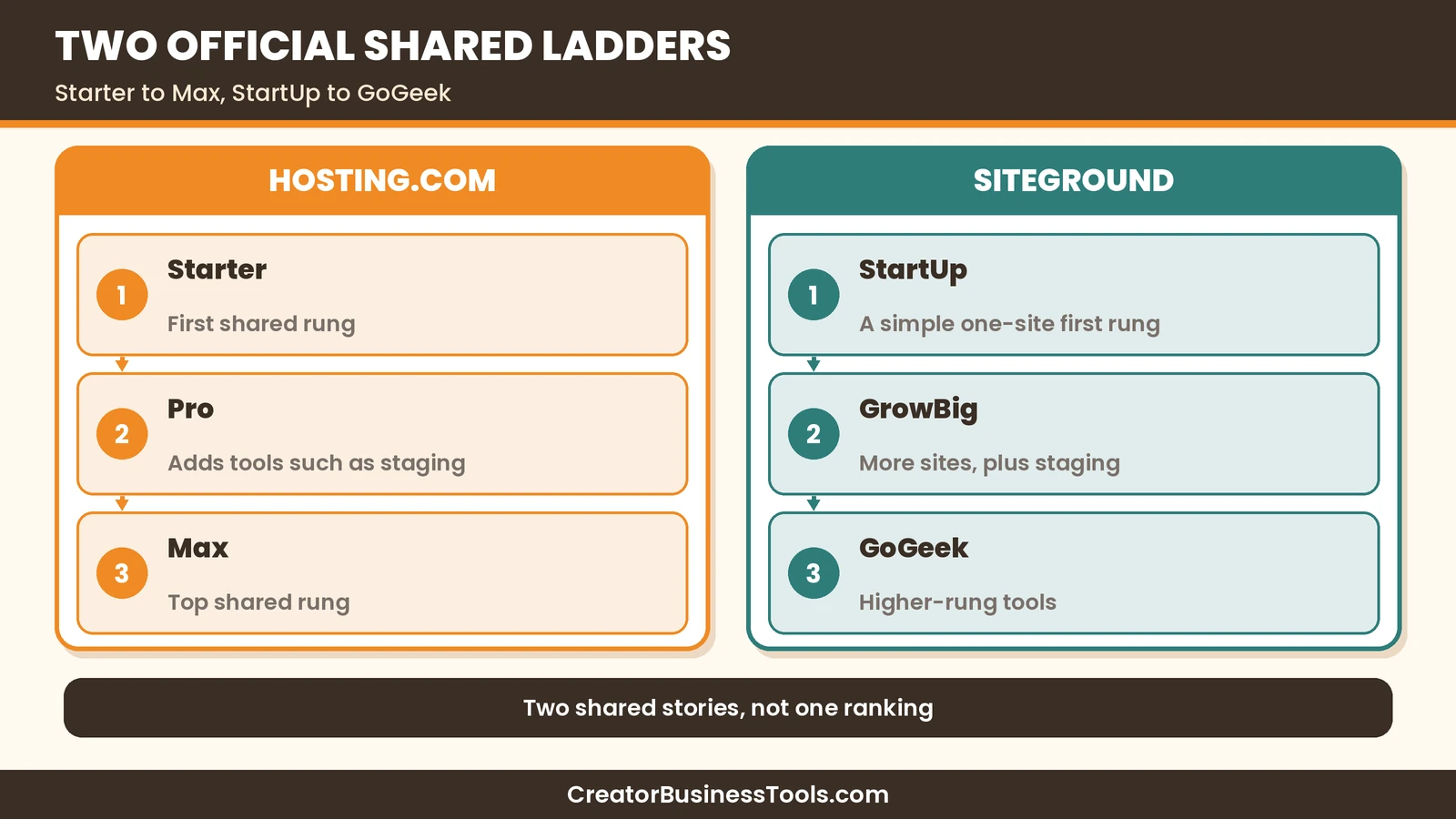
Official Hosting.com pages sell shared Starter, Pro, and Max rungs, with published storage and site caps. Official SiteGround pages sell StartUp, GrowBig, and GoGeek, with a site-count and storage story.
Criterion two: official limits you can confirm
Look for official caps on sites, storage, backups, and staging. Confirm the live official page, because Hosting.com’s public cards and comparison tables can describe the ladder in different words.
Criterion three: how you want to grow later
Shared growth often means a higher official rung on the same host. If you already know you want a visit-based managed WordPress desk, this may not be the right comparison. Stay here if the first site is still a shared blog.
Hosting.com vs SiteGround, at a glance
| Product | Best for | Key strength | Drawback | Price tier |
|---|---|---|---|---|
| Hosting.com | New bloggers who want a shared host with official LiteSpeed, NVMe, and published resource figures | Official shared stack on the plan family, daily backups, and in-house support | I did not run a speed test; confirm official site caps and the ongoing rate | Budget to mid-range official rungs, after you confirm the standard or renewal rate |
| SiteGround | New bloggers who want a WordPress ladder with a simple first rung | Official StartUp, GrowBig, and GoGeek story, with staging on higher rungs | Confirm the official standard or renewal rate, not only the first displayed figure | Budget to mid-range official standard rungs |
| Hostinger | The shortest beginner shared walkthrough | Official WordPress onboarding and a published first-post guide | It is not Hosting.com’s published resource-figure desk, and it is not SiteGround’s three-rung ladder | Budget official renewal rungs |
Hosting.com
What it is
Hosting.com is a shared web host under the Hosting.com brand, formerly A2 Hosting. Official shared pages describe Starter, Pro, and Max rungs, with LiteSpeed, NVMe storage, and AMD EPYC CPUs on the official shared plans. Official materials also describe daily backups, a firewall, SSL, email, and 24/7 in-house support.
Official comparison materials publish RAM, vCPU, and I/O figures. That transparency is part of the official story. Confirm the live site-count caps, because official pages do not all describe the ladder in the same wording.
Pros of Hosting.com
- Official shared pages describe LiteSpeed and NVMe on the shared plans
- Official comparison materials publish resource figures
- Official Pro adds tools such as staging
- Official materials describe a path to move up, or later to a server of your own
- In-house support sits on the official desk
Cons of Hosting.com
- I did not measure speed on a test blog
- Official public pages can disagree on how the site-count ladder is written
- The first figure on a pricing page may not be the official standard or renewal rate
- There is no lasting official free plan on the public pages I read
- A separate managed WordPress product can be easy to mix up with the shared plans
SiteGround
What it is
SiteGround officially sells shared WordPress hosting on a three-rung ladder: StartUp, GrowBig, and GoGeek. Official StartUp is one site. Official GrowBig and GoGeek allow more sites and add tools such as staging. Official pages also describe a set of data centers and a support desk on the paid plans.
SiteGround can be the calmer first desk if you want a WordPress-shaped onboarding path and a clear site-count story. Confirm the official standard or renewal rate on the pricing page, not only the first displayed figure.
Pros of SiteGround
- Official three-rung WordPress ladder is easy to explain to a first-time blogger
- Official StartUp is a simple one-site first plan
- Official GrowBig adds tools such as staging and on-demand backups
- Official GoGeek adds higher-rung tools such as Git and priority support
- A published review already maps this desk in more detail
Cons of SiteGround
- The first figure on a pricing page may not be the official standard or renewal rate
- I did not run a speed test, so I am not repeating official third-party speed claims
- Official plan limits still need a careful read, especially storage and site rules
- It is not a published RAM-and-IOPS desk in the same way Hosting.com’s comparison page is
- If you already wanted a visit-based managed platform, this is the wrong first question
Hostinger, as a nearby beginner path
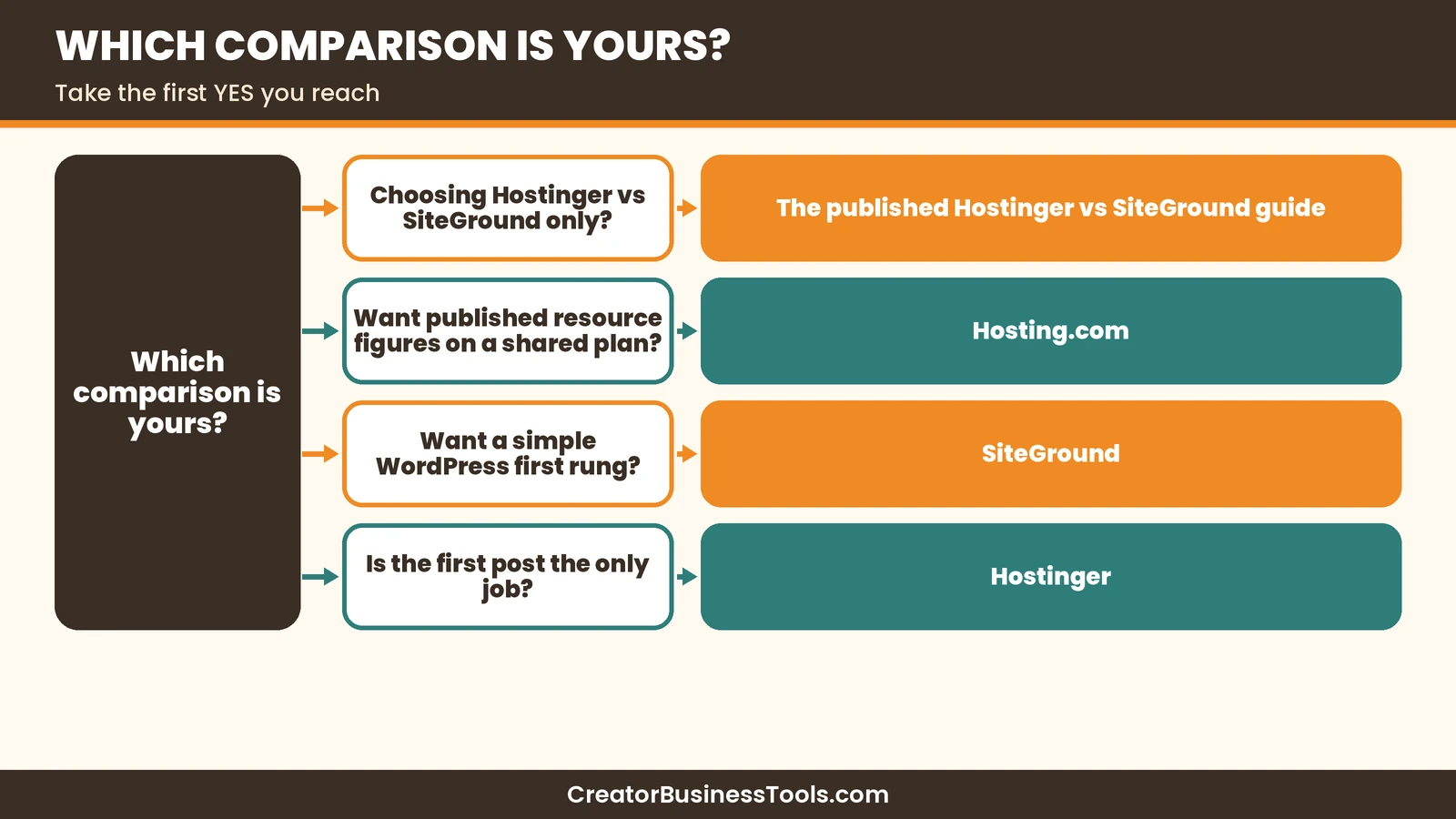
Hostinger is the nearby beginner shared path, not a third official column in the title. If the job is “publish the first post without a long setup,” a short official WordPress onboarding can fit better than either of the two desks above. That is the job of the published How to Start a Blog with Hostinger guide.
If you are choosing only between two shared beginner hosts, start with Hostinger vs SiteGround. Come back here when Hosting.com is one of the two names on your shortlist.
Best-use-case recommendations
| Situation | Pick | Why |
|---|---|---|
| You want a shared host with official LiteSpeed, NVMe, and published resource figures | Hosting.com | Official shared performance story |
| You want a WordPress ladder with a simple one-site first rung | SiteGround | Official StartUp to GoGeek story |
| You want the shortest first-post walkthrough | Hostinger | Official onboarding plus a published guide |
| You want staging on a shared rung | Hosting.com Pro, or SiteGround GrowBig or GoGeek | Official higher shared rungs, after you confirm the feature list |
| You already want a managed WordPress platform | A visit- or capacity-based desk, not this comparison | This guide is for shared first blogs |
Pricing structure, without the noise
Both official desks can show a first figure that is not the ongoing rate. Hosting.com uses official Starter, Pro, and Max rungs. SiteGround uses official StartUp, GrowBig, and GoGeek rungs. I am not restating dollar amounts here. Read the official standard or renewal rate, not only the first figure on the page.
Hostinger uses its own official renewal rungs. Budget the official ongoing rate on every desk in this table.
When Hosting.com is the better shared desk
Choose Hosting.com if you want the official LiteSpeed and NVMe story on a shared plan, and you want published resource figures you can read before you buy. Start with official Starter if the site count fits. Move to Pro if you need official staging or more official room.
It is a weaker fit if you wanted SiteGround’s one-site StartUp story, or if you only wanted the shortest first-post wizard.
When SiteGround is the better shared desk
Choose SiteGround if you want a WordPress ladder with a simple site-count story. StartUp can be enough for one site. GrowBig and GoGeek add official tools as the site count or the workflow grows.
It is a weaker fit if you already wanted Hosting.com’s published RAM and I/O figures, or if a managed WordPress platform is the real job.
Support, migrations, and the work after launch
Official Hosting.com pages describe 24/7 in-house support, daily backups, and a managed migration path. Official SiteGround pages describe support, daily backups, and official migration tools, including a WordPress migrator. I did not watch a migration on either desk, so I cannot grade the experience. Keep a current backup and read the official migration page before you move a live blog.
A domain and professional email can still sit outside either hosting card, depending on the official term. Write those costs down next to the official plan.
What this comparison cannot tell you
This Hosting.com vs SiteGround guide cannot tell you which host will feel faster for your theme and plugins. I did not measure TTFB. Official marketing on both sides can talk about performance. I am not repeating those claims as a lab result.
Stay on one official desk long enough to finish the domain, the SSL path, and the first article. Switching hosts will still leave you with the same writing job.
Questions to confirm on official pages
- Hosting.com official site, storage, and resource caps on the rung you will buy
- Whether you are looking at shared Hosting.com or its separate managed WordPress product
- SiteGround official standard or renewal rates for StartUp, GrowBig, or GoGeek
- Official storage, site, backup, and staging rules on both sides
- Domain and email terms
- The official ongoing rate, not only the first displayed figure
Mistakes I would avoid
- Treating this article as a repeat of Hostinger vs SiteGround
- Treating official speed language as a test I ran
- Budgeting from the first figure on a pricing page
- Mixing Hosting.com shared plans with its managed WordPress product
- Skipping official site-count caps
- Moving a live site without a current backup
Staging, email, and the official tool gap
Official SiteGround GrowBig and GoGeek add tools such as staging. Official Hosting.com Pro also describes staging and preview URLs. Official StartUp and official Hosting.com Starter are simpler first rungs, so confirm whether the tool you want sits on the plan you will actually buy.
Email and SSL sit on both official shared stories, with their own official terms. A domain may be included on some official billing terms and not on others. Write those details next to the plan name, so the first card is not mistaken for the whole first-site budget.
Who should not treat this as a speed contest
Official marketing on both sides can talk about performance. SiteGround’s public WordPress hosting page also publishes its own comparison figures against other hosts. I did not run a like-for-like test, so I am not ranking the two desks on TTFB or a plugin-heavy demo site. A theme, a cache layer, and a geographic audience can move those numbers more than a homepage slogan.
If speed is the only reason you opened this comparison, treat this article as a desk map, not as a lab result. Measure your own theme later, on the official desk you already chose, after the first pages are live.
A new blogger’s first-month list
The official hosting rate is only one line. A domain, a mailbox you will actually use, a backup export you control, and time to write posts all sit next to that line. A mid-range shared rung can still be the right desk if you already need staging. A simpler first rung can still be the right desk if the first job is a handful of posts and a calm first hour.
Write the full first-month list before you treat any official card as the whole cost of getting the blog online. Then pick one desk and stay there long enough to publish.
How I would choose from official pages
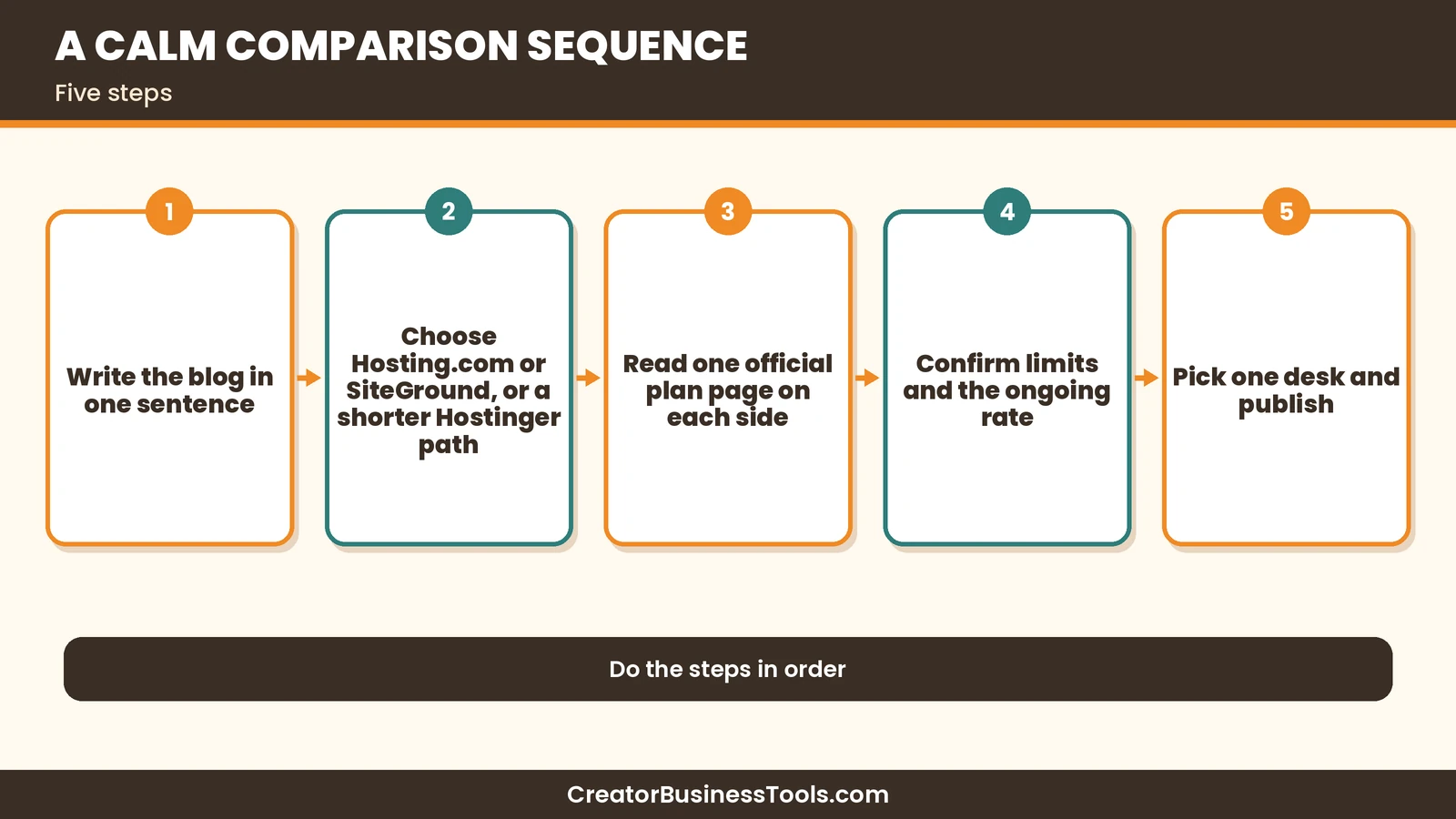
I am writing this Hosting.com vs SiteGround comparison from official product and pricing pages, not from a launched test blog. If I were choosing from those pages alone, I would write the first job in one sentence.
If the job was the shortest first post, I would look at Hostinger first. If the job was a simple one-site WordPress rung, I would read SiteGround StartUp. If the job was a shared host with published resource figures and a LiteSpeed stack, I would read Hosting.com Starter, then Pro if I needed staging.
If neither shared ladder feels like the right first hour, that is useful too. A visit-based managed WordPress desk is a different comparison, and a cloud server you size yourself is a different comparison again. This guide stays useful only if the job is still a shared first blog.
Published resources versus a WordPress-shaped ladder
The clearest official difference is not a speed trophy. It is the map each host publishes. Hosting.com’s comparison materials talk about RAM, vCPU, and I/O. SiteGround’s public ladder talks about site count, storage, and WordPress tools such as staging on higher rungs. A new blogger can use either map. The useful work is to pick the map you can explain, then stay there long enough to publish.
If official pages on one side feel harder to read, that is also data. A first blog does not need a confusing checkout. It needs a plan you can confirm and a post you can finish.
My honest take
Hosting.com vs SiteGround is a shared-desk match, not a trophy. Hosting.com is the shared host, formerly A2 Hosting, with a published performance stack and resource figures. SiteGround is the official WordPress ladder with a simple first rung. Hostinger remains the nearby beginner path.
I would start with the first hour I am willing to do. I would not start with a brand preference I could not map to a cap. And I would not pretend this comparison measured speed.
FAQ
Is Hosting.com or SiteGround better for a first blog?
Neither is automatically better. If you want official LiteSpeed, NVMe, and published resource figures, start with Hosting.com. If you want a simple one-site WordPress rung, start with SiteGround StartUp. If you want the shortest first-post path, look at Hostinger as well.
Is Hosting.com the same as A2 Hosting?
Official pages use the Hosting.com brand for the service formerly known as A2 Hosting. Confirm the live official plan names and caps when you buy. Do not assume an older A2 plan name still matches the current ladder.
Can I move from one shared host to the other later?
Official pages on both sides describe migration paths. I did not watch a move. Keep a current backup, read the official migration page, and confirm DNS and email before you change hosts.
Should I also read Hostinger vs SiteGround?
Yes, if those are the two shared hosts on your shortlist. See the published Hostinger vs SiteGround guide. This article is for readers who already have Hosting.com in the comparison.
Get the free Hosting.com vs SiteGround checklist
Free checklist: Get our free Hosting.com Vs Siteground Checklist — for comparing a Hosting.com shared rung with a SiteGround plan, including official limits and the ongoing rate. Contact us to request a copy.
Conclusion: pick the shared ladder you can explain
This Hosting.com vs SiteGround choice comes down to the official map you can explain in one sentence. If you want a shared host with a published performance stack, start with Hosting.com and read the official Starter-to-Max caps. If you want a WordPress ladder with a simple first rung, start with SiteGround and confirm the official standard or renewal rate. If you wanted the shortest first-post path, look at Hostinger as well. Confirm official limits, budget the ongoing plan, and let the first published post tell you whether the desk fits.