
Payhip vs Etsy for Selling Printables (Fees Compared)
Disclosure: This post contains affiliate links. If you buy through them, we may earn a commission at no extra cost to you. How we make money.
If you want to sell printables online, the first big decision is usually where to sell them: a marketplace like Etsy, or your own storefront on a platform like Payhip. Both can work beautifully for planners, wall art, templates, and worksheets, but they charge you in very different ways. In this guide, I’ll walk through how Payhip and Etsy fees compare, what each platform does well, and how you might use them together.
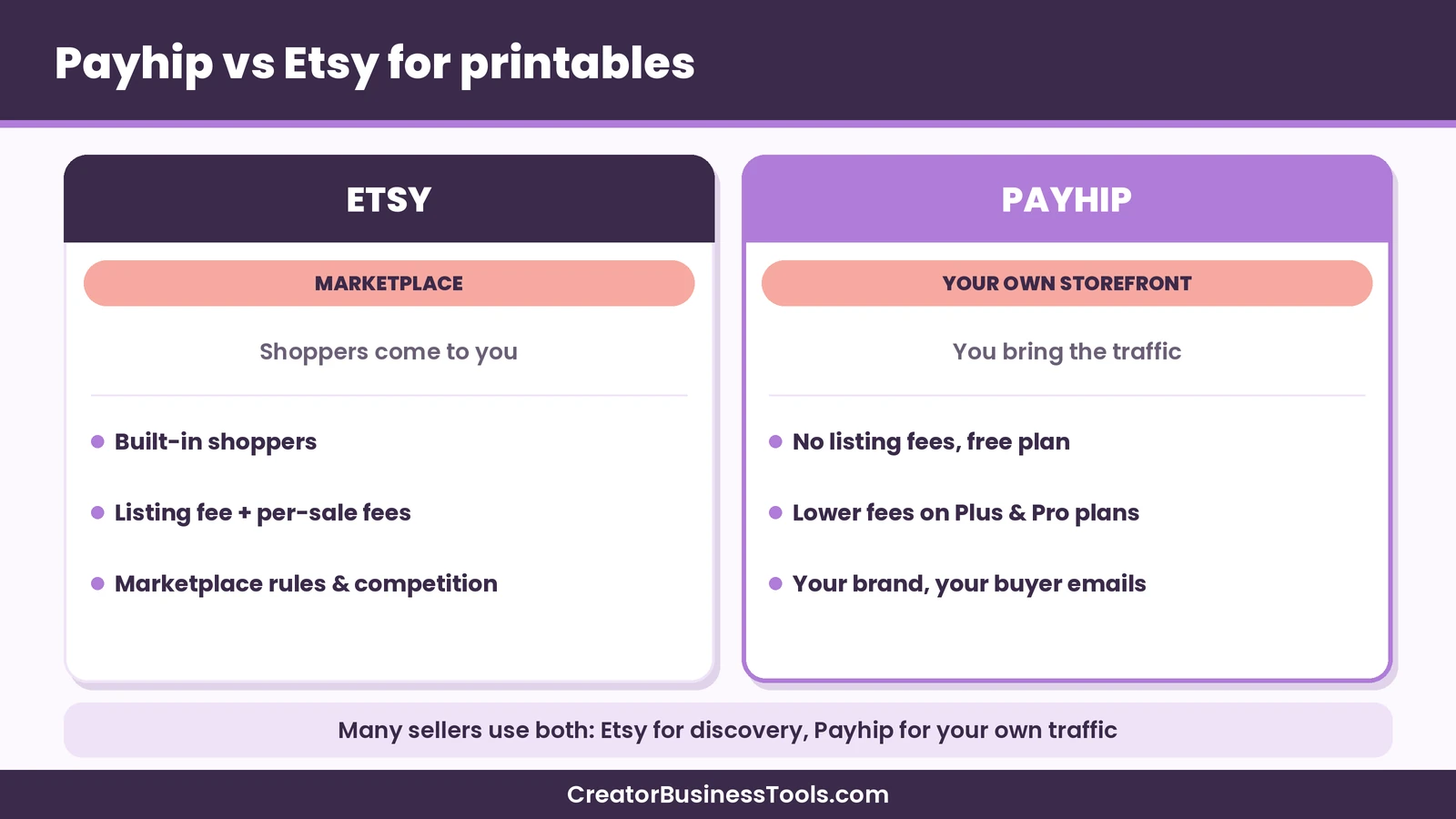
Quick verdict: Etsy is often the easier place to find your first buyers, because shoppers are already searching there. Payhip tends to be the better home for sales you bring in yourself, such as traffic from Pinterest, your blog, or your email list, because it has no listing fees and lets you lower per-sale costs as you grow. Many sellers may find that using both is the sweet spot.
Quick picks
- Best for finding first buyers through search: Etsy.
- Best for selling to your own Pinterest and blog traffic: Payhip Free Forever. Payhip
- Best for steady direct sales: Payhip Plus, with a lower per-sale fee.
- Best for established printable shops: Payhip Pro, with no Payhip transaction fee.
- Best overall strategy for many sellers: list on Etsy for discovery, and send your own audience to Payhip.
How to sell printables online: the two main paths
There are really two ways to sell printables online as a beginner.
1. A marketplace. You list your product in a big shared store, like Etsy. Shoppers search, find your listing, and buy. The marketplace brings traffic, and in return it takes several kinds of fees and sets the rules.
2. Your own storefront. You use a platform like Payhip to create a store and checkout links. Nobody stumbles onto your store by accident, so you bring the traffic yourself, usually from Pinterest, social media, a blog, or email. In return, your costs are often lower and you have more control.
Neither path is “right.” It mostly depends on whether you already have an audience, and how much time you want to spend marketing.
Etsy fees for digital downloads, explained
Etsy’s fee structure has several layers. For printables, these are the ones to know:
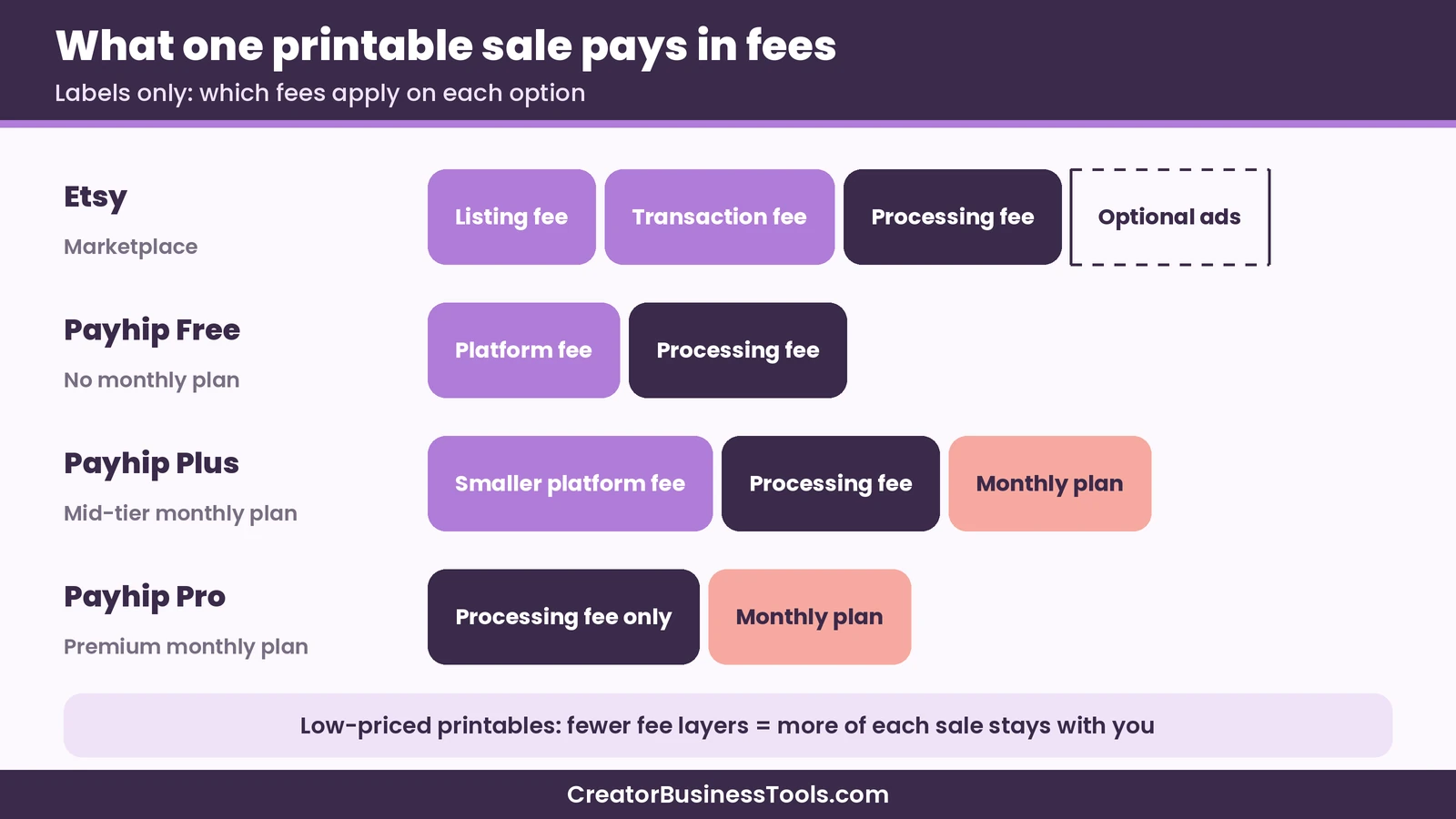
- Listing fee. Etsy charges a small fee for each listing you publish, whether or not it sells. Listings expire after a set period and can renew automatically, which charges the fee again.
- Renewal on multi-quantity listings. If a listing has multiple quantities, it renews (and charges the listing fee) each time one sells. Digital items are often listed this way, so this fee can recur.
- Transaction fee. When an item sells, Etsy takes a percentage of the price you display.
- Payment processing fee. If you use Etsy Payments, a percentage plus a small fixed amount is charged per order. The rate depends on where your bank account is located.
- Possible advertising fees. Etsy offers advertising programs that can add costs. Check Etsy’s fee policy so you know which apply to your shop.
Individually, each fee looks small. Together, on a low-priced printable, they can add up to a meaningful share of the sale.
Payhip fees for digital downloads, explained
Payhip keeps things shorter:
- No listing fees. You can upload as many products as you like on every plan.
- A platform fee per sale on the Free plan, a lower fee on Plus, and no Payhip fee on Pro.
- A monthly fee on Plus and Pro, in exchange for those lower per-sale fees.
- Payment processing from PayPal or Stripe, at their standard rates, on every plan.
Payhip also says it collects and remits EU/UK VAT and US/Canadian sales tax for you on digital sales, which is helpful if you sell worldwide.
Payhip vs Etsy: fees compared side by side
| Fee or feature | Etsy | Payhip |
|---|---|---|
| Monthly fee | None required | Free plan, or mid-range (Plus) / premium (Pro) |
| Listing fee | Yes, per listing and renewal | None |
| Per-sale platform fee | Yes, on every sale | Higher on Free, lower on Plus, none on Pro |
| Payment processing | Yes, varies by country | PayPal/Stripe standard rates |
| Built-in shoppers | ✓ Large marketplace | ✗ You bring the traffic |
| Your own branding | Limited (shop within Etsy) | ✓ Your own storefront |
| Email list ownership | Limited | ✓ Easier to build your own list |
| Tax handling | Marketplace handles many sales taxes | EU/UK VAT and US/Canadian sales tax |
| Competition on the page | High, similar listings nearby | None on your own store |
What this means for a low-priced printable
On a cheap printable, small fixed charges matter more. Etsy’s listing fee and fixed processing charge take a larger share of a low-priced item than of a higher-priced bundle. On Payhip, you avoid listing fees, though PayPal or Stripe still apply their own processing fees.
That’s why many sellers bundle printables into higher-value sets. A bundle spreads fixed costs across more value, which may help you keep more of each sale on either platform.
Three example scenarios
Numbers change, so rather than quoting exact fees, here’s how the trade-offs tend to play out for three typical sellers.
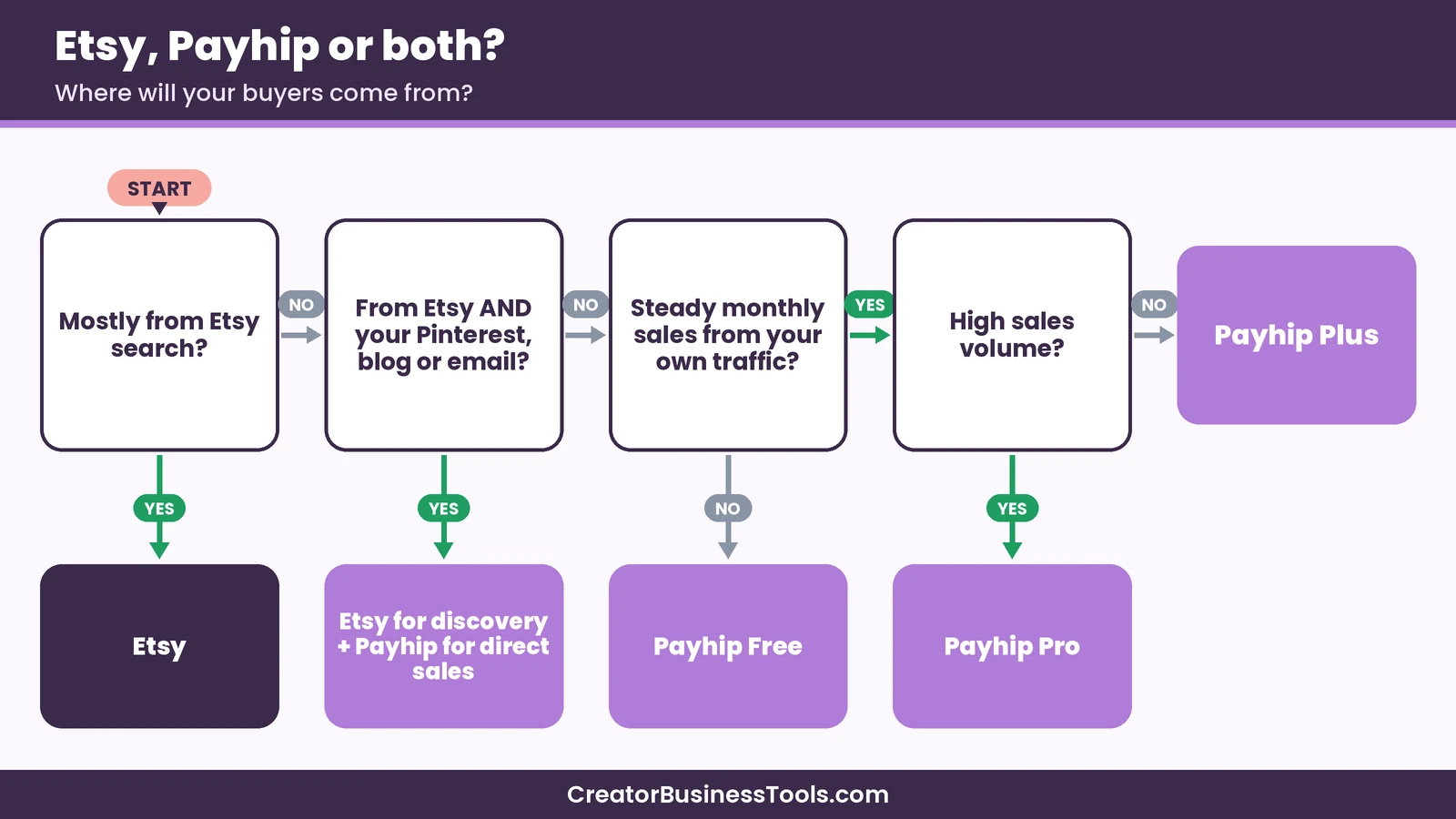
Scenario 1: The brand-new seller. Maya has a handful of printable planner pages and no audience yet. For her, Etsy’s built-in shoppers are likely worth the extra fee layers, because without traffic, even a zero-fee store won’t make sales. She might also open a free Payhip store so she has a home for future email subscribers, since the free plan costs nothing until she sells.
Scenario 2: The Pinterest creator. Jordan already gets steady clicks from Pinterest pins about homeschool worksheets. Sending that traffic to Etsy would mean paying listing and marketplace fees on sales Jordan generated on their own. A Payhip store probably makes more sense here, and once sales are steady, moving to the Plus plan may lower the overall cost per sale.
Scenario 3: The established shop. Priya runs a busy printable wall art shop on Etsy and has built an email list of past buyers. She might keep Etsy for discovery while launching new collections to her list through Payhip. At her volume, Payhip Pro could remove the platform fee on those direct sales entirely, though she’d want to compare that against the monthly cost.
In each case, the question is the same: who is bringing the buyer, you or the marketplace? When the marketplace brings them, its fees pay for that service. When you bring them, a storefront like Payhip often lets you keep more of the sale.
A small lesson from my first printable
Here’s my one personal story. The first printable I ever listed was a simple weekly planner page, and I priced it as low as I dared, thinking a tiny price would make it an easy yes. When I finally looked at what actually landed in my account after the various fees, I realized pricing that low made it hard for anything to be left over. I’d suggest doing that math before you list, not after.
Where Etsy may win
- Discovery. Etsy shoppers are already searching for printables, which may help you get early sales without an audience.
- Trust. Some buyers feel comfortable buying from a familiar marketplace.
- Reviews. Etsy reviews sit right on your listing and can build momentum.
- Learning. Seeing what sells on Etsy can teach you a lot about demand.
Where Payhip may win
- Lower costs on your own traffic. No listing fees, and the option to reduce per-sale fees as you grow.
- Your brand, your store. No competitor listings right next to yours.
- Customer relationships. It’s easier to invite buyers to your email list.
- Room to grow. Payhip also supports courses and memberships, so you can expand beyond printables.
Payhip vs Etsy: pros and cons
| Platform | Pros | Cons |
|---|---|---|
| Etsy | Built-in shoppers, buyer trust, visible reviews | Several fee layers, listing fees, heavy competition, marketplace rules |
| Payhip | No listing fees, free plan, lower fees as you grow, your own brand | You need to drive your own traffic, no big marketplace |
Using Etsy and Payhip together
You don’t have to choose just one. A common approach looks like this:
- List your printables on Etsy to reach marketplace shoppers.
- Create a Payhip store with the same or bonus products.
- Point your Pinterest pins to Payhip (or to a blog post that links to Payhip), so your own traffic goes to your lower-fee store.
- Offer a freebie to grow your email list, and announce new products there.
- Watch where sales come from, and adjust your effort accordingly.
Before you do this, read Etsy’s policies about directing buyers off the platform. It’s usually safest to keep Etsy and your own marketing channels separate rather than sending Etsy buyers elsewhere.
How to price printables (simple framework)
- Start with value, not cost. What problem does the printable solve, and how much time does it save?
- Check comparable listings to see the typical price range in your niche.
- Account for fees. Estimate what you’ll keep on each platform at your chosen price.
- Use bundles. Combine related pages into a set at a higher price.
- Test, then adjust. Small price changes can teach you a lot.
Printable launch checklist
- ☐ Files exported in the right size and format (for example, letter and A4 PDFs)
- ☐ Mockup images that show the printable in use
- ☐ Clear description with what’s included and how to print
- ☐ License terms stated (personal use or commercial use)
- ☐ Listing or product page tested with a sample purchase
- ☐ Pinterest pins created and linked to your store or blog
- ☐ Freebie ready to grow your email list
Getting Pinterest traffic to your printables
If you plan to sell printables online through your own Payhip store, Pinterest is often the most natural traffic source. Pinners actively search for planners, checklists, and wall art, and a single pin can keep sending visitors long after you publish it.
A few habits seem to help beginners most:
- Pin the problem, not the product. “Weekly meal plan for busy families” tends to attract more clicks than “Meal Planner Printable #3.”
- Create several pins per product. Try different images, headlines, and colors, so you learn what your audience responds to.
- Use keywords naturally. Put the phrases people actually search for in your pin title, description, and board names.
- Link to a helpful page. A blog post that explains how to use the printable, with a link to buy, often converts better than a bare product page.
- Offer a free sample. A free page in exchange for an email address lets you follow up when you launch new products.
- Be patient. Pinterest traffic often builds gradually, so consistent pinning usually matters more than any single viral pin.
On Etsy, by contrast, most of your effort goes into listing titles, tags, photos, and reviews, because Etsy’s own search does the heavy lifting. Both skill sets are useful, and they can complement each other nicely.
Making printables buyers love
Whichever platform you choose, a well-made printable earns better reviews and more repeat buyers. Some details to consider:
- Offer common paper sizes. Including both US letter and A4 versions can reduce questions from international buyers.
- Keep ink use reasonable. Large dark backgrounds can be frustrating to print at home.
- Add a quick “how to print” page. Explain recommended settings and paper types.
- Include fillable or editable versions if your audience prefers using a tablet.
- Show the printable in use. Mockups of the page on a desk or clipboard help buyers picture it.
- Name files clearly. “Meal-Planner-Letter.pdf” is friendlier than “final_v7.pdf.”
What to do after your first sale
Your first sale is a great moment, and it’s also a chance to learn. Look at where the buyer came from, which pin or listing they clicked, and which product they chose. On Payhip, consider sending a thank-you email with a link to a related product. On Etsy, focus on delivering a smooth experience so the buyer feels comfortable leaving a review. Small improvements after each sale tend to compound over time.
Who should choose which?
| Seller | Suggested starting point | Why |
|---|---|---|
| Brand-new seller, no audience | Etsy | Built-in shoppers |
| Pinterest creator with steady traffic | Payhip Free | No listing fees, your own store |
| Etsy seller with a growing email list | Etsy + Payhip | Discovery plus lower-fee direct sales |
| Established printable shop | Payhip Plus or Pro | Lower or no platform fee as volume grows |
| Seller planning courses later | Payhip | Courses and memberships in one place |
Common beginner mistakes
- Underpricing. Fixed fees hit cheap items hardest.
- Ignoring listing renewals. On Etsy, renewals can quietly add listing fees.
- Relying on one channel. Algorithms change; your email list stays yours.
- Skipping license terms. Be clear about personal versus commercial use.
- Using fonts or graphics without rights. Check commercial-use licenses for every element.
FAQ
Is it cheaper to sell printables on Payhip or Etsy?
For sales you bring in yourself, Payhip is often cheaper, since it has no listing fees and lets you lower per-sale fees on paid plans. Etsy charges listing, transaction, and processing fees, but it also brings shoppers to you.
Does Etsy charge a fee for digital downloads?
Yes. Digital downloads have the same core fees as other items: a listing fee, a transaction fee when it sells, and a payment processing fee if you use Etsy Payments.
Does Payhip charge listing fees?
No. Payhip doesn’t list a listing fee on its pricing page. You pay a per-sale fee on Free, a lower fee on Plus, or no Payhip fee on Pro, plus PayPal or Stripe processing.
Can I sell the same printables on Etsy and Payhip?
Generally yes, as long as you own the rights. Check each platform’s policies, and avoid steering Etsy buyers off Etsy.
Will people find my Payhip store on their own?
Not usually. Payhip is a storefront, not a big marketplace, so plan to bring traffic from Pinterest, a blog, social media, or email.
Who handles sales tax on printables?
Etsy handles many marketplace sales taxes. Payhip says it collects and remits EU/UK VAT and US/Canadian sales tax on digital sales. Check your own local obligations too.
What’s the best way to sell printables online as a beginner?
Many beginners start on Etsy for discovery, then add Payhip once they have their own Pinterest or email traffic.
Conclusion: the best place to sell printables online
If you want to sell printables online, Etsy and Payhip each solve a different problem. Etsy brings shoppers but layers on several fees and plenty of competition. Payhip gives you your own store, no listing fees, and the option to reduce per-sale costs as you grow, but you’ll bring the traffic yourself.
For many Pinterest-driven sellers, the most flexible path may be using both: Etsy for discovery and Payhip for your own audience. Start small, run the numbers at your real price point, and let your sales data guide the next step. For plan details and how Payhip compares with Gumroad, see our Payhip review.
[Start a free Payhip store](https://payhip.com/)Free checklist: Get our free Printable Shop Starter Checklist, a one-page plan for your first printable, mockups, pricing, and Pinterest pins. Contact us to request a copy.
Pricing and features from official vendor pages, last checked October 23, 2026.