
Guides / Sales funnels & all-in-one
ClickFunnels vs Kajabi: Which Is Better for Selling Courses?
Disclosure: This post contains affiliate links. If you buy through them, we may earn a commission at no extra cost to you. How we make money.
If you already sell a course or coaching program, you’ve probably noticed that the product isn’t usually the problem. Getting enough of the right people into your world, and moving them from free content to a paid offer, is. That’s why so many course creators and coaches end up comparing ClickFunnels and Kajabi. One is built around funnels first. The other is built around running your whole knowledge business in one place.
Here’s the short answer: Choose ClickFunnels if your growth depends on high-converting funnels, such as lead magnets, webinar or challenge funnels, one-click upsells, and lots of testing, and you want more contacts for less money at the entry level. Choose Kajabi if you want funnels plus a more complete home for your courses, coaching, community, and members, with unlimited marketing emails and a polished student experience. If budget is the biggest constraint, systeme.io is a lower-cost option worth considering.
Below, we compare pricing, funnel tools, checkout and upsells, email and automation, course and coaching delivery, community, payments, and support, so you can pick the platform that strengthens your funnel without overpaying.
Quick picks
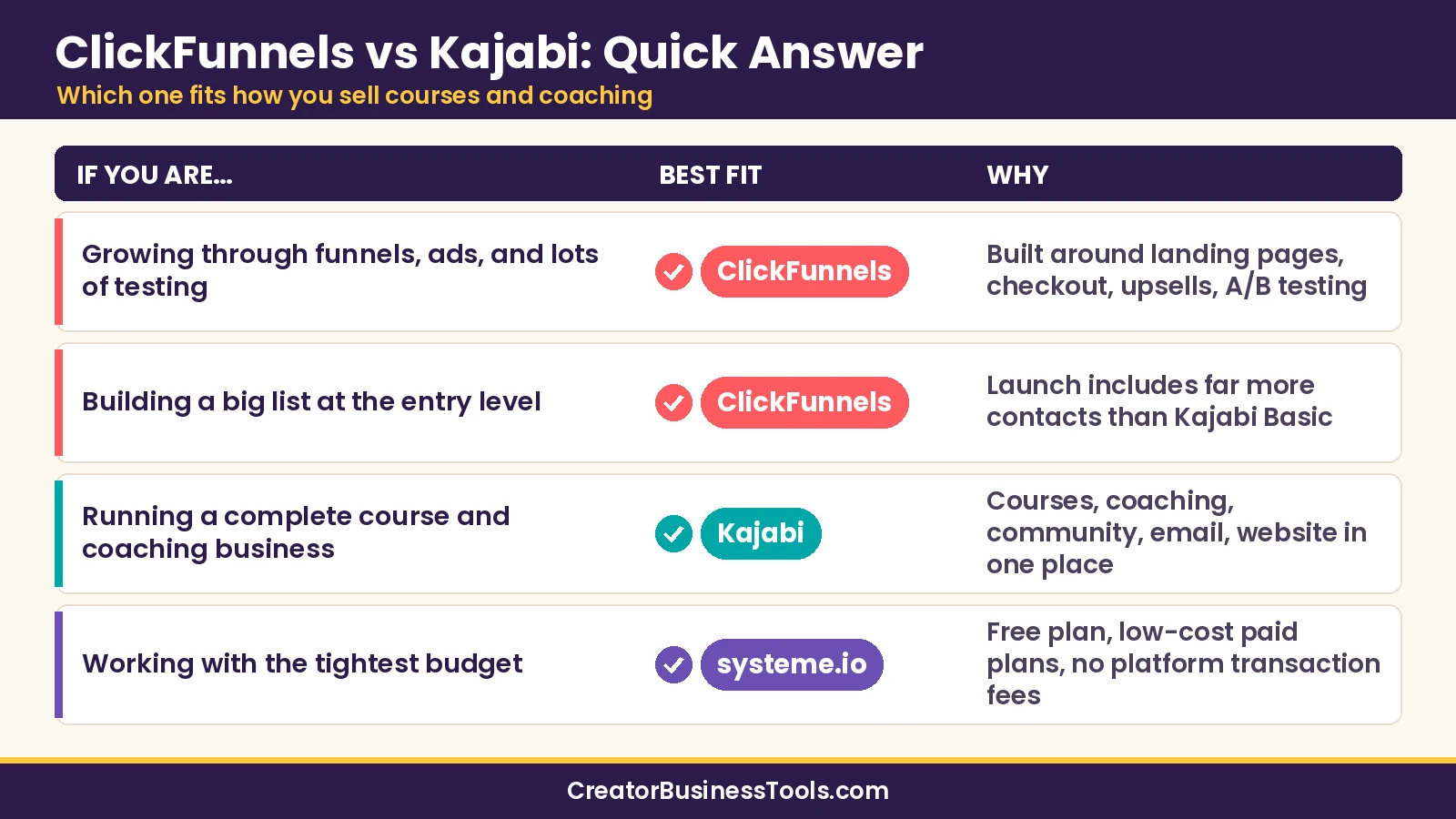
- Best for funnel-driven growth: ClickFunnels. Its tools are designed around landing pages, checkout flows, one-click upsells, surveys, countdown funnels, and A/B testing.
- Best for a complete course and coaching business: Kajabi. You get courses, coaching, communities, memberships, email, websites, and funnels in one polished platform.
- Best value at the entry level for big lists: ClickFunnels Launch, which includes far more contacts than Kajabi’s Basic plan at a lower price band.
- Best low-cost alternative: systeme.io, which has a free plan and paid plans under $50/month with no platform transaction fees.
ClickFunnels vs Kajabi at a glance
| Category | ClickFunnels | Kajabi |
|---|---|---|
| Core focus | Sales funnels and conversion tools | All-in-one platform for knowledge businesses |
| Entry plan price band | $50–$100/month | $100–$200/month |
| Free trial and guarantee | Free trial plus a 30-day money-back guarantee after the trial | Free trial plus a 30-day money-back guarantee |
| Contacts on entry plan | 10,000 | 2,500 |
| Email sending | Monthly send limit by plan | Unlimited marketing emails on every plan |
| Funnels | Unlimited (labeled a limited-time offer) | Unlimited on every plan |
| Courses and products | 3 courses on Launch, up to 20 on the top plan | 5 products on Basic, 50 on Growth, unlimited on Pro |
| Order bumps and upsells | Yes, built into Smart Checkout and one-click upsell pages | Yes, order bumps and post-purchase upsells and downsells |
| Community | Community app included | 1 community on Basic and Growth, 3 on Pro |
| Your own affiliate program | Affiliate Center on higher tiers | Growth plan and up |
| Platform cut of sales | None; you pay your payment processor’s fees | No revenue share; processing fees apply, plus an extra fee for third-party processors where Kajabi Payments is available |
| Branded mobile app | Not listed on the pricing page | Pro plan |
Pricing compared
Both platforms are premium tools, but their pricing is built differently.
ClickFunnels pricing
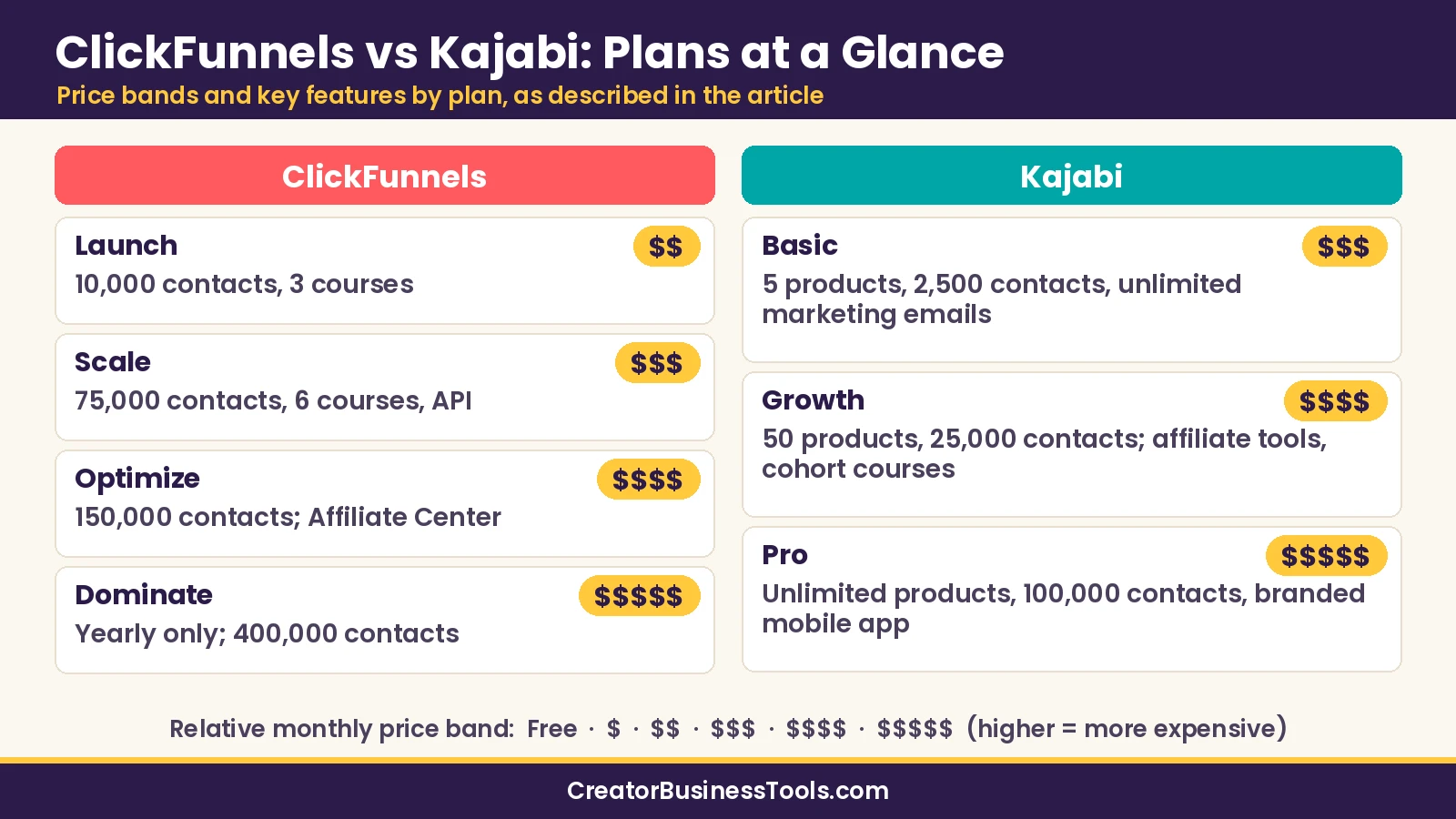
ClickFunnels has four plans. You can pay monthly or annually on the first three, and annual billing lowers the effective monthly cost:
- Launch: $50–$100/month. Includes unlimited funnels (currently labeled a limited-time offer), 1 workspace, 2 team members, 10,000 contacts, a monthly email allowance, 3 courses, 5 custom domains, appointments, group onboarding calls, and standard support.
- Scale: $150–$200/month. Adds 5 workspaces, 5 team members, 75,000 contacts, a much larger email allowance, 6 courses, unlimited custom domains, priority and live chat support, a custom code editor, and webhooks and full API access.
- Optimize: $200–$300/month. Raises the limits to 10 workspaces, 10 team members, 150,000 contacts, and 10 courses, and ClickFunnels’ help docs list the Affiliate Center on this tier.
- Dominate: billed yearly only, working out to roughly $450–$500/month. Includes 20 workspaces, 20 team members, 400,000 contacts, 20 courses, VIP support, and private onboarding.
Every plan comes with hosting and unlimited visitors, and ClickFunnels says it doesn’t take a percentage of your sales. New users get a free trial, and the 30-day money-back guarantee starts after the trial ends.
Kajabi pricing
Kajabi has three plans, with annual billing saving about 20%:
- Basic: $100–$200/month. 5 products, 2,500 contacts, 1 website, 1 community, and 2 admin users.
- Growth: $200–$250/month. 50 products, 25,000 contacts, and 11 admin users, plus Kajabi’s affiliate program tools, cohort courses, advanced automations, and the option to remove Kajabi branding.
- Pro: $400–$500/month. Unlimited products, 100,000 contacts, 3 websites, 3 communities, 26 admin users, and a branded mobile app.
Marketing emails, landing pages, and funnels are unlimited on every Kajabi plan. You get a free trial and a 30-day money-back guarantee, and Kajabi lets you add more contacts in large blocks for an extra monthly fee.
Which is cheaper?
At the entry level, ClickFunnels Launch sits in a lower price band than Kajabi Basic and includes four times as many contacts. That’s a meaningful advantage if you’re building a list with lead magnets and paid ads. Kajabi Basic, on the other hand, gives you unlimited email sends and more products.
At the middle tier, the gap narrows. ClickFunnels Scale and Kajabi Growth are close in price, and the right choice depends on whether you need more conversion tools and workspaces or more course, coaching, and community features.
Funnels and landing pages
This is the heart of the comparison.
ClickFunnels was built for funnels, and its toolkit reflects that. You get landing pages, sales funnels, survey workflows that collect data and route leads, countdown funnels that add urgency to offers, store funnels, short links for tracking, and A/B testing. Its help docs list countdown funnels and conversion boosters on Scale and above. The editor is designed around funnel steps, so it’s natural to map a full journey: opt-in page, thank-you page, sales page, checkout, upsell, and confirmation.
ClickFunnels also uses workspaces, which act like sub-accounts. That’s useful if you run more than one brand or manage funnels for clients.
Kajabi also includes unlimited funnels and landing pages on every plan, so you won’t hit a cap. Its funnels connect directly to your courses, coaching, and communities, which keeps the whole customer journey in one place. Kajabi’s templates are polished, and its website builder is strong if you want a professional brand site alongside your funnels.
The difference in practice: if your business lives and dies by funnel performance and you like building, testing, and iterating on lots of pages, ClickFunnels is the more specialized tool. If you want solid funnels that feed straight into a premium course and coaching experience, Kajabi is the more complete platform.
Checkout, order bumps, and upsells
Raising your average order value is one of the fastest ways to make paid traffic profitable, so checkout tools matter.
ClickFunnels’ Smart Checkout displays your main products and any order bumps automatically. After someone buys, you can send them to one-click upsell or downsell pages, where returning customers can accept an offer without re-entering their payment details. This kind of post-purchase flow is what ClickFunnels is known for.
Kajabi has caught up a lot here. Order bumps are available on all offers, and with its enhanced checkout you can add multiple bumps to a single one-time offer. Kajabi also supports post-purchase upsells and downsells, with several steps per offer. Accepted upsells are processed as separate transactions using the same payment method.
Both platforms can build a classic “tripwire, bump, upsell” flow. ClickFunnels gives you more funnel-centric options around it, while Kajabi keeps it tied tightly to your products.
Email marketing and automation
Email is where many funnels actually convert, so plan limits matter.
ClickFunnels includes email marketing and workflow automations on every plan, but each plan has a monthly email send limit along with its contact limit. Launch includes 10,000 contacts with a monthly email allowance that grows significantly on each higher plan. If you email a large list several times a week, check whether the plan you’re considering covers your volume.
Kajabi includes unlimited marketing emails on every plan, plus automations and a contact CRM. Advanced automations and features like comment-to-DM start on Growth. Kajabi’s tighter constraint is contacts, especially the 2,500-contact cap on Basic.
Put simply, ClickFunnels gives you more contacts per dollar, while Kajabi gives you unlimited sending. Your list size and email frequency will tell you which matters more. If you’d rather keep email in a dedicated tool, see our guide to the best email marketing for course creators.
Course and coaching delivery
If funnels bring people in, your product is what keeps them, earns referrals, and leads to repeat purchases.
ClickFunnels includes online courses and membership sites, with 3 courses on Launch and up to 20 on Dominate. It also offers appointments for booking calls and follow-ups, an opportunities pipeline for tracking sales conversations, and a message hub for connecting with leads and customers in one place. That’s useful for coaches who sell high-ticket programs through calls.
Kajabi goes deeper on delivery. Its products include courses, coaching, communities, memberships, newsletters, podcasts, and digital downloads. Kajabi’s coaching product brings scheduling, payments, communication, and delivery together, and Growth adds cohort courses for live, time-bound programs. Members can use Kajabi’s customer app to access content, and Pro adds your own branded app.
If your course is a supporting product in a funnel-heavy business, ClickFunnels covers it. If your course or coaching program is the main product and the student experience is a selling point, Kajabi is stronger.
Community
ClickFunnels includes a community app for creating and moderating a member community. It’s a convenient way to add discussion to a course or membership without another tool.
Kajabi includes one community on Basic and Growth and three on Pro, and communities are a central part of its product lineup. With the branded app on Pro, a paid community can feel like its own product.
If the community is your main offer, you may want a dedicated community platform. Our Circle vs Skool vs Mighty Networks guide compares the leading options.
Payments and fees
ClickFunnels says it charges no fees of its own for processing payments. You pay the standard rates of the gateway you connect, such as Stripe or Payments AI, a multi-gateway solution that also supports PayPal. Optional features like billing, tax, and invoicing tools can add small percentages on the processor side.
Kajabi doesn’t take a revenue share either, but it has its own processor, Kajabi Payments, with card rates that drop slightly on higher plans. If you’re in a region where Kajabi Payments is available and you use a third-party processor instead, Kajabi adds an extra percentage fee that’s highest on Basic and lowest on Pro.
For a funnel-heavy business with lots of transactions, those fees add up. Compare the current rates for your country on each platform’s official pages before you commit.
Support, onboarding, and teams
ClickFunnels includes group onboarding calls on every plan. Launch gets standard support, Scale and Optimize add priority and live chat support, and Dominate adds VIP support and private onboarding. Team members and workspaces increase with each plan, which suits agencies and growing teams.
Kajabi offers a help center, live webinars, and video guides, and its Pro plan description promises dedicated support. Admin seats grow from 2 on Basic to 26 on Pro, and Kajabi also runs a directory of experts you can hire to set up your business.
ClickFunnels review: built for conversion
ClickFunnels is a funnel-first platform for businesses that grow through landing pages, lead magnets, webinars, and paid traffic. Its strengths are the tools around the sale: survey workflows, countdown funnels, Smart Checkout with order bumps, one-click upsells, A/B testing, and analytics. At the entry level, it includes more contacts than Kajabi’s Basic plan at a lower price band, and it adds courses, community, email, appointments, and a CRM so you can run more of your business in one place.
Keep in mind: Email sends are capped monthly by plan, and the entry plan includes only a few courses. The unlimited funnels perk is labeled limited-time, and features like webhooks, the custom code editor, and the Affiliate Center sit on higher tiers.
Best for: Course creators and coaches who sell through funnels and paid ads, high-ticket coaches who book sales calls, and marketers who want to test and optimize every step.
Not ideal for: Creators who mainly want a polished course and community experience, or anyone who emails a large list very often on a small plan.
Start a ClickFunnels free trial
Kajabi review: the complete knowledge business platform
Kajabi gives you courses, coaching, communities, memberships, email, websites, funnels, and payments in one polished platform. Unlimited funnels, landing pages, and marketing emails on every plan mean you can market freely, and its order bumps and upsells cover the core of a sales funnel. Coaching tools, cohort courses, and a customer app make it a strong choice when the student experience is part of what you sell.
Keep in mind: Basic includes only 2,500 contacts and 5 products, so list-building creators may need Growth sooner than they expect. Processing fees apply, and using a third-party processor where Kajabi Payments is available adds an extra fee.
Best for: Coaches and course creators who want one premium home for products, community, and marketing, and who value design and a polished member experience.
Not ideal for: Funnel-heavy marketers who want advanced conversion tooling and lots of contacts at the lowest possible price.
A lower-cost option: systeme.io
If both platforms feel expensive for where your business is today, systeme.io is worth a look. It has a free plan with no time limit and paid plans in the under $50/month and $50–$100/month ranges. You get funnels, email marketing with unlimited sends, courses, a community, order bumps and upsells, and evergreen webinars on its Webinar plan and above, with no platform transaction fees.
The tradeoff is polish. Templates and design options are simpler than Kajabi’s, and plan limits on funnels, courses, and automation rules apply below the top tier. For creators testing their first funnel on a tight budget, though, it’s a practical starting point. See systeme.io’s plans. For a closer look at that trade-off, see our systeme.io vs Kajabi comparison.
For agencies and service businesses: HighLevel
If you run an agency or a service business and need a CRM, sales pipelines, and SMS follow-up alongside your funnels, HighLevel (GoHighLevel) is another option. It’s built for managing many clients and can be white-labeled, which can be more than a solo course creator needs. Our HighLevel review covers who it suits.
Weighing Kajabi against a course-focused platform instead? Our Kajabi vs Teachable comparison and Teachable vs Thinkific guide cover those options.
⚠️ Before you decide: Plans, limits, and fees change often. ClickFunnels labels its unlimited funnels as a limited-time offer, and email send limits, contact limits, and processing rates can change. Check each platform’s official pricing page and help docs for current details before you sign up.
How to choose between ClickFunnels and Kajabi
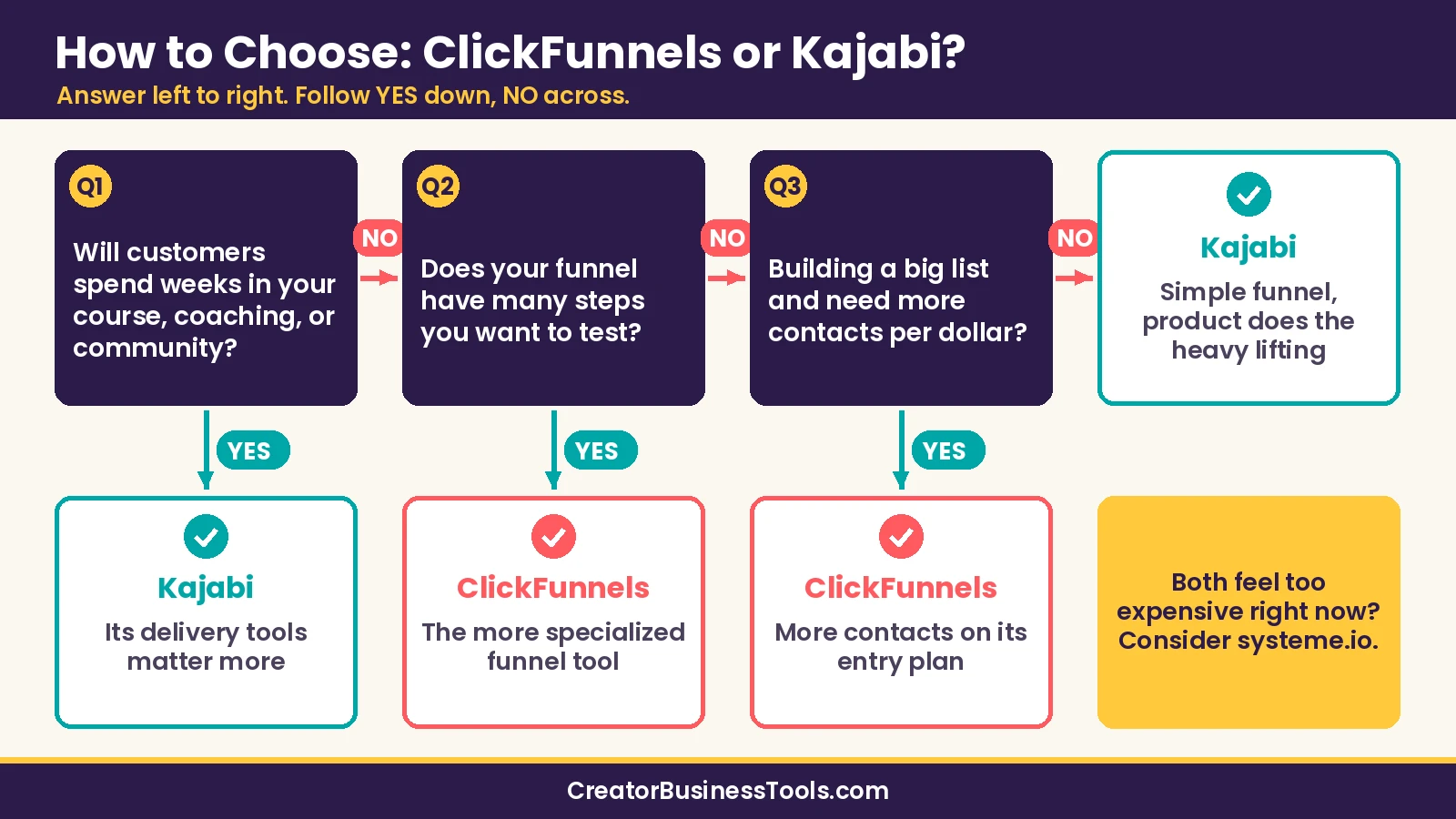
- Map your main funnel. Write out how a stranger becomes a buyer: ad or content, opt-in, email sequence, webinar or sales page, checkout, upsell. If that journey has many steps you want to test, ClickFunnels fits naturally. If it’s simple and your product does the heavy lifting, Kajabi fits.
- Check your list size and email frequency. ClickFunnels gives you more contacts on its entry plan, while Kajabi gives you unlimited sends but fewer contacts on Basic. Run your own numbers.
- Decide where your customers will spend their time. If they’ll mostly see your funnel pages, ClickFunnels is enough. If they’ll spend weeks inside your course, coaching program, or community, Kajabi’s delivery tools matter more.
- Count your products and brands. ClickFunnels limits courses by plan but adds workspaces for multiple brands. Kajabi limits products by plan, and Pro supports more websites and communities.
- Factor in payment fees. Compare your expected sales volume against each platform’s processing setup in your country.
- Use the trials. Both offer a free trial and a money-back guarantee. Build one real funnel on each and see which workflow feels faster for you. If CRM pipelines or agency client work matter more than course delivery, consider HighLevel as well.
FAQ
Is ClickFunnels better than Kajabi for funnels?
For funnel-specific tools like survey workflows, countdown funnels, one-click upsells, and A/B testing, ClickFunnels is more specialized. Kajabi also includes unlimited funnels, order bumps, and upsells, so it’s capable, but its focus is broader.
Is Kajabi better than ClickFunnels for courses?
Generally, yes. Kajabi offers more products on its middle tier, plus coaching tools, cohort courses, communities, and a customer app. ClickFunnels includes courses and memberships, but its course limits are tighter.
Which one is cheaper?
ClickFunnels’ entry plan sits in a lower price band than Kajabi’s and includes more contacts. Kajabi includes unlimited email sends. At the middle tier, the two are close in price.
Do ClickFunnels or Kajabi take a cut of my sales?
ClickFunnels says it doesn’t take a percentage of your sales; you pay your payment gateway’s fees. Kajabi doesn’t take a revenue share, but processing fees apply, and there’s an extra fee if you use a third-party processor where Kajabi Payments is available.
Can I use both together?
Some creators run front-end funnels on one platform and deliver products on another, but paying for two premium tools adds cost and complexity. Most course creators and coaches are better off choosing one.
Is systeme.io a good alternative to both?
For creators on a tight budget, yes. systeme.io has a free plan, low-cost paid plans, and no platform transaction fees. It’s less polished than Kajabi and less specialized than ClickFunnels, but it covers funnels, email, and courses.
The bottom line
If you want to strengthen the front end of your business with more leads, better conversions, and bigger orders, ClickFunnels is the more focused tool, and its entry plan gives you more contacts for less. If you want strong-enough funnels inside a polished home for your courses, coaching, and community, Kajabi is the better all-around platform. And if both feel like too much right now, systeme.io lets you build a working funnel on a much smaller budget.
The best way to decide is to build the same funnel on both. Start a ClickFunnels trial and try Kajabi free, then keep the one that gets your offer live faster and fits your budget.