
systeme.io vs Kajabi: Which Is Better for Your First Course?
Disclosure: This post contains affiliate links. If you buy through them, we may earn a commission at no extra cost to you. How we make money.
If you’re getting ready to sell your first online course or coaching program, Kajabi is probably on your shortlist. It’s polished, it does almost everything, and it’s widely recommended. Then you see the monthly price and wonder whether you really need to spend that much before you’ve made a single sale. That’s usually when systeme.io comes up as the budget alternative.
Here’s the short answer: systeme.io is the better pick for most first-time creators who want to launch cheaply, because it has a genuinely usable free plan and paid plans that start under $50/month with no platform transaction fees. Kajabi is the better pick if you want a more polished, design-forward platform with deeper coaching, community, and app features, and you’re comfortable paying in the $100–$200/month range or more from day one.
Below, we compare pricing, course and coaching tools, funnels, email, community, payments, and ease of use, so you can decide which one fits where your business is today rather than where it might be in three years.
Quick picks
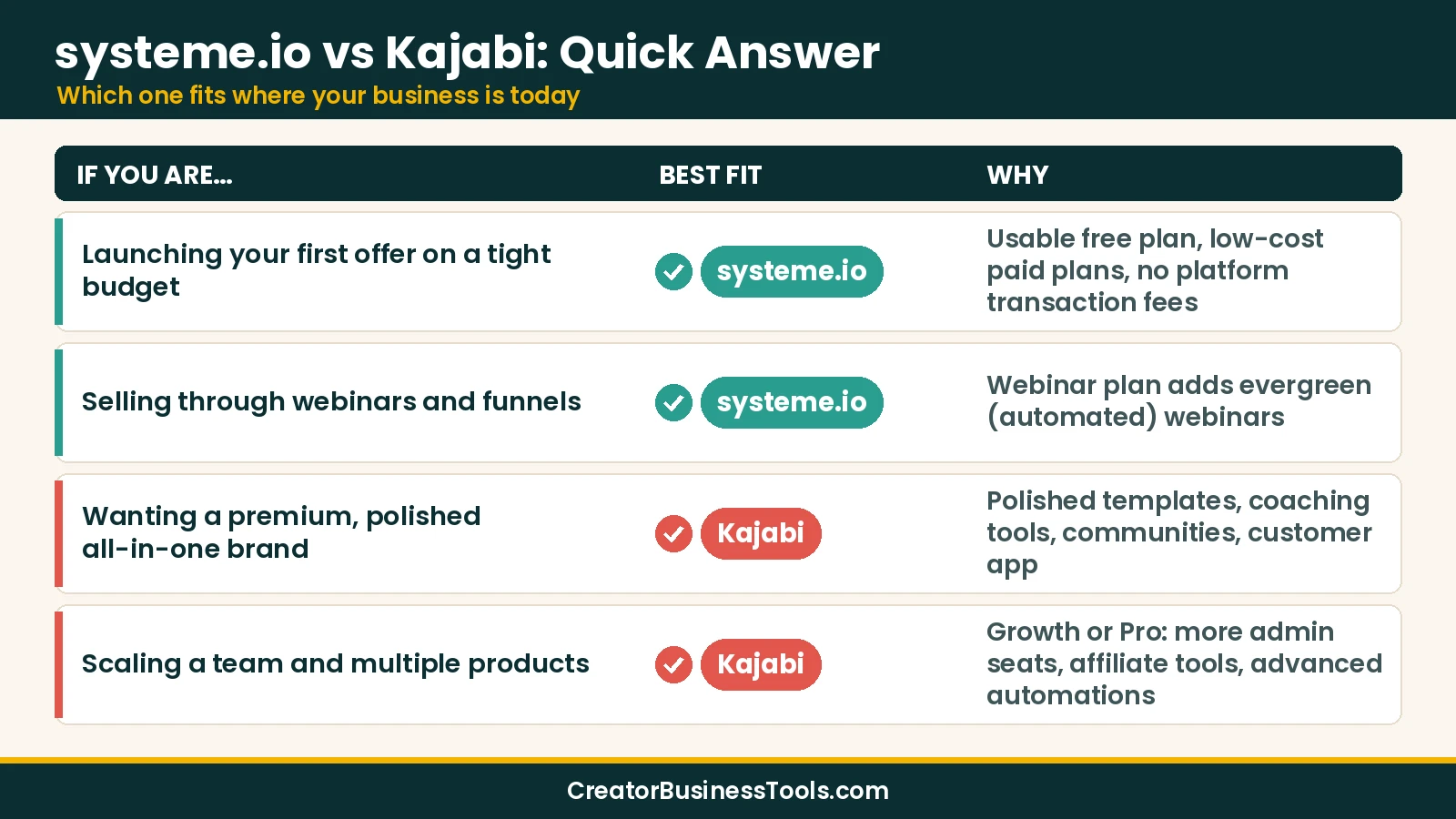
- Best for launching on a tight budget: systeme.io. You can build a funnel, a course, and an email list on the free plan, then upgrade to a low-cost plan when you outgrow it.
- Best for a premium, all-in-one brand experience: Kajabi. It costs more, but you get polished templates, coaching tools, communities, and a customer app for your members in one place.
- Best if you sell webinars: systeme.io’s Webinar plan, which adds evergreen (automated) webinars at a price that is still far below Kajabi’s entry plan.
- Best if you plan to scale a team and multiple products: Kajabi Growth or Pro, which add more admin seats, affiliate tools, advanced automations, and higher contact limits.
systeme.io vs Kajabi at a glance
| Category | systeme.io | Kajabi |
|---|---|---|
| Starting price | Free plan; paid plans from under $50/month | $100–$200/month for the entry plan |
| Free option | Free plan with no time limit and no credit card required | Free trial, then a paid plan |
| Platform transaction fees | None on any plan | No revenue share; card processing fees apply, plus an extra fee if you use a third-party processor where Kajabi Payments is available |
| Contacts on entry tier | 2,000 (free), 5,000 (first paid plan) | 2,500 (Basic) |
| Courses and products | 1 course on free; more on each paid plan, unlimited at the top | 5 products on Basic, 50 on Growth, unlimited on Pro |
| Funnels and landing pages | Limited by plan, unlimited at the top | Unlimited on every plan |
| Email marketing | Unlimited sends on every plan | Unlimited marketing emails on every plan |
| Webinars | Evergreen webinars on the Webinar plan and up | Not a headline feature on the pricing page |
| Community | Included, with unlimited members | 1 community on Basic and Growth, 3 on Pro |
| Your own affiliate program | Included on every plan | Growth plan and up |
| Branded mobile app | Not offered on the pricing page | Pro plan |
| Try before you pay | Free plan lets you start without paying | 14-day free trial plus a 30-day money-back guarantee |
Pricing: what you’ll actually pay
Price is the main reason people compare these two, so let’s start there.
systeme.io pricing
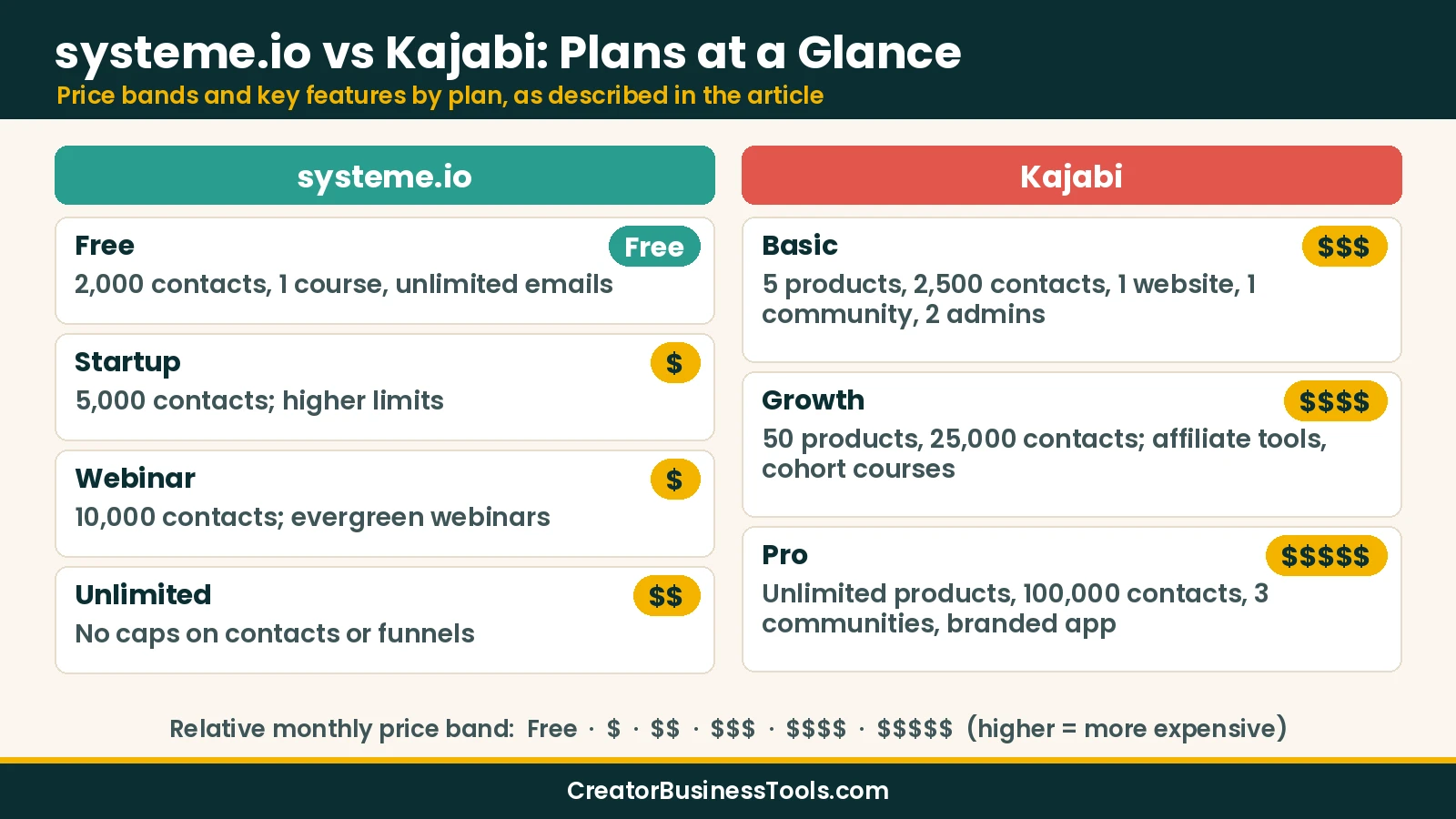
systeme.io has four self-serve plans plus a custom option for teams. The structure is built around contacts, with everything else scaling alongside:
- Free: $0, with no credit card required and no expiration. You get up to 2,000 contacts, a small number of funnels, one course, one community, one custom domain, and one automation rule. Course students are capped at 500 on this plan.
- Startup: under $50/month. Raises your limit to 5,000 contacts and gives you more funnels, courses, automation rules, and custom domains.
- Webinar: also under $50/month. Raises your limit to 10,000 contacts and adds evergreen webinars, along with higher limits on funnels, courses, and automations.
- Unlimited: $50–$100/month. Removes the caps on contacts, funnels, automation rules, and custom domains, and adds a free migration service and early access to new features.
Paying annually gets you roughly two months free on each paid plan. Every plan, including Free, includes unlimited email sends, unlimited file storage, and zero platform transaction fees. If you cancel a paid plan, your account drops back to the free plan instead of disappearing, though contacts above the free limit get archived.
Kajabi pricing
Kajabi has three plans, and all of them sit in a much higher price band:
- Basic: $100–$200/month depending on monthly or annual billing. You get 5 products, 2,500 contacts, 1 website, 1 community, and 2 admin users.
- Growth: $200–$250/month. You get 50 products, 25,000 contacts, and 11 admin users, plus Kajabi’s affiliate program tools, cohort courses, advanced automations, and the option to remove Kajabi branding.
- Pro: $400–$500/month. You get unlimited products, 100,000 contacts, 3 websites, 3 communities, 26 admin users, and a branded mobile app.
Annual billing saves about 20%. Kajabi offers a free trial and a 30-day money-back guarantee on every plan. Marketing emails, landing pages, and funnels are unlimited on all three plans, which is a real strength.
Fees that change the math
systeme.io doesn’t take a cut of your sales on any plan. You connect Stripe, PayPal, or another supported processor and pay that processor’s normal fees.
Kajabi also says it takes no revenue share. However, if you use Kajabi Payments, you pay Kajabi’s card processing rate, which drops slightly on higher plans. If you’re in a region where Kajabi Payments is available but you choose a third-party processor instead, Kajabi adds an extra percentage fee on top of your processor’s charges. That extra fee is highest on Basic and lowest on Pro. Check the current rates for your country on Kajabi’s pricing page before you decide.
What this means for a new creator: in your first year, systeme.io can cost you nothing or close to it. Kajabi’s entry plan alone runs into four figures a year before any processing fees. That gap only makes sense if Kajabi’s extra polish and features will help you sell more.
Courses and coaching
Both platforms let you build and sell online courses with modules, lessons, video, and downloadable files. The differences show up in limits and depth.
systeme.io gives you one course on the free plan and more on each paid tier, with unlimited courses on Unlimited. Paid plans allow unlimited students. You sell access through an order form: after payment, the customer automatically gets access to the course, a course bundle, a community, or a paid calendar event. That last option, plus the built-in booking calendar, is how you can sell coaching calls without adding a separate scheduling tool. It’s practical rather than fancy.
Kajabi counts courses, coaching programs, communities, memberships, newsletters, podcasts, and digital downloads as “products,” with 5 on Basic and 50 on Growth. Kajabi has a dedicated coaching product that puts scheduling, payments, communication, and delivery in one place, which is a step up if one-on-one or group coaching is your main offer. Growth also adds cohort courses, which work well for live, time-bound programs. Kajabi also offers video transcriptions and translations and a customer app that your students can use to access content.
If you’re selling a single signature course plus a few coaching calls, systeme.io covers the basics. If coaching is the core of your business and you want a more structured client experience, Kajabi has the edge.
Funnels, sales pages, and websites
This is where systeme.io punches well above its price. It started as a funnel builder, and it shows. You get sales funnels, landing pages, order forms, one-click upsells, order bumps, coupons, and A/B testing, with limits that grow on each plan. You can also build full websites and blogs, connect custom domains, and use a mobile-optimized link-in-bio page.
Kajabi includes unlimited funnels and landing pages on every plan, which removes a common worry. Its templates are more polished and design-forward, and its website builder is stronger if you want a brand site that looks premium out of the box. Basic and Growth include one website, while Pro includes three.
In practice, systeme.io is better if you like to test offers quickly with upsells and split tests on a budget. Kajabi is better if you care most about how your brand looks and want unlimited funnels without watching plan limits.
Email marketing and automation
Both platforms include email marketing, so you don’t need a separate tool.
systeme.io offers unlimited email sends on every plan, including Free, along with newsletters, sequences, tags, and automation rules. The number of automation rules is the main limit: one on the free plan, more on each paid plan, and unlimited at the top. For a simple welcome sequence and launch emails, the lower plans are usually enough.
Kajabi includes unlimited marketing emails on every plan, plus automations and a contact CRM. Advanced automations and features like comment-to-DM sit on Growth and above. Contact limits are the bigger constraint: 2,500 on Basic means you may need to upgrade sooner than you’d expect if your list grows quickly. Kajabi lets you add capacity in large contact blocks for an additional monthly fee.
If you plan to build a large free list before you sell, systeme.io’s contact limits and pricing are friendlier. If you’d rather have a more refined email and CRM experience inside a premium platform, Kajabi is the more polished choice.
Community features
Both platforms include a community area where members can post, comment, and interact.
systeme.io’s free plan includes one community, and all plans allow unlimited community members. You can sell community access through the same order forms you use for courses. It’s a simple, functional discussion space rather than a full-featured community platform.
Kajabi includes one community on Basic and Growth and three on Pro. Communities are a core part of Kajabi’s product lineup, and it has invested in features that keep members engaged. Pro adds a branded mobile app, which can make a paid membership feel more premium.
If community is the main thing you’re selling, compare both of these with dedicated community platforms. Our Circle vs Skool vs Mighty Networks guide breaks those options down.
Payments and checkout
systeme.io supports Stripe, PayPal, Apple Pay, Razorpay, Flutterwave, Mercado Pago, Xendit, and even cash on delivery for physical products. Because systeme.io takes no transaction fee, what you pay is your processor’s standard rate. You can attach one or more price plans to a payment page, so you can offer different ways to pay for the same course or program.
Kajabi has its own payment system, Kajabi Payments, alongside other payment integrations. Using Kajabi Payments keeps everything in one dashboard, but the processing rate is set by Kajabi. If you prefer an outside processor in a region where Kajabi Payments is available, expect the extra platform fee described above.
For most US creators, the practical question is simple: do you want the lowest possible fees, or a single built-in checkout? systeme.io wins on cost, while Kajabi wins on convenience.
Ease of use and design
systeme.io’s editor is straightforward and covers a lot of ground, but its templates are more functional than beautiful. The workflow is built around getting a funnel live quickly, though you may spend more time on design if you want a premium look.
Kajabi is known for a polished interface and attractive templates. It also has AI tools, and its higher plans include AI credits. If you want your first launch to look professional without hiring a designer, Kajabi makes that easier.
Support and migration
systeme.io lists 24/7 email support on every plan and says its average response time is under two hours. The Unlimited plan, and annual paid plans, include a free migration service, which helps if you’re moving from another platform.
Kajabi offers a help center, live webinars, and video guides, and its Pro plan description promises dedicated support. If you’d like someone to build your setup for you, Kajabi also runs a marketplace of Kajabi experts you can hire.
systeme.io review: the budget all-in-one
systeme.io combines funnels, email marketing, courses, communities, websites, blogs, webinars, and an affiliate program in a single low-cost platform. Its biggest selling point is the free plan, which is generous enough to launch a real offer, plus paid plans that stay affordable as you grow. Zero platform transaction fees on every plan mean you keep more of each sale.
It’s especially strong for creators who think in funnels: a lead magnet, an email sequence, a sales page, a checkout with an order bump, and an upsell. All of that is available without stacking separate tools.
Keep in mind: Templates and design options are more basic than Kajabi’s. Plan limits on funnels, courses, and automation rules matter more than they first appear, and its pricing page doesn’t list a branded mobile app.
Best for: First-time course creators and coaches who want to launch for little or no money, creators who rely on webinars and funnels, and anyone who wants zero transaction fees.
Not ideal for: Creators who want a premium, highly designed brand experience, or a structured coaching and member app experience from day one.
Start with systeme.io’s free plan
Kajabi review: the premium all-in-one
Kajabi brings courses, coaching, communities, memberships, email marketing, websites, funnels, and payments together in one polished platform. Unlimited funnels, landing pages, and marketing emails on every plan mean you rarely hit a wall on marketing. Its coaching tools, cohort courses, and customer app make it a strong choice when you want your clients to have a premium experience.
The tradeoff is cost. Even the entry plan sits in a far higher price band than systeme.io, and the features many growing creators want, such as an affiliate program, advanced automations, and removing Kajabi branding, start on Growth.
Keep in mind: Basic caps you at 5 products and 2,500 contacts, which some creators outgrow quickly. Processing fees apply, and using a third-party processor where Kajabi Payments is available adds an extra fee.
Best for: Coaches and course creators who already have an audience or revenue, value design and polish, and want coaching, community, and courses under one premium brand.
Not ideal for: Creators validating their very first offer on a tight budget, or anyone who wants to avoid platform-related payment fees.
Other options worth a quick look
If neither platform feels right, a few alternatives are worth a glance:
- Teachable focuses on courses and digital products. If you’re torn between a course-first platform and an all-in-one, read our Kajabi vs Teachable comparison. For course-focused platforms only, our Teachable vs Thinkific guide goes deeper.
- ClickFunnels is a funnel-first builder for creators who want to test lots of opt-in, webinar, and upsell flows. See how it stacks up in ClickFunnels vs Kajabi.
- HighLevel suits coaches and agencies that care most about CRM, pipelines, and automated follow-up. Our HighLevel review explains the trade-offs.
- Community-first platforms like Circle, Skool, and Mighty Networks make sense if your paid community is the main product rather than an add-on.
- Coaching-focused platforms like LearnWorlds and Podia are worth comparing if live sessions and cohorts matter most. See our guide to the best LMS for coaches.
⚠️ Before you decide: Plans, limits, and fees change often. Check systeme.io’s and Kajabi’s official pricing pages for current details, especially plan limits on contacts, products, and funnels, and Kajabi’s processing rates in your country. Promotions and add-on prices can also change without notice.
How to choose between systeme.io and Kajabi
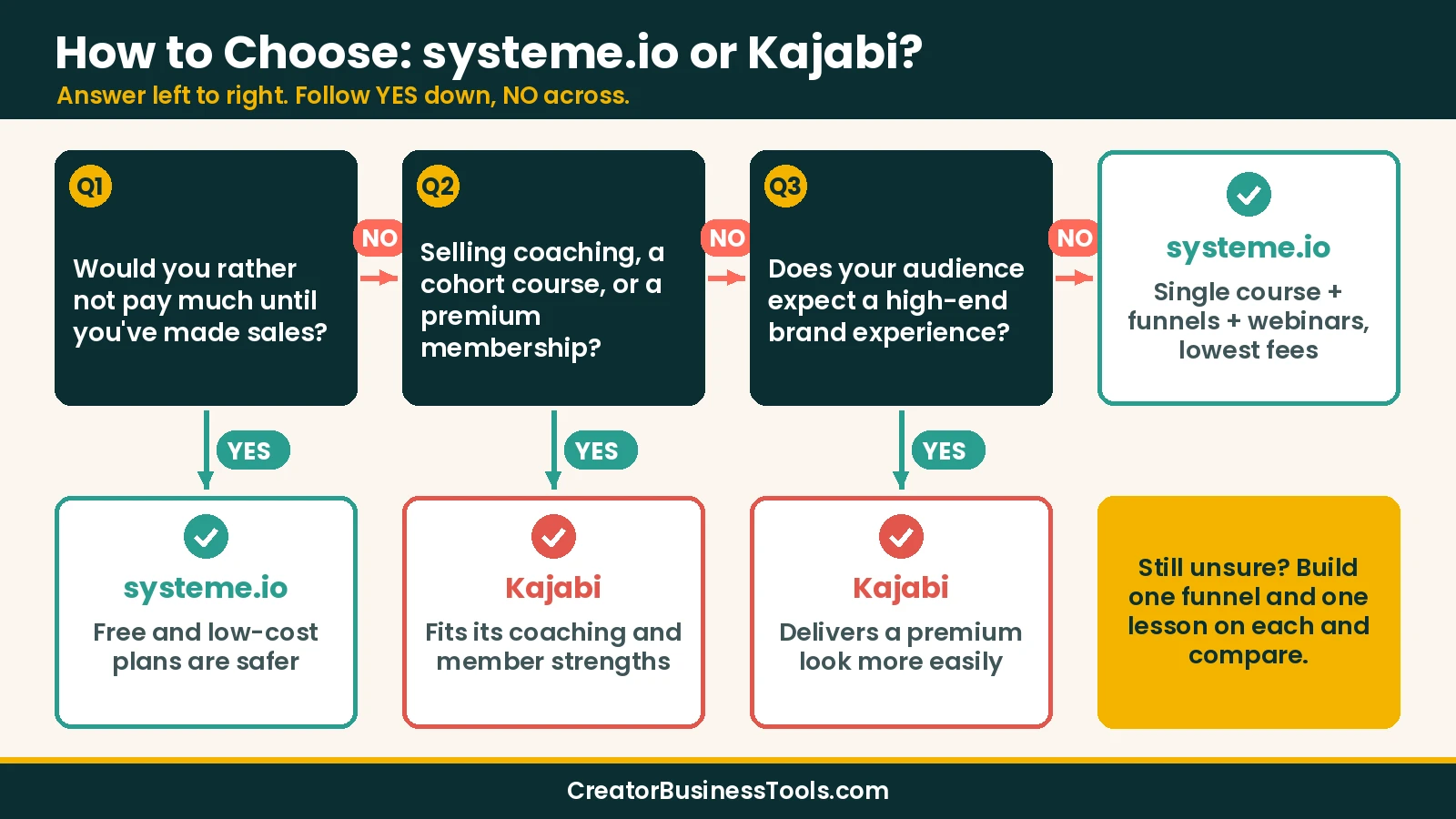
- Start with your budget for the next six months. If you’d rather not pay much until you’ve made sales, systeme.io’s free and low-cost plans are the safer bet. If you can comfortably cover Kajabi’s entry plan, its extra polish may be worth it.
- Count your contacts, not just your products. Look at your current list and your growth plans. systeme.io’s paid plans step up in contact limits at low prices, while Kajabi’s Basic plan caps you at 2,500.
- Decide what you’re really selling. A single course with funnels and webinars fits systeme.io well. A coaching program, cohort course, or premium membership fits Kajabi’s strengths.
- Think about fees. If keeping payment costs as low as possible matters, systeme.io’s zero transaction fees with your own processor are hard to beat. With Kajabi, factor in its processing rates.
- Consider how much design matters to you. If your audience expects a high-end brand experience, Kajabi delivers it more easily. If you’re comfortable with simpler templates, systeme.io saves you money.
- Test before you commit. Build one funnel and one course lesson on systeme.io’s free plan, or use Kajabi’s free trial, and see which workflow feels more natural.
On a tight budget for courses only, also see our Teachery review.
FAQ
Is systeme.io really free?
Yes. systeme.io’s free plan has no time limit and doesn’t require a credit card. It includes up to 2,000 contacts, a course with up to 500 students, a community, and unlimited email sends, with limits on funnels, automation rules, and custom domains.
Is Kajabi worth the price for beginners?
It can be if you value polish, coaching tools, and a premium brand experience, and you’re confident you’ll make sales. If you’re still validating your first offer, a lower-cost platform like systeme.io lets you test with far less risk.
Does either platform take a percentage of my sales?
systeme.io charges no platform transaction fees on any plan. Kajabi doesn’t take a revenue share, but its card processing fees apply when you use Kajabi Payments, and there’s an extra fee if you use a third-party processor where Kajabi Payments is available.
Can I sell coaching on systeme.io?
Yes. You can sell paid calendar events through order forms and use systeme.io’s booking calendar for sessions. Kajabi’s dedicated coaching product is more structured if coaching is your main offer.
Can I move from systeme.io to Kajabi later?
Yes. Many creators start on a low-cost platform and move once they have revenue. Plan your content and email list so they’re easy to export, and check each platform’s current migration options before you switch.
Which one is better for webinars?
systeme.io’s Webinar plan adds evergreen webinars, which is useful if webinars are part of your sales process. Kajabi doesn’t highlight webinars on its pricing page, so you may need a separate tool.
The bottom line
For most first-time creators who feel Kajabi’s price is too heavy, systeme.io is the smarter starting point. Its free plan is enough to launch a real offer, its paid plans stay affordable as your list grows, and it takes no transaction fees. Kajabi is the better choice when you want a polished, premium platform with structured coaching, cohort courses, and a branded experience, and you’re ready to invest in it.
Our advice is to start lean. Open a free systeme.io account, build one funnel and one course lesson, and make your first sales. If you later want more polish and are hitting your plan’s limits, Kajabi’s free trial is a smart next step.