
EverBee Review: Find What to Sell on Etsy With Product Data (vs eRank)
Disclosure: This post contains affiliate links. If you buy through them, we may earn a commission at no extra cost to you. How we make money.
Choosing what to sell is the hardest part of starting an Etsy shop. You can guess, follow trends you saw on social media, or look at data.
EverBee is a research tool built for the data route. It shows estimated sales and revenue for Etsy listings, plus keyword research, so you can see what’s already selling before you make anything.
This EverBee review explains what you get, how the plans work, who it fits, and how it compares with eRank, the other big name in Etsy research.
It’s based on EverBee’s official pricing and product pages, not on hands-on testing.
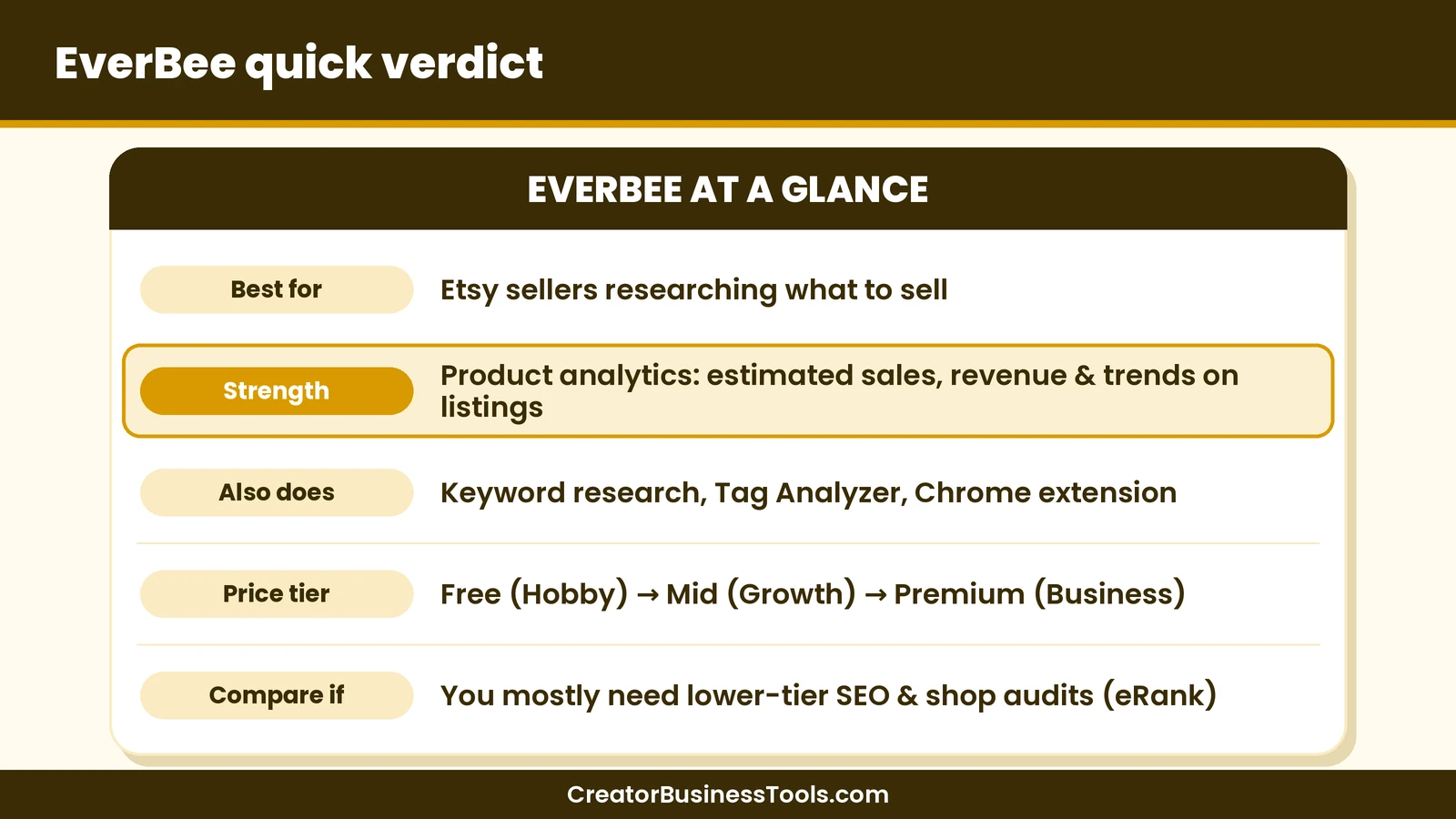
Quick verdict: EverBee is a strong pick for Etsy sellers who want product research first: which listings sell, how much they earn, and which keywords bring traffic. Its free Hobby plan is enough to try the basics. If your main goal is cheap, day-to-day SEO and shop audits, eRank costs less and covers that well.
Quick picks
- Best for Etsy product research: EverBee Growth. See EverBee’s plans
- Best free way to start: EverBee Hobby, which needs no credit card.
- Best for multi-shop sellers and brands: EverBee Business, with unlimited store connections and longer trend history.
- Best budget Etsy SEO tool: eRank, with a free plan and low-cost paid tiers.
What is EverBee?
EverBee is an Etsy research platform. You use it through a free Chrome extension that adds research data while you browse Etsy, after connecting your Etsy account.
Its core job is product analytics. On paid plans, EverBee shows estimated sales, revenue and conversion-rate data for Etsy listings, so you can spot products that appear to have steady demand.
It also includes keyword research with a Keyword Score, a Tag Analyzer, trend data and AI Actions. EverBee also lists MCP access on paid plans, which lets you bring Etsy data into an AI assistant.
| Feature | What it does | Plans |
|---|---|---|
| Product Analytics | Views, reviews and favorites on Hobby; sales, revenue and conversion rate on paid plans | All (limited on Hobby) |
| Keyword Research | Search terms with a Keyword Score on paid plans | All (10 keywords on Hobby) |
| Trends & Growth Rate | How listings perform over time | Growth and Business |
| Tag Analyzer | Reviews the tags on a listing | Growth and Business |
| AI Actions | AI help inside EverBee | Growth (monthly limit) and Business (unlimited) |
| Store connections | Connect your own Etsy shops | Growth (3) and Business (unlimited) |
One note on the data: sales and revenue figures for other sellers’ listings are best treated as estimates. Use them to compare products, not as exact numbers.
Who EverBee is for
EverBee fits sellers who want to make data-driven product decisions.
- New Etsy sellers deciding what to make first.
- Digital product sellers testing printables, planners and templates. You can also sell those printables from your own store with Payhip.
- Print-on-demand sellers looking for designs and niches with demand.
- Established shops checking trends before adding a product line.
- Multi-shop sellers and brands that need unlimited store connections.
It’s less of a fit if you already know exactly what you sell and only want to tune tags and titles. A cheaper SEO-focused tool can cover that.
EverBee pricing explained
EverBee has three plans: Hobby, Growth and Business. Paid plans can be billed monthly or annually, and annual billing costs less per month.
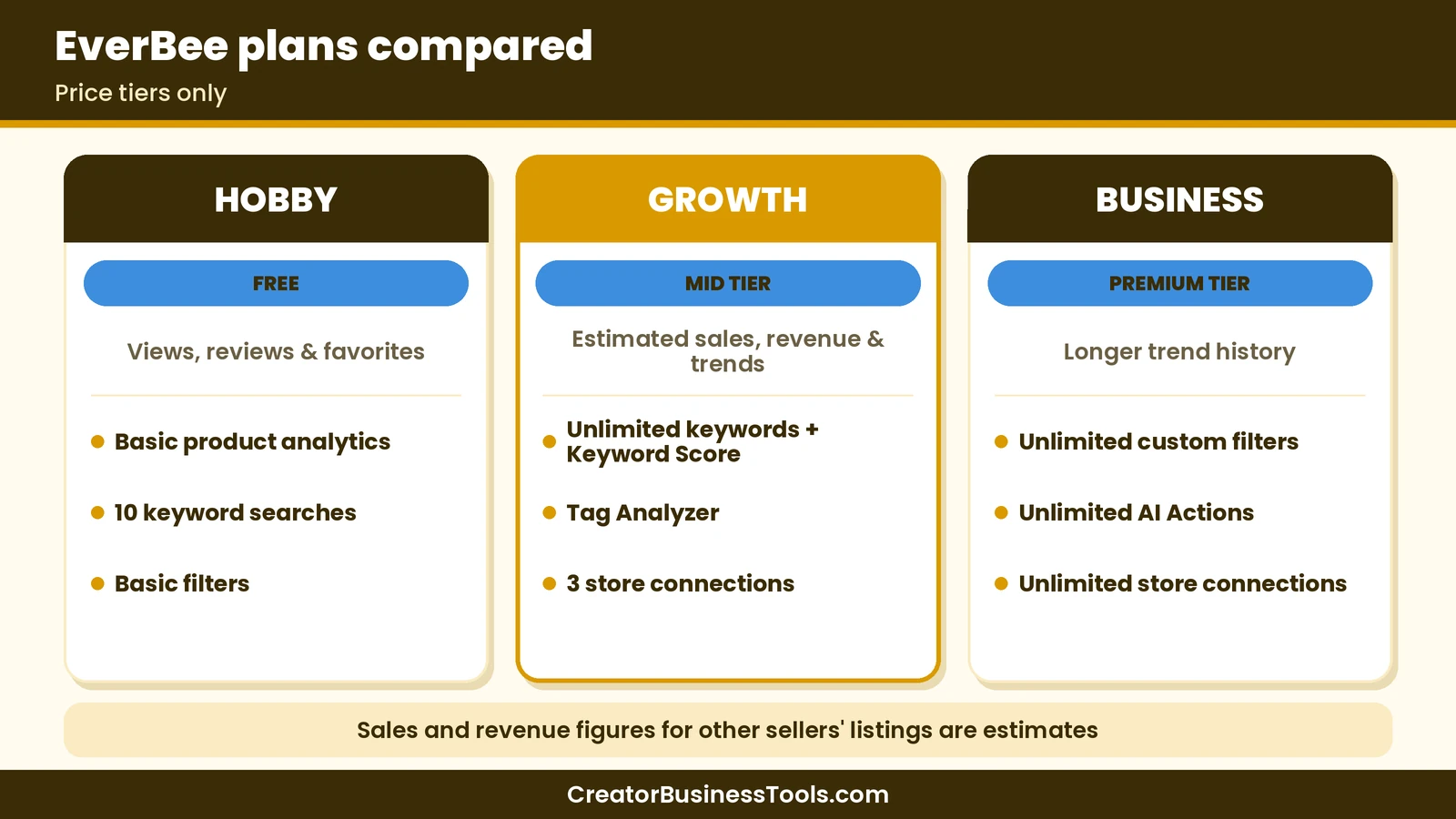
| Plan | Price tier | Product data | Keyword research | Extras |
|---|---|---|---|---|
| Hobby | Free | Views, reviews, favorites | 10 keywords | Basic filters, small favorites list |
| Growth | $$ | Sales, revenue, conversion rate, trends on listings | Unlimited, with Keyword Score | Tag Analyzer, 3 Hot Filters, AI Actions (monthly limit), 3 store connections |
| Business | $$$ | Adds longer trend patterns across research tables | Unlimited, with Keyword Score | Unlimited custom filters, unlimited AI Actions, unlimited store connections |
Is there a free trial?
EverBee says it doesn’t offer a free trial. Instead, the Hobby plan is free and doesn’t require a credit card. You install the Chrome extension, connect your Etsy account, and start.
Which plan should you choose?
- Hobby is enough to learn the tool and browse basic listing data.
- Growth is the main plan for most sellers. It unlocks the sales and revenue data that make product research useful.
- Business makes sense for brands and multi-shop sellers who want longer trend history and no limits.
EverBee says you can upgrade or downgrade at any time.
Key features in more detail
Product analytics
This is EverBee’s headline feature. Search Etsy as usual, and EverBee adds data to the results: estimated sales, revenue and other metrics for each listing on paid plans.
That turns a page of search results into a quick market scan. You can see which listings seem to sell well, at what price points, and how many competitors there are.
Keyword research and Keyword Score
EverBee’s keyword research shows search terms related to your idea. On paid plans, each keyword gets a Keyword Score, which helps you compare options quickly.
Good keywords help in two places: choosing products with demand, and writing titles and tags buyers actually search.
Tag Analyzer
Etsy listings use tags to match searches. The Tag Analyzer reviews the tags on a listing, which helps you learn from successful competitors and tighten your own tags.
Trends and growth rate
Trend data shows how listings perform over time. Growth covers individual listings, while Business adds trend patterns across research tables over longer periods.
This helps you separate steady sellers from short spikes, which matters for seasonal products.
AI Actions and MCP access
Paid plans include AI Actions inside EverBee, with a monthly limit on Growth and no limit on Business. EverBee also lists MCP access, which connects its Etsy data to an AI assistant.
These are useful extras, but the product data and keyword research are what most sellers pay for.
How to find what to sell on Etsy
This is where a tool like EverBee earns its keep. Here’s a practical workflow you can follow with EverBee’s free plan first, then a paid plan when you need sales data.
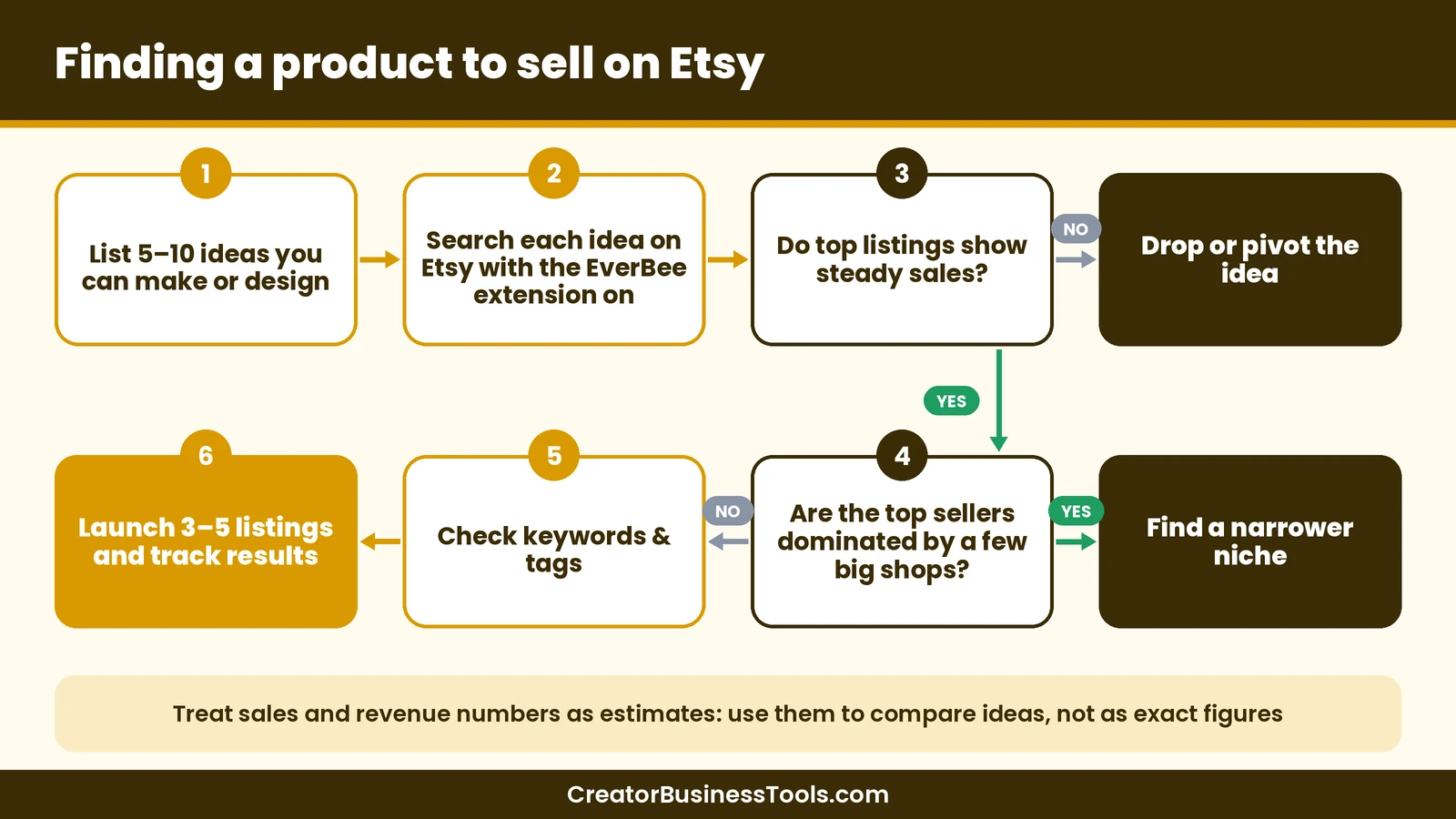
Step 1: Start with ideas you can actually make. List 5 to 10 product ideas that fit your skills, tools and budget. A great niche doesn’t help if you can’t produce it well.
Step 2: Search each idea on Etsy. With the EverBee extension running, search Etsy as a buyer would. Look at the listings on the first page.
Step 3: Look for steady demand. On paid plans, check estimated sales and revenue. You want several listings selling, not just one outlier.
Step 4: Check competition. If a handful of large shops dominate every top spot, look for a narrower angle, such as a specific audience, style or occasion.
Step 5: Research keywords and tags. Use keyword research to find the phrases buyers use, and the Tag Analyzer to see how top listings tag their products.
Step 6: Launch small and track. Start with a few listings in your chosen niche. Watch views, favorites and sales, then expand what works.
Ideas that often suit new Etsy sellers
For fonts and graphics to build those printables, see our Creative Fabrica review.
- Digital printables: planners, trackers, wall art and worksheets.
- Templates: Canva templates for social media, invitations and small business forms.
- Personalized items: custom name prints, pet portraits and gifts.
- Print-on-demand designs: niche shirts, mugs and totes.
- Seasonal products: holiday cards, party printables and planners for the new school term.
Treat these as starting points. The research steps above tell you whether a specific idea has room for a new shop.
Digital printables and templates often get traffic from Pinterest. Once you have a niche, Pin Generator can help you make pin designs that send shoppers to your listings.
A quick hypothetical example
Imagine a hypothetical seller who wants to sell wedding printables. “Wedding sign” is broad and crowded.
Narrower ideas like “boho wedding welcome sign template” or “minimalist seating chart template” may show steady sales with fewer dominant shops. That’s the kind of gap this workflow helps you find.
Pricing your product with research data
Research also helps with pricing. When you look at top listings in your niche, note the price range where most steady sellers sit.
Pricing far below that range can signal low quality and leave little margin. Pricing far above it needs a clear reason, such as premium materials, personalization or a larger bundle.
For digital products, bundles often work well. A single planner page competes on price, while a complete planner set can justify a higher price and stand out in search.
Keep in mind: Sales and revenue figures for other sellers’ listings are estimates. Use them to compare ideas and spot patterns, and always respect other sellers’ designs and intellectual property. Research helps you find demand, not copy products.
EverBee vs eRank
EverBee and eRank are the two research tools Etsy sellers mention most. They overlap, but they lean in different directions.
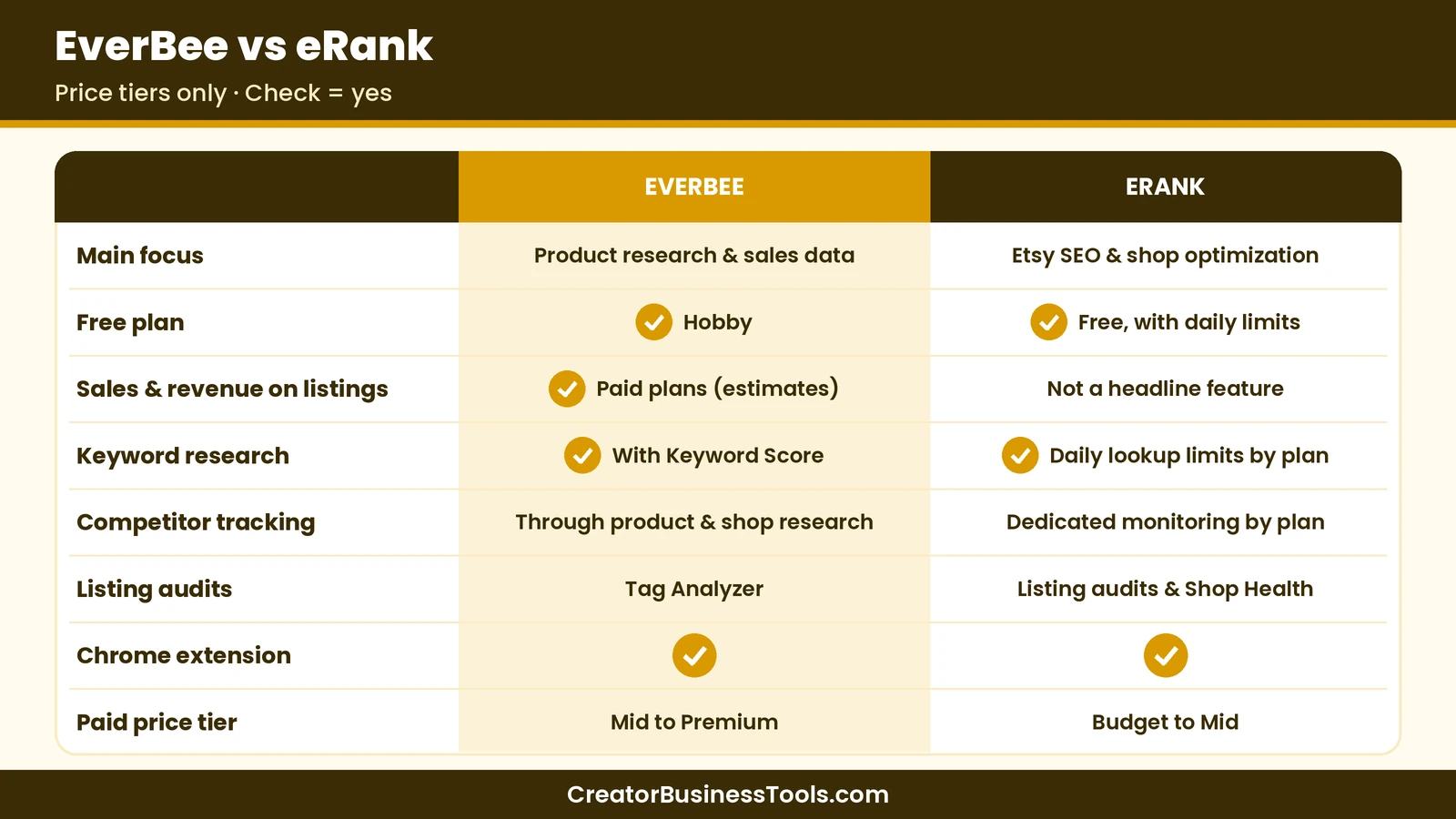
| EverBee | eRank | |
|---|---|---|
| Main focus | Product research and sales data | Etsy SEO and shop optimization |
| Free plan | Yes (Hobby) | Yes (Free, with daily limits) |
| Sales and revenue on listings | Yes, on paid plans | Not a headline feature on its pricing page |
| Keyword research | Yes, with Keyword Score | Yes, with daily lookup limits by plan |
| Competitor tracking | Through product and shop research | Dedicated competitor monitoring by plan |
| Listing audits | Tag Analyzer | Listing audits and Shop Health |
| Chrome extension | Yes | Yes |
| Paid price tier | $$ to $$$ | $ to $$ |
When EverBee is the better pick
Choose EverBee if your main question is “what should I sell?” Its sales and revenue data for listings is built for product research.
It also suits sellers who like to research inside Etsy search, with data layered over the results.
When eRank is the better pick
Choose eRank if you mainly want to optimize what you already sell. eRank’s plans focus on keyword lookups, competitor monitoring, listing audits and shop health.
Its paid plans start at a lower price tier than EverBee’s, which matters for a shop that isn’t earning much yet. Our eRank review covers its free plan and paid tiers in detail.
Can you use both?
Another all-in-one option to compare is covered in our Alura review.
Yes, and some sellers do. A common split is EverBee for finding products and eRank for ongoing SEO checks. If you only want one tool, choose based on your biggest bottleneck: ideas or optimization.
Our take
For a new seller still choosing products, we’d start with EverBee’s free plan, then move to Growth when you need sales data. For an established shop focused on SEO, eRank’s low-cost plans are hard to beat.
How EverBee fits different Etsy sellers
Different sellers get different value from EverBee. Here’s how it lines up with common setups.
| Seller type | Main question | How EverBee helps |
|---|---|---|
| Brand-new seller | What should I make first? | Compare product ideas by estimated demand |
| Printable and template seller | Which niches still have room? | Spot steady sellers and narrower angles |
| Print-on-demand seller | Which designs and audiences sell? | Research designs and keywords before uploading |
| Handmade maker | Is this product worth the time? | Check demand before investing in materials |
| Multi-shop brand | Where should we expand next? | Longer trend history and unlimited connections on Business |
Imagine a hypothetical seller who makes printable planners. They might use EverBee to compare demand for budget planners, meal planners and teacher planners, then pick the niche where several listings sell steadily without a few shops taking every top spot.
Is EverBee worth it?
For sellers who are still choosing products, EverBee can save a lot of trial and error. Making a product that nobody searches for costs time and money. Research reduces that risk.
The free plan is a low-risk way to learn the interface. The real value starts on Growth, where sales and revenue data appear. If one well-chosen product line covers the cost, the plan pays for itself.
If you already have a working shop and mainly need keyword tune-ups, EverBee may be more than you need. In that case, eRank’s lower-cost plans or EverBee’s free plan may be enough.
EverBee pros and cons
Pros
- Product analytics with estimated sales, revenue and conversion data on paid plans
- Research happens inside Etsy search through the Chrome extension
- Free Hobby plan with no credit card required
- Keyword research with a Keyword Score and a Tag Analyzer
- Business plan covers unlimited store connections
Cons - The most useful data needs a paid plan
- Paid plans sit in a higher price tier than eRank
- Sales figures for other shops are estimates
- No free trial of paid features
Best for: Etsy sellers who want to research what to sell, including digital product and print-on-demand sellers.
Not ideal for: sellers who only want low-cost SEO checks on listings they already have.
Common mistakes when researching Etsy products
Chasing one viral listing. A single listing with huge sales may be an outlier. Look for several listings with steady results.
Ignoring production cost. A product that sells well but costs too much to make, ship or design won’t build a profitable shop. Check your margins before you launch.
Copying instead of differentiating. Data shows you demand. Your designs, quality and niche angle are what make buyers choose you.
Skipping keywords. Even a great product needs the right title and tags to be found. Research keywords before you write your listing.
Not tracking results. Launch, then measure. Keep a simple sheet of views, favorites and sales for each new listing.
How to get started with EverBee
- Install the EverBee Chrome extension and create a free Hobby account. See EverBee’s plans
- Connect your Etsy account.
- Search a few product ideas on Etsy and review the basic listing data.
- Run keyword research on your best ideas.
- Upgrade to Growth when you need sales and revenue data for deeper research.
- Launch a few listings and track how they perform.
FAQ
Is EverBee free?
EverBee has a free Hobby plan with basic product analytics and limited keyword research. Sales and revenue data need a paid plan.
Does EverBee have a free trial?
EverBee says it doesn’t offer a free trial. The free Hobby plan is the way to try it.
Is EverBee better than eRank?
They focus on different jobs. EverBee is stronger for product research and sales data, while eRank focuses on SEO, competitor monitoring and shop audits at a lower price tier.
Is EverBee’s sales data accurate?
Treat sales and revenue figures for other sellers’ listings as estimates. They’re most useful for comparing products, not as exact numbers.
Can EverBee help me decide what to sell on Etsy?
Yes. That’s its main purpose. Use its product analytics and keyword research to compare ideas before you create a product.
Can I cancel or change my EverBee plan?
EverBee says you can upgrade or downgrade your plan at any time.
Does EverBee work for digital products?
EverBee researches Etsy listings in general, so it covers digital products like printables and templates as well as physical items.
Do I need Chrome to use EverBee?
EverBee’s research inside Etsy search runs through its Chrome extension, so a Chromium-based browser is the easiest setup. Check EverBee’s help center for other supported browsers and access options.
Bottom line
EverBee is one of the most useful tools for answering the hardest Etsy question: what should I sell? Its product analytics, keyword research and Tag Analyzer give you a data-backed starting point.
Start with the free Hobby plan, test a few ideas, and upgrade to Growth when you’re ready for sales data. See EverBee’s plans
If your shop is already set and you mainly need SEO tune-ups, eRank is the lower-cost alternative.
Contact us to request a copy.
Pricing and features from official vendor pages, last checked October 21, 2026.