
Frase Review: An AI SEO Writing Tool for Bloggers and Creators
Disclosure: This post contains affiliate links. If you buy through them, we may earn a commission at no extra cost to you. How we make money.
If you write blog posts to bring Pinterest and Google visitors to your shop or course, you’ve probably wondered whether an AI SEO writing tool could save you time. This Frase review looks at what Frase does, how its plans are structured, and whether it makes sense for beginner creators and small bloggers. We based it on Frase’s official pricing and product pages, so you can see what you’d actually get before starting a trial.
Quick verdict: Frase looks like a solid choice for solo bloggers and small teams who want help researching, outlining, writing, and optimizing content for both traditional search and AI search tools. The entry plan is aimed at one person and one site. It’s probably more than you need if you publish only occasionally, and keyword-research-first bloggers may still want a dedicated SEO tool alongside it.
Quick picks
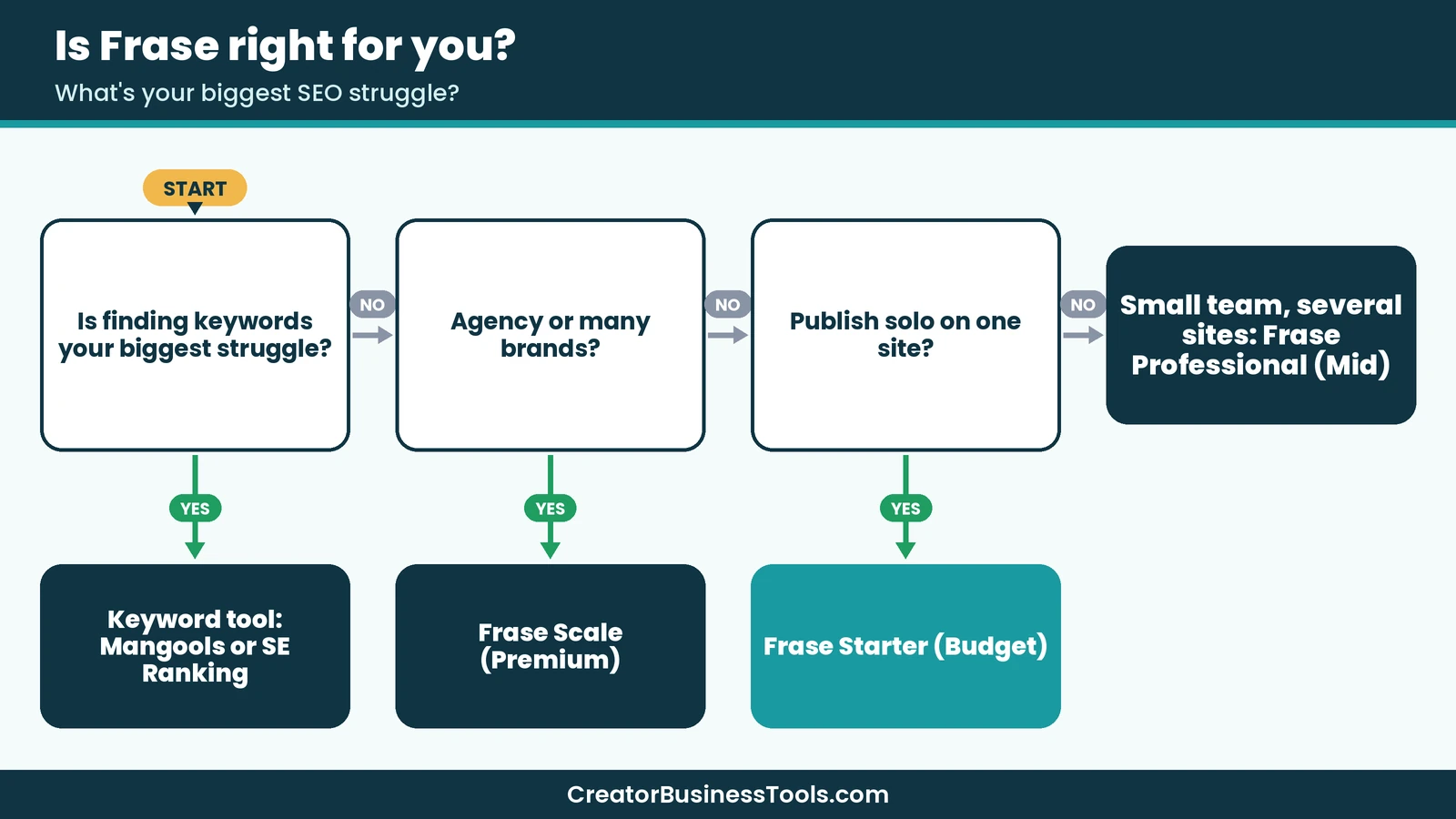
- Best for a solo creator with one blog: Frase Starter. Frase
- Best for a small in-house content team: Frase Professional, with more seats, sites, and articles.
- Best for agencies and multi-site brands: Frase Scale.
- Best if you mainly need keyword research: A dedicated SEO tool, such as the ones we cover in our SE Ranking and Mangools reviews.
Frase at a glance
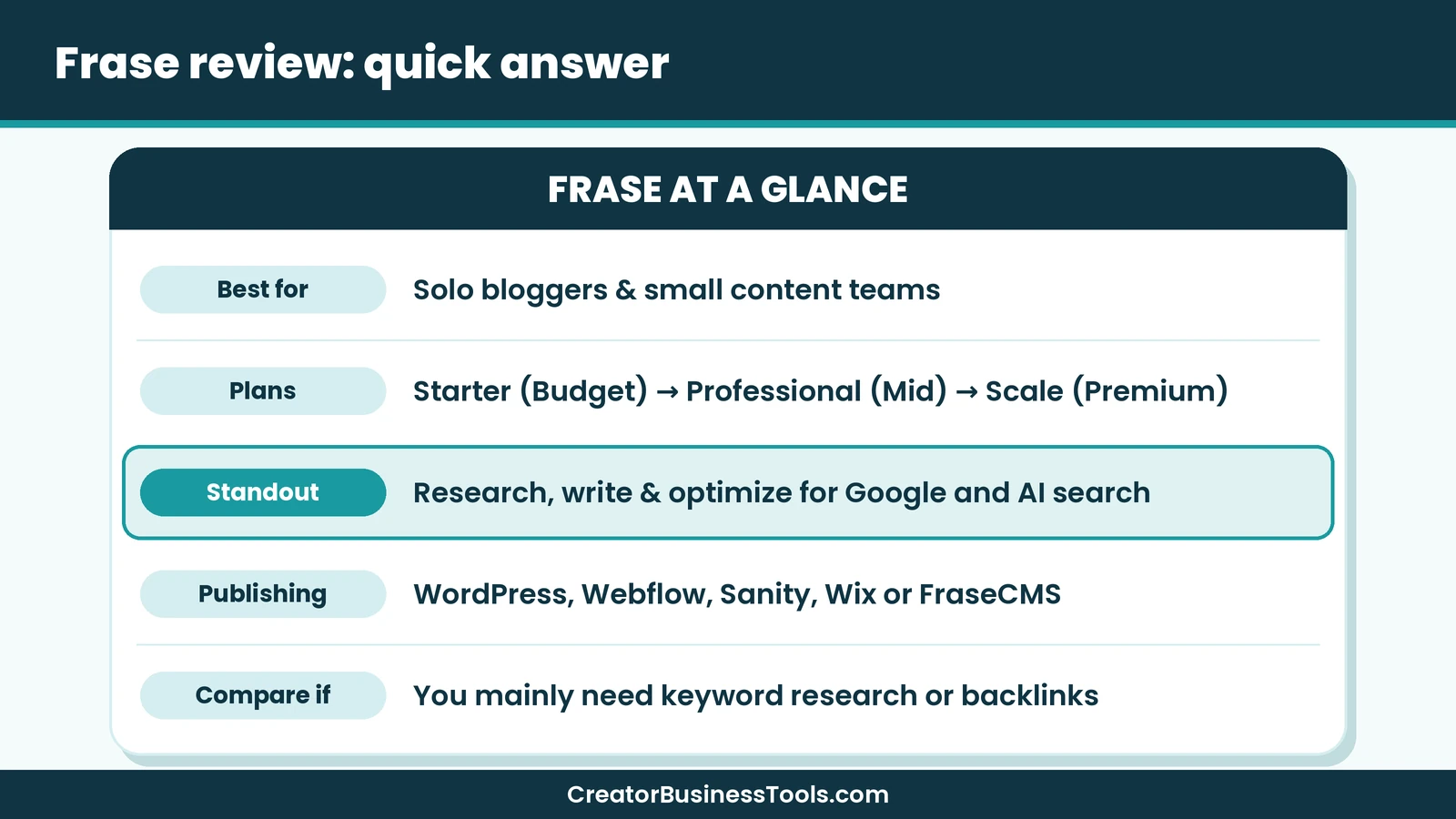
| Item | What Frase offers |
|---|---|
| What it is | An AI-assisted platform for SEO and AI-search content |
| Plans | Starter, Professional, Scale, Enterprise |
| Price tier | Budget (Starter), mid-range (Professional), premium (Scale), custom (Enterprise) |
| Starter limits | One seat, one site, a monthly article and audit allowance |
| Publishing | WordPress, Webflow, Sanity, Wix, or Frase’s own hosted CMS |
| Optimization | SEO and “GEO” scores for AI search visibility |
| Billing | Monthly or yearly |
What is Frase?
Frase is a content platform that helps you research what to write, create drafts with AI, and optimize those drafts so they have a better chance of showing up in search. It describes itself as a “content operating system for AI search,” which is a fancy way of saying it tries to cover both classic Google results and answers from AI assistants such as ChatGPT and Google’s AI features.
For beginner creators, the appeal is simple: instead of juggling a keyword spreadsheet, a dozen open tabs, a writing app, and a separate optimization checker, much of that work can happen in one place.
Frase also leans into automation. It mentions an AI agent that can draft and even publish content for you, if you choose to switch that on. We’d suggest keeping a human in the loop, especially for a small brand where your voice matters.
Frase review: the features that matter for beginners
SEO research and topic clusters
Frase helps you look at what’s already ranking for a topic and spot the questions and subtopics those pages cover. That can make planning a blog post much faster. It also offers topic clusters, which group related ideas so you can plan a series of posts that support each other.
For a printable seller, that might look like one main guide on “how to sell printables” supported by smaller posts on pricing, file formats, and Pinterest tips. Frase aims to make that kind of planning less of a guessing game.
AI writing and brand voice
Frase can generate outlines and drafts with AI. It also mentions brand voice settings, which help the AI write in a tone closer to yours. We’d still treat AI drafts as a starting point rather than a finished article. Adding your own examples, opinions, and stories is what makes a post feel human and trustworthy.
Content optimization with SEO and GEO scores
Once you have a draft, Frase scores it for SEO and for what it calls GEO, meaning visibility in generative AI search. The idea is to show what topics, terms, and questions your post may be missing compared with the pages already doing well. This is similar in spirit to other content optimization tools, with an extra focus on AI answers.
AI visibility tracking
Frase includes AI visibility features that look at whether your content shows up in AI tools. The entry plan includes ChatGPT and Google AI, while higher tiers add more assistants. This is a newer area, so we’d view the numbers as helpful signals rather than precise measurements.
Content Guard
Content Guard watches a set of your pages for signs of declining Google performance. On the entry plan, it covers a small number of pages, with more on higher tiers. For bloggers with a few important money pages, this kind of early warning could be useful.
Publishing and FraseCMS
Frase can push finished posts to WordPress, Webflow, Sanity, or Wix. It also offers its own hosted CMS, called FraseCMS, with a free hosting allowance included on every plan. If you already have a WordPress blog, you probably won’t need FraseCMS, but it’s a handy option for a simple content site.
Working with other AI tools
Frase says it can run inside tools you may already use, such as Claude, ChatGPT, and Cursor, through an MCP server and command-line tool. Most beginner creators won’t need this, but it’s nice to know the option exists if your workflow grows.
Frase pricing explained
We’ll keep this simple and avoid exact figures, since pricing can change. Please check the official pricing page before deciding.
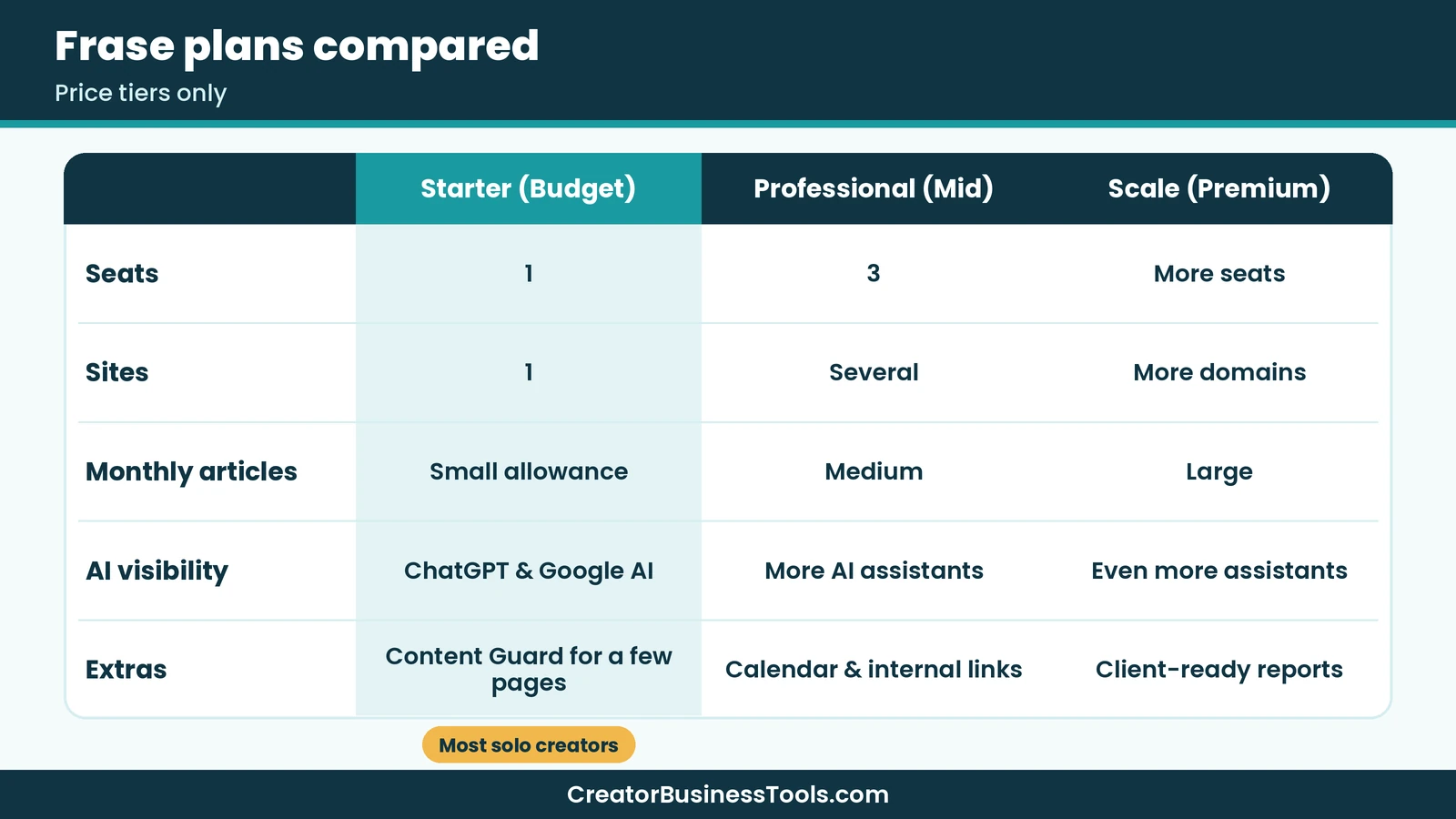
- Starter (budget): One seat and one site, with a monthly allowance of articles and audited pages. Includes SEO and GEO scores, AI visibility for a couple of AI tools, Content Guard for a few pages, and publishing to popular platforms. Starter stops at its monthly limits rather than charging extra.
- Professional (mid-range): Three seats and several sites, a bigger monthly allowance, a content calendar, internal linking suggestions, repurposing for social channels, and broader AI visibility.
- Scale (premium): More seats and domains, larger allowances, client-ready reports, and more AI assistants tracked.
- Enterprise (custom): White-label reports, single sign-on, a dedicated manager, and custom limits.
Check Frase’s pricing page to see whether a trial is offered, and compare each plan’s monthly limits with how much you actually publish.
Who Frase is best for
Frase seems like a good fit for:
- Solo bloggers who publish regularly and want help planning and optimizing posts.
- Course creators and digital product sellers who use blog content to support Pinterest traffic and sales pages.
- Small content teams that want a shared workflow for research, drafts, and updates.
- Creators curious about AI search who want to see how their content appears in AI answers.
Who might want something else
If you publish only a few posts a year, a content platform may be more than you need. If your main challenge is finding keywords, checking competitors, or tracking rankings, an all-in-one SEO tool might be a better first purchase. We cover those in our reviews of SE Ranking, Mangools, and Semrush.
And if you’d rather write everything yourself, a simple keyword tool plus a careful outline may serve you well for a while.
How Frase compares with other SEO tools
Frase sits in the content optimization category, alongside tools like Surfer SEO. It’s different from broader SEO suites, which focus more on keyword research, backlinks, and rank tracking.
| Tool | Main focus | Price tier | Good for |
|---|---|---|---|
| Frase | Content research, AI drafting, SEO and AI-search optimization | Budget to premium | Bloggers who want help planning and optimizing posts |
| Surfer SEO | Content optimization and AI search visibility | Budget to premium | Teams focused on on-page optimization |
| SE Ranking | All-in-one SEO suite | Budget to premium | Bloggers who want rank tracking and audits |
| Mangools | Beginner-friendly keyword research | Budget to mid-range | New bloggers who mainly need keywords |
| Semrush | Broad SEO and competitor research | Mid-range to premium | Growing sites that need deep data |
We compare Frase and Surfer SEO in detail in our Frase vs Surfer SEO guide.
Pros and cons
Pros
- Research, drafting, and optimization in one place
- Focus on both Google and AI search visibility
- Clear monthly limits, so costs stay predictable
- Entry plan stops at its limits instead of adding surprise charges
- Publishes to popular website platforms
- Brand voice settings to keep drafts closer to your style
Cons
- The entry plan covers only one seat and one site
- Monthly article allowances may feel tight for prolific bloggers
- AI visibility data is a new and evolving area
- Not a replacement for a full keyword research or backlink tool
- AI drafts still need careful human editing
The one time we really wished for a tool like this
When one of us was planning a long blog post to support a printable shop. The “research” phase meant opening a dozen search results in separate tabs, copying headings into a document, and trying to spot which questions everyone answered and which ones nobody did. It went on late into the night, and the outline still felt a little patchy. That evening is what made us curious about content research tools like Frase, which aim to pull that kind of comparison into a single view.
How to get started with Frase
- Create an account. Pick one real post you want to improve and use it as your test case. Try Frase
- Connect your site. Link your WordPress or other platform so you can publish or update posts.
- Pick one important post. Choose a page that already gets some traffic or supports a key product.
- Run research and optimization. See which topics and questions Frase suggests adding.
- Edit with your own voice. Add examples, stories, and opinions that only you can share.
- Plan a small topic cluster. Map out a few related posts that support your main page.
- Decide on a plan. Before you commit, think about how many articles you’ll realistically publish each month.
A sample Frase workflow for a printable or course seller
To make this more concrete, here’s how a beginner creator might use Frase over a typical month. Imagine you sell budget planners and want more blog traffic from Google and Pinterest.
Week one: plan. Use Frase’s research to look at what already ranks for a topic like “how to make a monthly budget.” Note the questions those pages answer and the gaps they leave. Then sketch a small topic cluster: one main guide and three or four supporting posts on related questions, such as budgeting for families or using printable trackers.
Week two: draft. Create an outline for the main guide, let Frase suggest a first draft, and then rewrite it in your own voice. Add photos of your planners in use, examples, and a clear link to your product.
Week three: optimize and publish. Check the SEO and GEO scores, add any important missing subtopics, and publish to your site. Create a few Pinterest pins that point to the new post.
Week four: review. Look at Content Guard and your analytics for older posts that may be slipping, and pick one to refresh next month.
This kind of rhythm can feel manageable even alongside product creation, and it uses the entry plan’s monthly allowance without much waste.
Questions to ask yourself before you buy
Before choosing a plan, it may help to answer a few honest questions:
- How many posts will we realistically publish each month? If the answer is one or two, the entry plan is likely enough, and you may not need a content tool every month.
- Do we already have a keyword strategy? Frase works best when you know which topics matter for your products.
- Who will edit the drafts? AI drafts save time, but someone still needs to add expertise and personality.
- Which sites will we work on? If you run more than one blog or shop, compare the site limits on each plan.
- Do we care about AI search yet? If AI visibility is interesting to you, Frase’s focus here could be a plus. If not, simpler tools may do the job.
Frase and Pinterest traffic
Many of our readers rely on Pinterest, and it’s fair to ask whether an SEO tool helps there at all. Pinterest has its own search, but the pins that drive lasting traffic usually point to genuinely useful blog posts. A well-researched, well-structured post tends to keep more of the visitors a pin sends, and it may also earn Google traffic over time. In that sense, Frase supports a Pinterest strategy indirectly by helping the destination page do its job.
Tips for using AI writing tools without losing your voice
- Use AI for structure, not personality. Let it help with outlines and coverage, then rewrite in your own words.
- Add real examples. Screenshots, results, and personal lessons make content more helpful and more trustworthy.
- Fact-check everything. AI can sound confident while being wrong.
- Keep your audience in mind. Pinterest visitors often want quick, practical answers, so keep intros short.
- Update regularly. Revisit top posts and refresh them when things change.
Is Frase worth it?
For bloggers and creators who publish regularly and want help researching and optimizing content, Frase seems worth trying, especially if you can test it on a real post first. The entry plan should be enough for many solo creators with one site.
If you publish rarely or mainly need keyword data, we’d suggest starting with a keyword tool first and coming back to Frase once content production becomes a bigger part of your week.
FAQ
Can I test Frase before paying?
Check Frase’s pricing page to see whether a trial is offered. Testing it on one real post is the best way to judge the fit.
Is Frase good for beginners?
It can be, especially for beginners who publish regularly. The entry plan is designed for one person and one site.
What’s the difference between Frase Starter and Professional?
Professional adds more seats, more sites, a larger monthly allowance, a content calendar, internal linking suggestions, and broader AI visibility.
Does Frase work with WordPress?
Frase says it can publish to WordPress, Webflow, Sanity, and Wix, or to its own hosted CMS.
Can Frase replace a keyword research tool?
Frase covers content research, but if you mainly need keyword data, rank tracking, or backlinks, a dedicated SEO tool may still be helpful.
Is Frase better than Surfer SEO?
It depends on your workflow. We compare the two in our Frase vs Surfer SEO guide.
Conclusion: our Frase review in a nutshell
To wrap up this Frase review, Frase looks like a helpful, all-in-one content tool for bloggers and creators who want to research, write, and optimize posts for both Google and AI search. The entry plan suits solo creators with one site, higher tiers suit teams and agencies, and testing it on one real post is an easy way to judge the fit. Pair it with your own voice and a solid keyword strategy, and it could save you a lot of late-night tab juggling.
[See Frase's plans](https://www.frase.io/)Related guides: Koala AI Review · Koala AI vs Writesonic vs Frase · Writesonic vs Frase · Frase vs Surfer SEO
Get our free blog post checklist
Want a simple checklist for planning and optimizing blog posts that support your products? Join our email list and we’ll send it your way, along with beginner-friendly SEO tips for creators. Contact us to request a copy.
Pricing and features from official vendor pages, last checked October 24, 2026.