
Writesonic vs Frase: Which AI SEO Tool Fits Your Content?
Disclosure: This post contains affiliate links. If you buy through them, we may earn a commission at no extra cost to you. How we make money.
Writesonic and Frase both promise better rankings with the help of AI, and both now talk about visibility in AI search, not just Google. That makes them look like direct rivals. In practice, they are built around different jobs. Writesonic is an AI search visibility platform that also writes content. Frase is a content research and optimization platform that also tracks AI visibility. This Writesonic vs Frase comparison explains where they overlap, where they differ, how their plans line up, and which one makes more sense for bloggers, creators, agencies, and brands.
Quick verdict: Choose Frase if your main goal is to research, write, and optimize articles that rank, especially as a solo blogger or a small content team watching costs. Choose Writesonic if your main goal is to track and improve how ChatGPT, Gemini, and Google AI Overviews mention your brand, and you have a premium-tier marketing budget. For most independent creators, Frase is the more practical starting point.
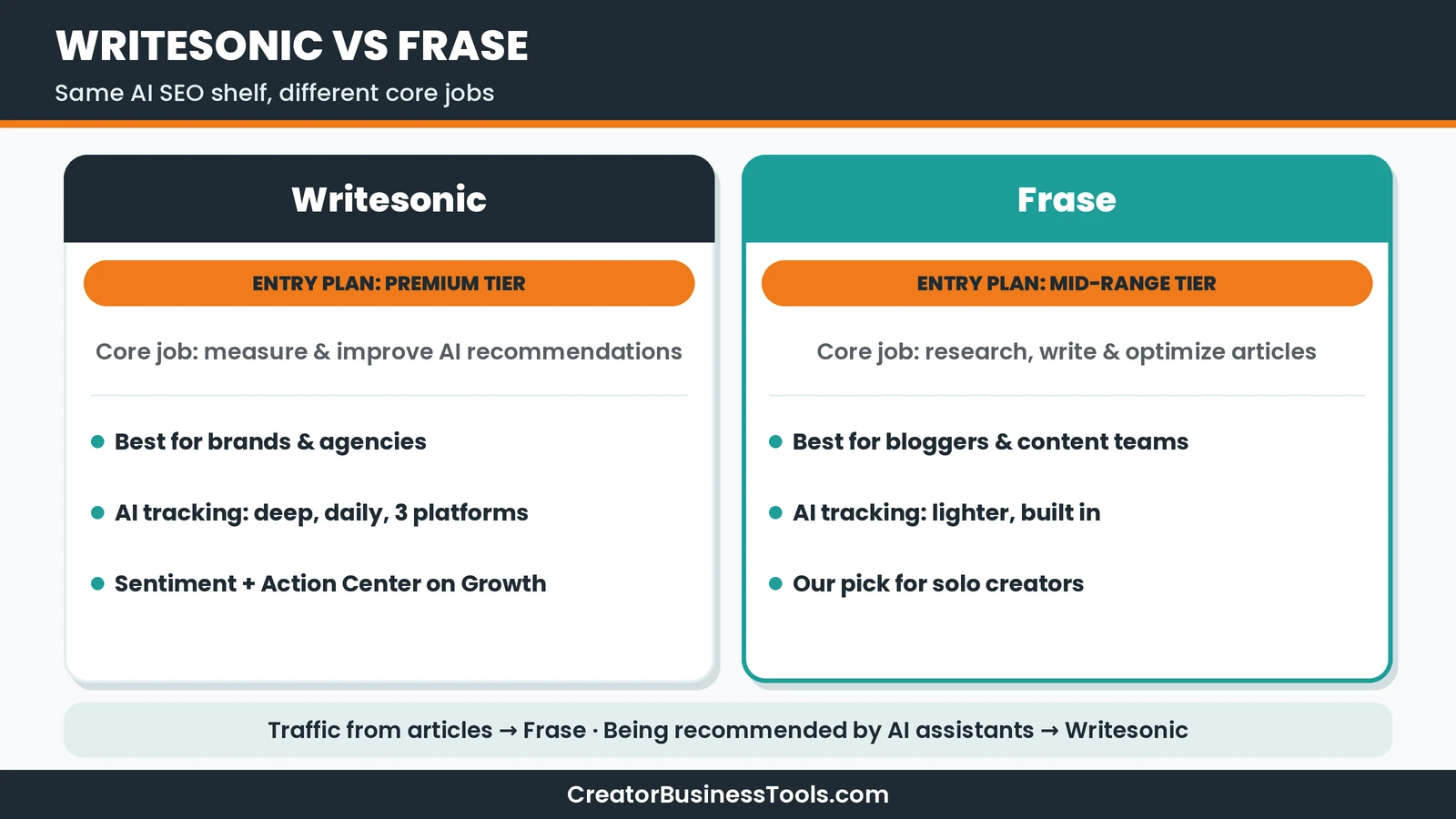
Quick picks
- Best for solo bloggers and creators: Frase Starter, a mid-range plan with research, writing, optimization scores, and AI visibility basics. Try Frase
- Best for small content teams: Frase Professional, with three seats, five sites, a content calendar, and internal linking.
- Best for brands tracking AI recommendations: Writesonic Starter or Growth, with daily tracking across ChatGPT, Gemini, and Google AI Overviews. Try Writesonic
- Best for agencies: Frase Scale for content-heavy client work, or Writesonic Growth for AI visibility reporting.
Writesonic vs Frase at a glance
| Item | Writesonic | Frase |
|---|---|---|
| Main focus | AI search visibility, with content and audits | Content research, writing, and optimization, with AI visibility |
| Entry plan | Starter, premium tier | Starter, mid-range tier |
| Top self-serve plan | Growth, premium tier | Scale, premium tier |
| AI platforms tracked | ChatGPT, Gemini, Google AI Overviews; nine on Enterprise | ChatGPT and Google AI; Perplexity from Professional |
| AI articles per month | Fifteen to fifty on self-serve plans | Ten to one hundred depending on plan |
| Site audits | Large audits with automatic AI fixes | Page audits sized by plan |
| Seats | One to three, plus paid extras | One to five |
| Publishing | WordPress integration | WordPress, Webflow, Sanity, Wix, and FraseCMS |
| Unique strengths | Sentiment analysis, Action Center, ads monitoring | SEO and GEO scores, Content Guard, content calendar, MCP and CLI access |
What each tool is really for
Writesonic: measure and improve AI recommendations
Writesonic starts with a question: when someone asks an AI assistant about your category, does it mention you? You add prompts that matter to your business, and Writesonic checks the answers every day across ChatGPT, Gemini, and Google AI Overviews. It records mentions, competitors, and, on Growth, sentiment. Then it offers tools to act, including an AI article writer, site audits with automatic fixes, and on Growth a limited Action Center that ranks the most impactful next steps. For a deeper look, read our Writesonic review.
Frase: research, write, and optimize content that ranks
Frase starts with a different question: what should this article contain to rank and be cited? It analyzes top results for a keyword, builds a brief, helps you write the draft, and scores the content for both SEO and GEO, its term for optimization for AI answers. Frase also tracks AI visibility on ChatGPT and Google AI, adds Perplexity on Professional and above, and includes Content Guard to watch published pages for decline. Our Frase review covers the workflow in detail.
Feature-by-feature comparison
Content research and briefs
Frase is stronger here. Its whole workflow is built around researching what ranks, turning that into an outline, and helping writers cover the topic well. Writesonic can generate articles using Google Keyword Planner, search results, and Reddit data, but its research tools serve the visibility platform rather than being the centerpiece.
Winner: Frase
Writing and AI article generation
Both tools write full drafts. Writesonic includes brand voice styles, so drafts can match your tone, and an allowance of AI articles that grows with each plan. Frase includes its own article allowance, with higher limits on Professional and Scale. Neither produces publish-ready content without a human edit. Writesonic’s brand voice options give it a small edge for teams with a defined style.
Winner: Writesonic, narrowly
On-page optimization
Frase gives every draft an SEO score and a GEO score, so writers can see what is missing while they work. That real-time guidance is one of the main reasons bloggers choose Frase. Writesonic includes content optimization too, but it is less central to the product.
Winner: Frase
AI search visibility tracking
Writesonic is the specialist. Daily tracking across three AI platforms on every self-serve plan, competitor mentions, ads monitoring, sentiment analysis on Growth, and nine platforms on Enterprise make it the deeper tool for brand visibility. Frase covers the basics well and adds Perplexity on higher plans, which is enough for many bloggers who want a signal rather than a full report.
Winner: Writesonic
Site audits and technical fixes
Writesonic’s audits are larger, especially on Basic and Growth, and can apply automatic AI fixes. Frase includes page audits sized by plan and focuses on content quality. For sites with hundreds or thousands of pages, Writesonic does more.
Winner: Writesonic
Publishing and workflow
Frase publishes to WordPress, Webflow, Sanity, and Wix, or to its own FraseCMS, and adds a content calendar and internal linking on Professional. It also offers MCP and CLI access for teams that connect AI tools to their workflow. Writesonic integrates with WordPress, Google Search Console, and GA4. For writers who publish often, Frase’s workflow is smoother.
Winner: Frase
Teams and agencies
Writesonic Growth includes three users and two projects, with paid extra seats. Frase Scale includes five seats, up to ten domains, and client reports, which suits content agencies. Agencies focused on AI visibility reporting may still prefer Writesonic.
Winner: depends on the service you sell
Pricing compared
Both tools publish clear plans, but they sit at different price levels.
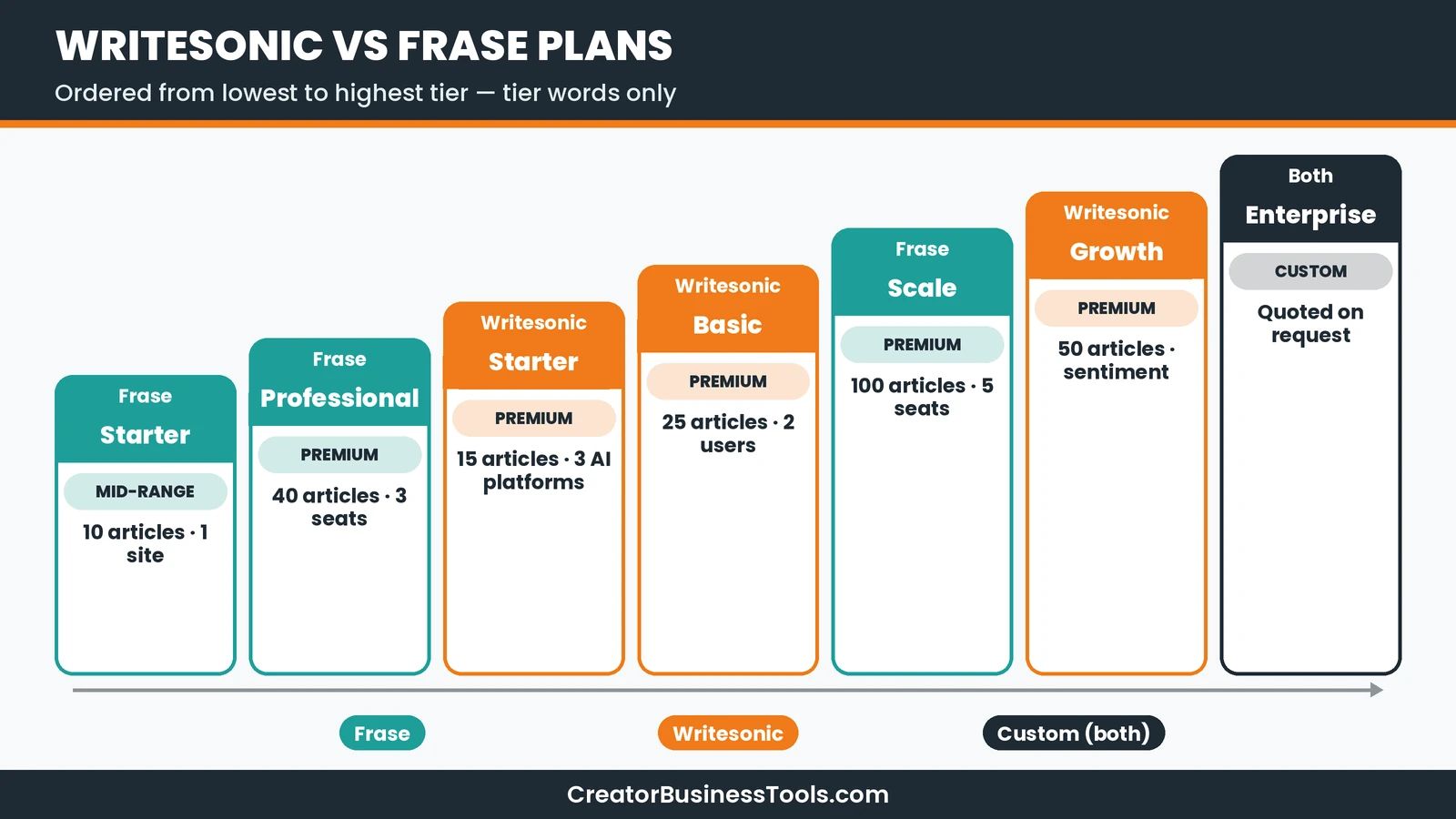
- Frase Starter is mid-range, with one seat, one site, ten articles, and small audits. When you reach a limit, Frase stops rather than adding charges.
- Frase Professional is premium, with three seats, five sites, forty articles, the content calendar, internal linking, and Perplexity visibility.
- Frase Scale is higher premium, with five seats, ten domains, one hundred articles, and client reports.
- Writesonic Starter is entry premium, with one user, three AI platforms, a small prompt set, and fifteen articles.
- Writesonic Basic is higher premium, with two users, more prompts, twenty-five articles, and large audits.
- Writesonic Growth is higher premium, with three users, sentiment analysis, a limited Action Center, and fifty articles.
- Enterprise plans from both companies are custom.
Both tools offer monthly or yearly billing. In short, Frase’s entry plan costs noticeably less than Writesonic’s, and Frase gives more articles per tier at the top end, while Writesonic gives more AI visibility data at every tier.
Budget also shapes the choice in a quieter way. A tool you can afford for a full year gives you time to learn it, build habits, and see results. A tool you cancel after two months because the bill feels heavy rarely pays off, however good it is. Choose the plan you can keep using long enough to judge it fairly.
Which tool fits your situation?
| Your situation | Better choice | Why |
|---|---|---|
| Solo blogger growing organic traffic | Frase Starter | Research, writing, and optimization at a mid-range price |
| Niche site owner with several sites | Frase Professional | Five sites, internal linking, and a content calendar |
| SaaS or course brand worried about AI answers | Writesonic Starter or Growth | Daily AI visibility tracking with competitors and sentiment |
| Content agency writing for clients | Frase Scale | Five seats, ten domains, client reports |
| Marketing agency reporting AI visibility | Writesonic Growth | Prompts, sentiment, and an Action Center |
| Large brand needing Perplexity and Claude tracking | Writesonic Enterprise | Nine AI platforms and custom regions |
Example setups
| Creator type | Tool and plan | Monthly routine |
|---|---|---|
| Food blogger with one site | Frase Starter | Research and write eight to ten recipes or guides, check SEO and GEO scores, refresh older posts flagged by Content Guard |
| Affiliate site owner with three niche sites | Frase Professional | Plan content in the calendar, add internal links, publish to WordPress |
| Online course creator with a small team | Writesonic Starter | Track twenty buyer prompts, write a comparison article, fix audit issues |
| SaaS marketing team | Writesonic Growth | Track prompts and sentiment, work through the Action Center, report monthly |
| Content agency | Frase Scale | Manage client domains, deliver optimized articles, share client reports |
These setups are examples, not rules. The point is to match the plan to the work you actually do each month. If your routine is mostly writing, the Frase rows will look familiar. If it is mostly monitoring and reporting, the Writesonic rows will. A plan that fits your routine will feel easy to use, and a plan that does not will feel like paying for features that sit unused.
Can you use both?
Yes, and some teams do. A common pattern is Frase for day-to-day content work and Writesonic for monthly AI visibility tracking and reporting. However, both tools write articles and both track AI visibility to some degree, so you will pay twice for overlapping features. For most creators, it is better to pick the tool that matches your main goal, use it well for a few months, and only add the second when you have a clear reason.
Ease of use and learning curve
Frase feels familiar to anyone who has written a blog post. You type a keyword, review what ranks, build an outline, and write inside an editor that scores your progress. Most bloggers can produce a better article in their first session. The learning curve is mostly about understanding the scores and knowing when to ignore a suggestion that does not fit your reader.
Writesonic takes a little more thinking at the start. The tool itself is clear, but its value depends on the prompts you choose to track. If you pick vague prompts, the reports will be vague too. Teams usually need a few weeks of daily data before patterns appear, and they need to agree on what counts as progress. Once that is in place, the weekly routine is simple: review the report, pick actions, publish, and measure again.
In short, Frase rewards you on day one, while Writesonic rewards patience and a clear strategy.
Content quality and accuracy
Neither tool replaces an editor. Frase’s drafts follow the structure of top-ranking pages, which helps coverage but can make articles feel similar to what already exists. The fix is to add your own examples, opinions, and data. Writesonic’s drafts can match your brand voice and draw on Reddit discussions, which helps them sound closer to how real people talk, but they still need fact checks.
This matters more than ever for AI search. AI assistants tend to cite pages that contain clear, specific, and original information. A generic draft from either tool is unlikely to earn citations on its own. Use the tools to speed up research and structure, then spend the time you gain on the parts only you can write.
Common mistakes when choosing between them
- Buying AI visibility tracking before you have content. If your site has only a few articles, there is little for AI assistants to cite. Build a content base first.
- Judging Writesonic by its article allowance. The articles are a supporting feature. If articles are all you want, Frase is the better fit.
- Ignoring site limits. Frase Starter covers one site. If you run several blogs, compare Professional instead.
- Tracking too many prompts too early. Start with the questions that lead to sales, then expand.
- Skipping the edit. Publishing raw AI drafts from either tool rarely builds trust with readers or AI systems.
Pros and cons
Writesonic pros
- Deep daily AI visibility tracking across three platforms
- Sentiment analysis and an Action Center on Growth
- Large site audits with automatic fixes
- Brand voice styles for consistent drafts
Writesonic cons
- Premium pricing on every self-serve plan
- Action Center limited or missing below Enterprise
- Less focus on research and on-page scoring
Frase pros
- Mid-range entry plan for solo creators
- Strong research, briefs, and SEO and GEO scores
- Broad publishing options and a content calendar
- Usage limits that stop instead of adding charges
Frase cons
- Lighter AI visibility tracking than Writesonic
- Perplexity tracking only on Professional and above
- One site on Starter
A small story from our team
When we first tried to choose between these two tools, we did what we always do: we copied every plan limit into a spreadsheet. Halfway through, the columns stopped lining up. One tool counted prompts and daily answers, the other counted articles, sites, and audit pages. That was the moment we realized we were not comparing two versions of the same product. We were comparing two different questions, and the right tool depended on which question kept us up at night.
How to decide in one afternoon
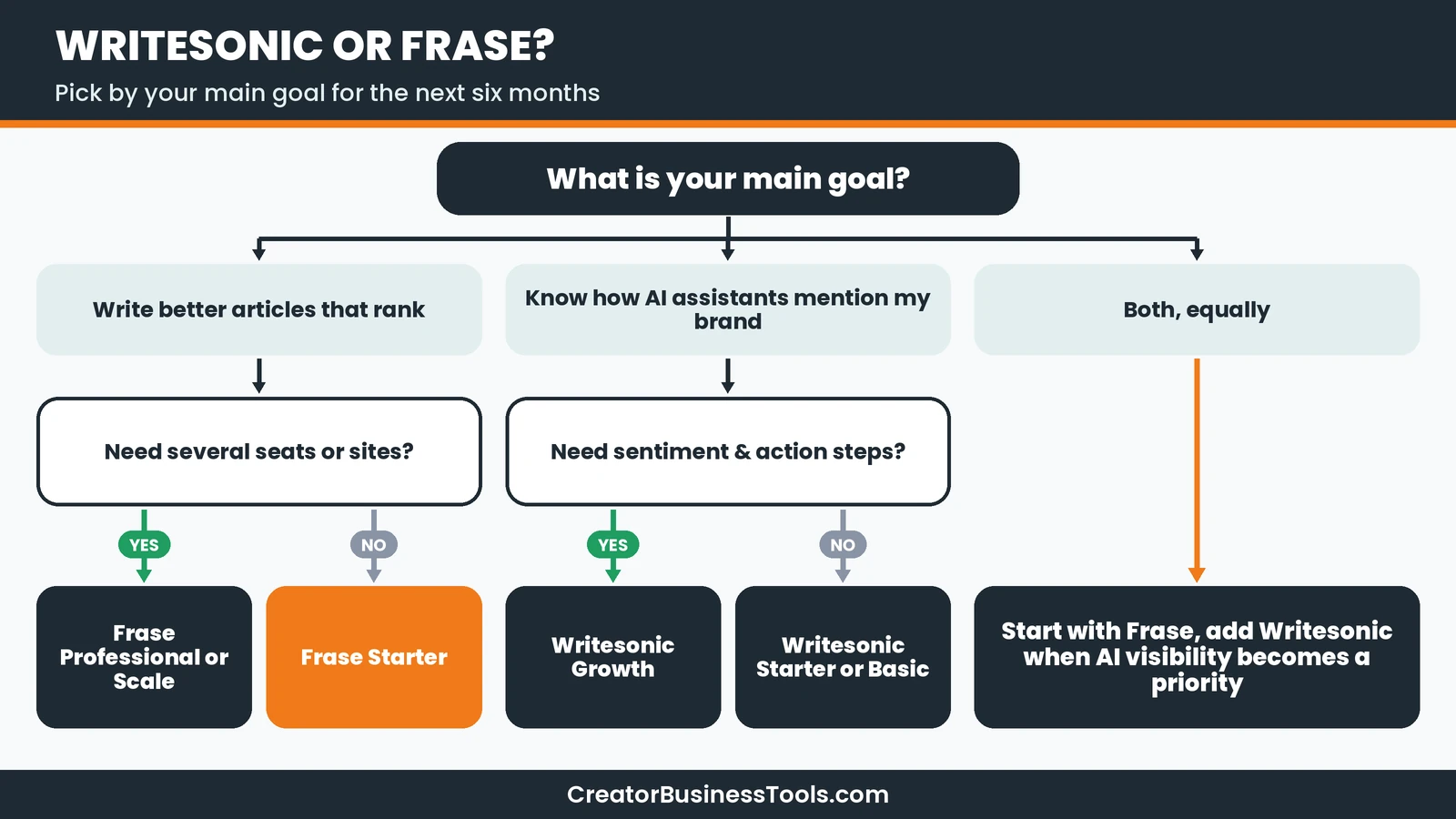
- Write down your main goal for the next six months in one sentence.
- If the sentence is about traffic from articles, start with Frase.
- If it is about being recommended by AI assistants, start with Writesonic.
- List how many sites, writers, and articles you need each month.
- Match those numbers to the plan limits above.
- Review the choice after three months of real use.
FAQ
Is Writesonic better than Frase? Not overall. Writesonic is better for AI search visibility tracking, while Frase is better for content research and on-page optimization.
Which costs less, Writesonic or Frase? Frase. Its Starter plan sits in the mid-range tier, while every Writesonic self-serve plan is in the premium tier.
Do both tools track AI search? Yes. Writesonic tracks ChatGPT, Gemini, and Google AI Overviews on every self-serve plan. Frase tracks ChatGPT and Google AI, adding Perplexity on Professional and above.
Which is better for bloggers? Frase, for most bloggers, because its workflow focuses on researching and optimizing articles at a lower price.
Which is better for agencies? Frase Scale suits content agencies, while Writesonic Growth suits agencies that report AI visibility to clients.
Can I switch later? Yes. Both tools offer monthly billing, so you can change tools after testing your workflow.
Conclusion: Writesonic vs Frase
Writesonic and Frase overlap, but they answer different questions. If you want to write articles that rank and get cited, Frase gives you more of what you need at a lower price. If you want to know and improve how AI assistants talk about your brand, Writesonic is the deeper platform. Pick the one that matches your main goal. Check Frase or check Writesonic.
Related guides: Koala AI vs Writesonic vs Frase · Koala AI Review · Writesonic Review · Frase Review
Get our free content tool picker
Not sure which SEO or AI content tool fits your workflow? Join our email list for a free one-page tool picker that matches your goals, budget, and team size to the right plan. Contact us to request a copy.
Pricing and features from official vendor pages, last checked October 26, 2026.