
Koala AI Review: KoalaWriter, Plans, and Who It Is Best For
Disclosure: This post contains affiliate links. If you buy through them, we may earn a commission at no extra cost to you. How we make money.
Koala AI is an AI SEO platform built around long-form writing, brand context, and — on higher plans — an agent that plans from your own search data. Creators often still call the writer KoalaWriter, but the product is now a wider suite: writing, images, internal links, chat, and Brand DNA.
This Koala AI review explains what you get on each plan, who it fits, and how it differs from content tools that focus more on briefs or AI visibility tracking. It is based on Koala’s public marketing and pricing pages, not on lab tests or invented team stories.
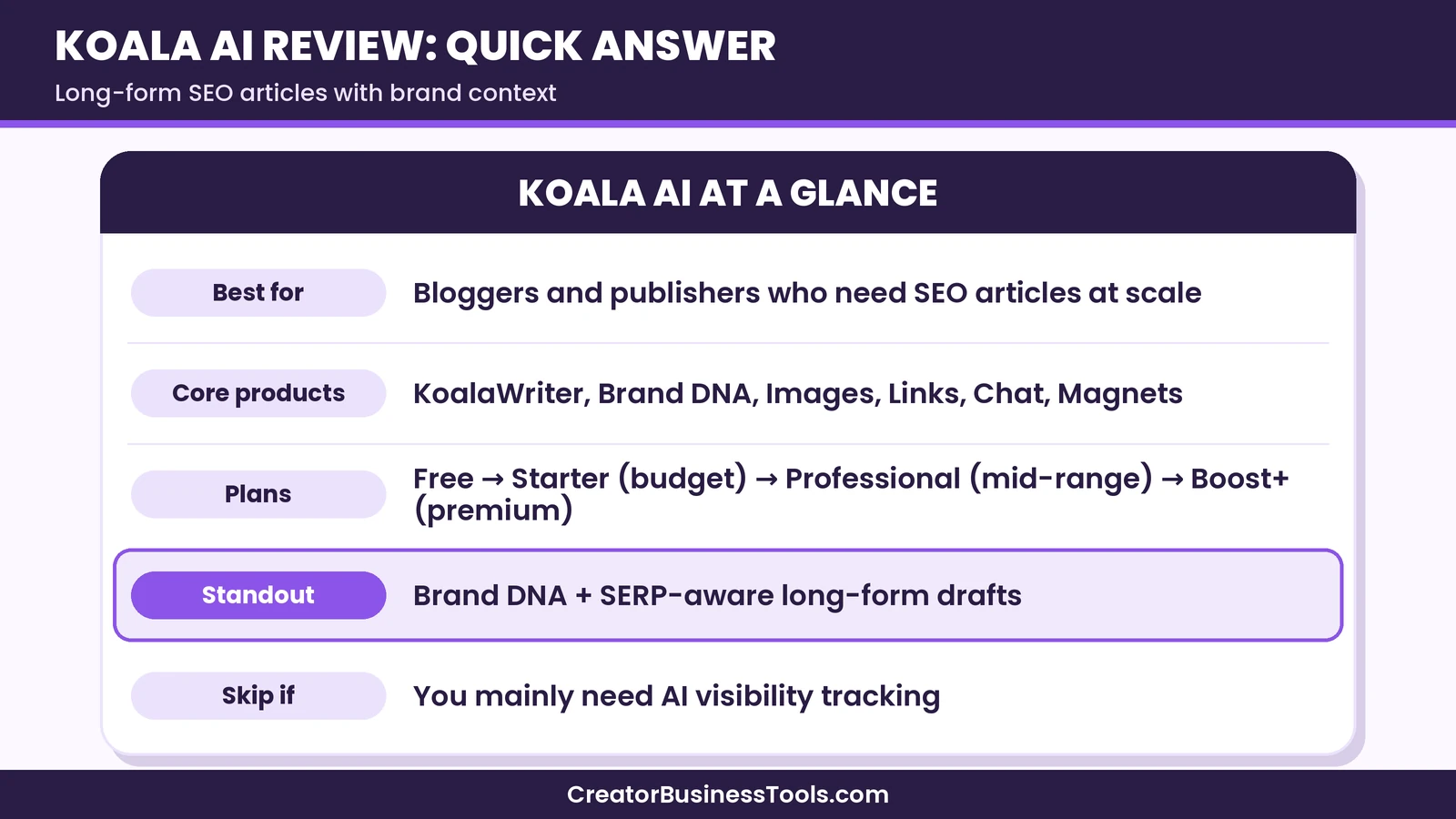
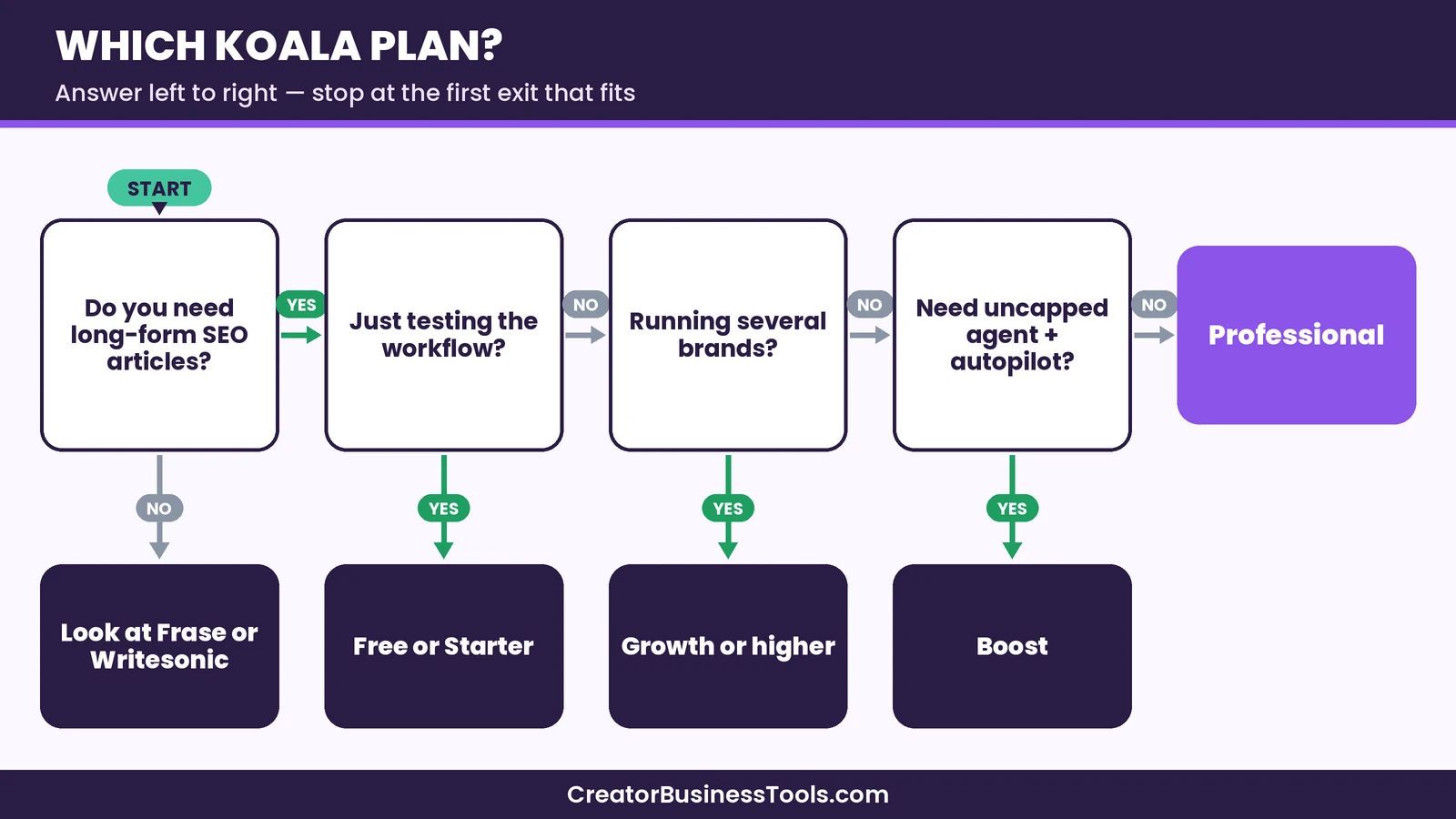
Quick verdict: Koala AI is a strong fit for bloggers, niche-site operators, and small content teams who want publishable long-form drafts with SEO research baked in. Starter works for lighter output. Professional is the practical mid-range plan for most serious solo publishers. Boost makes sense when you want the uncapped agent and calendar autopilot. If your main need is AI answer tracking for a brand, look at Writesonic instead.
Quick picks
- Best for trying the writer: Koala AI Free allowance, then Starter if you publish regularly. See Koala AI Starter
- Best for most solo publishers: Professional, with Deep Research and stronger editing tools. See Koala AI Professional
- Best for autopilot calendars and uncapped agent use: Boost. See Koala AI Boost
- Best alternative for AI visibility tracking: Writesonic. See our Writesonic review.
- Best alternative for research-led briefs: Frase. See our Frase review.
Koala AI links on this page are affiliate links.
Related guides: Koala AI vs Writesonic vs Frase · Writesonic Review · Frase Review · Writesonic vs Frase
Koala AI at a glance
| Details | |
|---|---|
| Product type | AI SEO writing + brand agent platform |
| Best for | Bloggers, niche sites, small content teams |
| Entry paid tier | Starter (budget) |
| Sweet spot | Professional (mid-range) |
| Premium automation | Boost and higher |
| Publishing | WordPress, Shopify, Webflow, Ghost, webhooks |
| Not ideal for | Brands that only need AI mention tracking |
What Koala AI includes
KoalaWriter
KoalaWriter is the long-form engine. It aims to produce structured articles from keywords, with SERP-aware outlines, optional Deep Research on higher plans, images, and automatic internal linking. Drafts are meant to be edited by a human, not pasted blindly.
Brand DNA
Brand DNA imports business context from a website or maps listing so articles can reference real services, voice, and details. Every paid plan that includes a brand slot can use it. Agent message caps rise with the plan; Boost removes the cap and adds calendar autopilot.
KoalaChat, Images, Links, Magnets
One subscription spans chat with web data, AI images, bulk internal linking, and embeddable lead magnets on higher mid-range and premium plans. Platform credits are shared across these tools, while article generation uses a separate word allowance.
MCP and API
Paid plans include MCP access so compatible AI assistants can use Koala’s research and writing tools on your credit balance. API access is listed on Starter and above.
Plans and who they fit
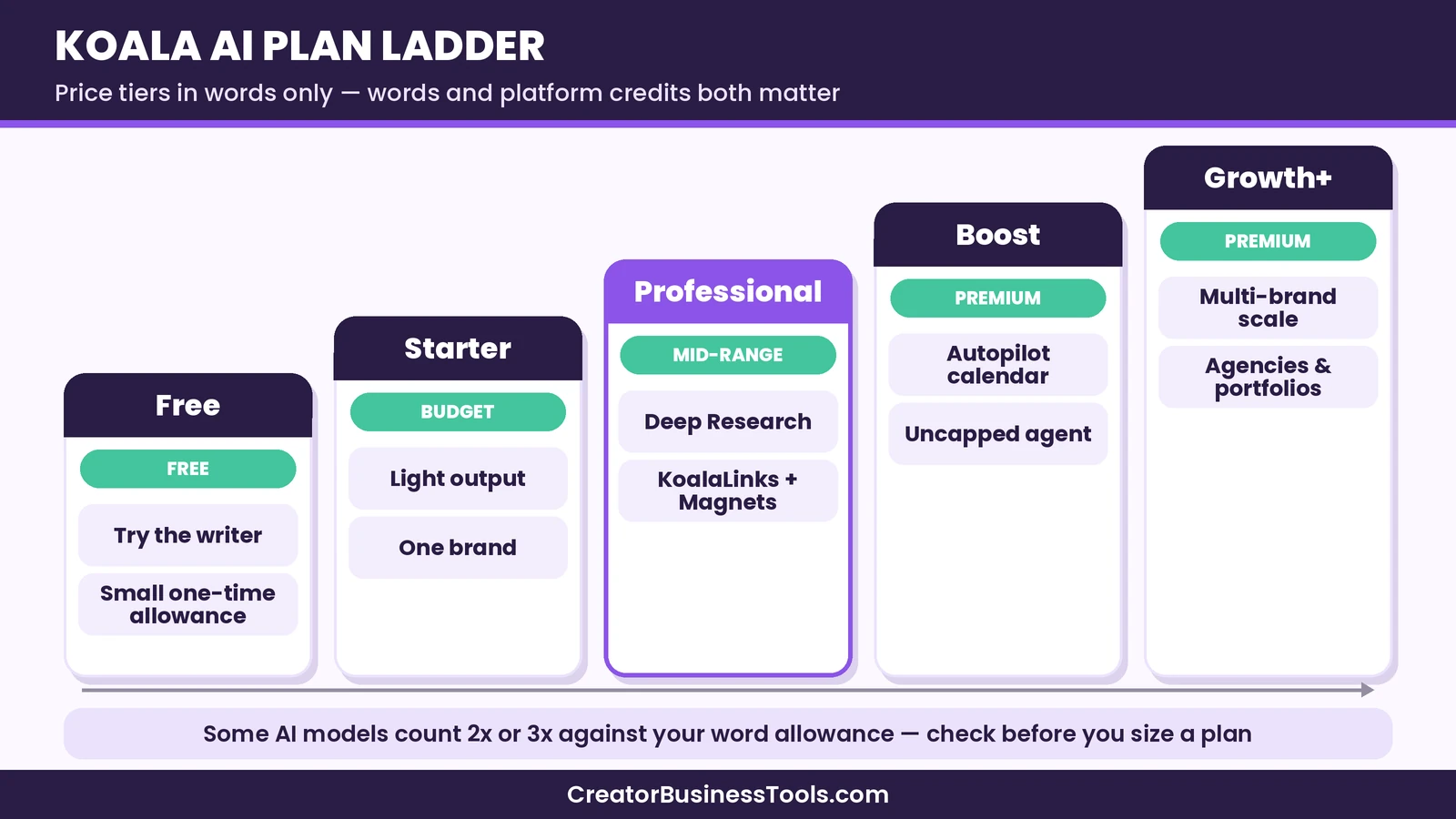
| Plan | Price tier | Words / credits (monthly) | Good for |
|---|---|---|---|
| Free | Free | One-time small allowance | Trying the writer |
| Starter | Budget | Modest words and credits | Light publishing, one brand |
| Professional | Mid-range | Larger words and credits | Most solo publishers |
| Boost | Premium | High words and credits | Autopilot + uncapped agent |
| Growth and above | Premium | Very high / multi-brand | Agencies and portfolios |
Starter
Starter includes the writer, images, MCP, and a Brand DNA slot with a limited agent message cap. It is enough to learn the workflow and publish a measured number of articles each month.
Professional
Professional is the plan most serious individuals should evaluate first. It adds Deep Research, stronger article editing and SEO scoring, Search Console and Analytics in one dashboard, KoalaLinks, and KoalaMagnets, with a higher agent message allowance than Starter.
Boost
Boost keeps one brand but unlocks the full Brand DNA experience: uncapped agent messages and Content Calendar Autopilot, plus a much larger word and credit pool. Choose it when you will actually use the agent and calendar every week.
Higher plans
Growth and above raise words, credits, and brand counts for agencies and multi-site operators. Extra brand slots can also be added on paid plans for an add-on fee.
Word usage depends on the model you pick. Koala’s pricing page notes that some models count at 2x or 3x against the allowance. That detail matters more than the headline word number.
Strengths
- Long-form drafts aimed at SEO publishers, not just short marketing copy
- Brand DNA reduces generic output when you invest in setup
- One subscription covers writer, images, links, and chat
- Clear publishing destinations for common CMS tools
- Plan ladder that scales from solo blogs to multi-brand shops
Limitations
- Output still needs human editing and fact checking
- Agent and autopilot value concentrates on Boost and above
- Platform credits are shared across many features, so chat-heavy use can compete with images and links
- Model multipliers can cut effective word counts
- Not specialized for daily AI visibility tracking the way Writesonic is
Who should use Koala AI
- Bloggers building topical authority with steady article volume
- Affiliate and niche publishers who need researched drafts quickly
- Small teams that want one AI writing stack instead of five single-purpose tools
- Operators ready to maintain a Brand DNA knowledge base
Who should look elsewhere
- Brand marketers who mainly need ChatGPT / AI Overview mention tracking — start with Writesonic
- Writers who want a brief-first optimization workspace — evaluate Frase
- Users who only need occasional social captions — this is the wrong category
- Teams that refuse to edit AI drafts
Writing quality and editing reality
Koala’s marketing emphasizes publish-ready structure: headings, research, links, and images. In real editorial work, “publish-ready” still means “ready for a human pass.” Plan time for:
- factual checks on claims, prices, and stats
- adding first-hand examples the model cannot know
- trimming repetitive sections
- aligning the draft with your exact offer and disclaimer needs
Teams that skip editing eventually pay for it in trust. Teams that treat Koala as a fast first draft usually keep the efficiency gains.
Brand DNA setup checklist
Brand DNA only helps if you feed it. Before you generate a large batch:
- Import from your site or maps listing.
- Correct services, locations, and credentials.
- Add voice notes and phrases you never want.
- Connect Search Console if your plan supports the dashboard and agent workflow you need.
- Generate one sample article and revise the knowledge base based on what looked wrong.
Skipping those steps is the most common reason people say an AI writer “sounds generic.”
Credits vs words
Koala separates article words from platform credits. Words cover KoalaWriter output. Credits cover chat, images, links, magnets, agent work, and MCP research. A month heavy on images and agent research can feel tight even when word count remains. Watch both meters.
Publishing and collaboration
One-click publishing to major CMS tools is a practical advantage for solo operators. Agencies should decide whether drafts publish as drafts (recommended) or live. Koala is not a full replacement for an editorial calendar in Notion or a project manager, except insofar as Boost’s Content Calendar Autopilot covers part of that job.
When Koala is the wrong buy
- You need courtroom-grade citation workflows for regulated copy without expert editors
- You only need social captions and ad variants
- Your company mandate is AI visibility reporting for leadership, not article production
- You refuse to maintain brand context and will only enter a keyword
In those cases, a different category — or a human workflow — is the honest answer.
A hypothetical example
Imagine a niche-site owner publishing eight SEO articles a month across one brand. In this hypothetical case, she imports Brand DNA from her site, writes on Professional so she can use Deep Research, and edits every draft before publishing to WordPress. She does not need Boost yet because she plans topics herself. Six months later, if she wants the agent to maintain a calendar across gaps in Search Console data, Boost becomes worth comparing. The upgrade trigger is workflow, not a vanity feature list.
Koala AI vs nearby tools (short)
Against Frase, Koala leans harder into bulk long-form generation and brand agents. Frase leans into research briefs, on-page scores, and a content-ops workspace. Against Writesonic, Koala is the writer-first platform; Writesonic is visibility-first with writing attached. Our full three-way guide covers the tradeoffs: Koala AI vs Writesonic vs Frase.
Common mistakes
- Buying Boost for autopilot before Brand DNA is filled in
- Ignoring model multipliers when estimating monthly article count
- Publishing unedited drafts
- Choosing Koala when the real need is AI mention tracking
- Spending platform credits on chat experiments during a heavy publishing week
FAQ
Is KoalaWriter the same as Koala AI?
KoalaWriter is the article product inside the wider Koala AI platform.
Does Koala AI have a free plan?
Koala AI offers a one-time free word and credit allowance for new accounts, according to the pricing page. Ongoing publishing needs a paid plan.
Which plan do most bloggers need?
Professional is the usual sweet spot once you publish regularly and want Deep Research. Starter is fine while you are proving the workflow.
Does Koala replace Ahrefs or Semrush?
Koala includes keyword, backlink, and SERP-style data inside its agent story, but specialized SEO suites still go deeper for many technical workflows. Treat Koala as a content-and-planning layer first.
Can I publish to WordPress?
Yes. Official materials list WordPress, Shopify, Webflow, Ghost, and webhooks.
Do unused words roll over?
Koala describes a rollover bank on monthly plans. Confirm the current rules on the pricing FAQ before you rely on them.
Is Boost required for Brand DNA?
No. Brand DNA appears on lower plans with message caps. Boost removes the cap and adds calendar autopilot.
Deep Research and SERP mirroring
On Professional and above, Deep Research and SERP-aware generation are the features that separate Koala from a generic chat window. The promise is simple: look at what already ranks, gather sources, then draft with more context. That helps — and it can also overfit to whatever currently ranks, including mediocre pages. Editors should still ask whether the draft adds something new.
Internal linking at scale
KoalaLinks and automatic internal linking are especially useful for older sites with dozens or hundreds of URLs. Used well, they reduce orphan pages and reinforce topical clusters. Used carelessly, they create awkward anchors. Review links in the first weeks until you trust the patterns.
Images and media
KoalaImages can generate featured images and in-article visuals. That speeds drafting, but stock-looking AI images can hurt trust in some niches. For YMYL or premium brands, keep a human design pass or use real photos.
API, MCP, and assistants
MCP access on paid plans means your coding or chat assistant can call Koala tools with your credits. This is powerful for technical operators and easy to overspend for curious experimenters. Set norms for who may connect assistants and which research calls are allowed.
Onboarding plan for the first two weeks
Week 1: Free or Starter — import Brand DNA, publish two edited articles, measure editing time.
Week 2: If quality and speed feel right, move to Professional before a big content push. Only evaluate Boost after you have a backlog and a reason for autopilot.
Affiliate and ecommerce article modes
Koala publicly emphasizes Amazon affiliate article modes with live product data, plus service pages grounded in Brand DNA. Those modes are useful when they reduce blank-page time. They are risky when they invent product claims. Always verify prices, availability, and specs on the source before publishing.
For service businesses, Brand DNA-filled service pages can speed local SEO drafts. Still add proof: photos, reviews, and real FAQs customers ask on calls.
How Koala fits with classic SEO tools
You may still want a crawler, a rank tracker, or a backlink database for technical work. Koala’s pitch is that a lot of keyword and SERP context lives beside the writer. That can replace parts of a stack for smaller sites. Larger SEO teams usually keep specialized tools and use Koala as the drafting layer.
Collaboration patterns
- Solo blogger: Professional, drafts as CMS drafts, edit same day
- Two-person team: one person owns Brand DNA, one edits
- Agency: higher plans or extra brands, strict client folders, draft-only publishing
Clear ownership of Brand DNA prevents contradictory voice settings.
Measuring success after 30 days
Judge Koala on editing minutes per article, factual error rate, and whether published pieces index and earn impressions — not on how impressive the first raw draft looked. If editing time is not down versus your old process, change prompts, Brand DNA, or plan features before you blame the category.
Red flags when evaluating competitors
If a competitor promises hands-off ranking with no editing, be skeptical. If a competitor hides model multipliers or credit rules, budget carefully. Koala is relatively explicit about words, credits, and model multipliers on its pricing page — use that transparency as a baseline when you compare alternatives.
Example monthly rhythms
Light rhythm (Starter): four edited articles, light image use, minimal agent chat.
Standard rhythm (Professional): eight to twelve articles with Deep Research on competitive keywords, measured link passes, GSC-informed topics.
Automation rhythm (Boost): calendar-backed drafts every week, agent maintaining gaps, human editors focusing on expertise inserts.
Pick the rhythm first, then the plan. Buying Boost for a light rhythm wastes agent capacity; buying Starter for an automation rhythm creates constant ceiling hits.
Voice and originality
Brand DNA helps voice. It does not create original reporting. Interview customers, add screenshots, and include operator notes the model cannot invent. Those inserts are what make Koala drafts defensible in competitive SERPs.
Teams that already draft in Google Docs may prefer exporting Markdown and pasting, while WordPress-heavy teams benefit more from the draft-as-post flow. Match the publishing path to where editors already work.
Closing note
Koala AI rewards operators who treat AI as a drafting partner and Brand DNA as a living document. If you invest in those habits, Professional is often enough for a long time. If you want the product to plan and push a calendar with less manual topic picking, Boost is the plan to compare next — after the basics work.
Bottom line
Koala AI is one of the clearest writer-first AI SEO platforms for publishers who will edit drafts and maintain brand context. Start on the free allowance or Starter, move to Professional when Deep Research and linking matter, and only then consider Boost for autopilot. If your problem is AI brand visibility rather than article production, choose a different tool.
Koala AI links below are affiliate links.
[See Koala AI's plans](https://koala.sh/pricing)Free checklist: Get our free AI Writing Stack Checklist — words, credits, research depth, and when to pick a visibility tool instead. Contact us to request a copy.
Pricing and features from official vendor pages, last checked October 28, 2026.