
Writesonic Review: AI Search Visibility, Plans, and Who It's For
Disclosure: This post contains affiliate links. If you buy through them, we may earn a commission at no extra cost to you. How we make money.
Search is changing. Many buyers now ask ChatGPT, Gemini, or Google’s AI Overviews which tool, product, or service to choose, and they never scroll through ten blue links. Writesonic has repositioned itself around that shift. It started as an AI writer, and today it sells itself as an SEO and AI search visibility platform that tracks how AI assistants talk about your brand, then helps you fix the gaps with articles, site audits, and AI agents. This Writesonic review explains what each plan includes, how the AI visibility tracking works, and which creators and small teams will actually get value from it. We based it on Writesonic’s official pricing page and product pages.
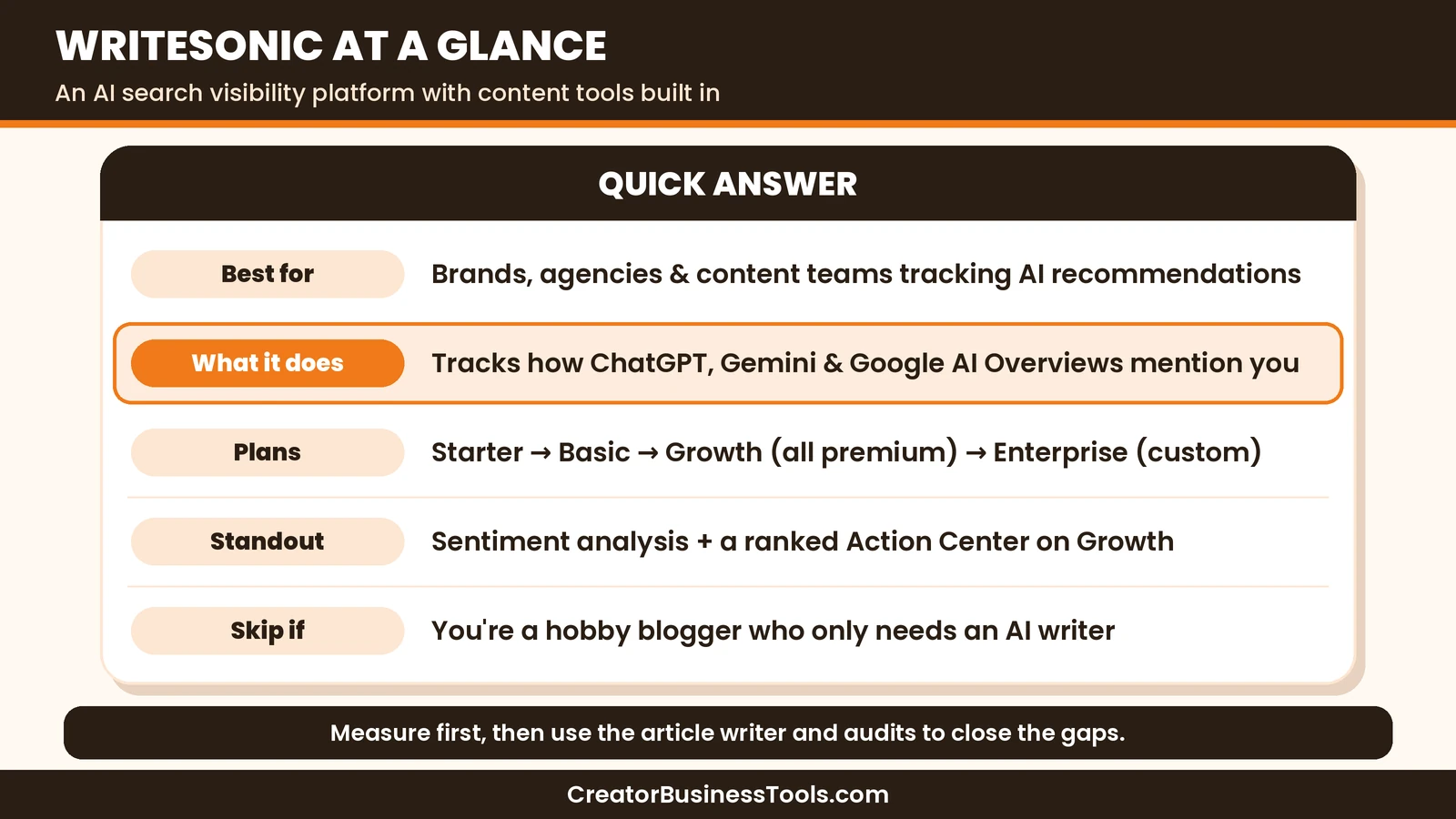
Quick verdict: Writesonic is a strong choice for brands, agencies, and growing content teams that want to measure and improve how often AI assistants recommend them, with content creation and site audits in the same place. Every plan sits in the premium price tier, so it is a business tool rather than a hobby writing app. Solo bloggers who only need help writing optimized articles will usually get more value from a dedicated content tool such as Frase.
Quick picks
- Best for trying AI visibility tracking: Writesonic Starter, with daily tracking across ChatGPT, Gemini, and Google AI Overviews plus a monthly batch of AI articles. Try Writesonic
- Best for a small marketing team: Writesonic Basic, with more tracked prompts, larger site audits, and two users.
- Best for teams that want to act on the data: Writesonic Growth, with sentiment analysis, a starter version of the Action Center, and fifty articles a month.
- Best for large brands: Writesonic Enterprise, with nine AI platforms, the full Action Center, and a dedicated strategist.
- Best alternative for solo bloggers: a content-first SEO tool such as Frase, which we compare in our Writesonic vs Frase guide.
Writesonic at a glance
| Item | What Writesonic offers |
|---|---|
| What it is | An SEO and AI search visibility platform with content creation and site audits |
| Plans | Starter, Basic, Growth, Enterprise |
| Price tiers | Premium on every self-serve plan, custom for Enterprise |
| AI platforms tracked | ChatGPT, Gemini, and Google AI Overviews on self-serve plans; nine platforms on Enterprise |
| Content | AI article writer, content optimization, brand voice styles |
| Site audits | Monthly audits with automatic AI fixes |
| Agents | Agentic workflows for SEO, content, and AI search tasks, limited on self-serve plans |
| Integrations | Google Search Console, WordPress, GA4, and Looker Studio on higher plans |
| Team | One to three users on self-serve plans, with paid extra seats on Basic and Growth |
What is Writesonic?
Writesonic began with AI copywriting and long-form article generation. Its current product focuses on two connected jobs. The first is visibility in AI search, sometimes called generative engine optimization or GEO. Writesonic runs a set of prompts you choose, such as “best project management tool for freelancers”, through AI platforms every day and records whether your brand appears, how it is described, and which competitors are mentioned instead. The second job is classic SEO and content work: writing articles, optimizing pages, and auditing your site.
The pitch is that most tools stop at the report. Writesonic wants to show you where you are missing from AI answers and then give you the tools to do something about it, from new articles to technical fixes.
Writesonic review: the features that matter
AI search visibility tracking
This is the heart of the product. On every self-serve plan, Writesonic tracks ChatGPT, Gemini, and Google AI Overviews daily. You choose the prompts that matter to your business, and Writesonic records the answers. Starter tracks a small set of prompts, Basic tracks more, and Growth tracks the most. Enterprise can track nine AI platforms, including Perplexity, Claude, Microsoft Copilot, Grok, and Google AI Mode, with custom regions and languages.
Over time, this tells you which questions you win, which ones you lose to competitors, and whether your changes are moving the numbers. For a brand that sells software, courses, or services, that is valuable information that traditional rank trackers do not provide.
Ads monitoring and sentiment analysis
Every plan includes ads monitoring across ChatGPT and Google AI surfaces, so you can see which brands are paying for placement around your topics. Growth adds sentiment analysis, which shows whether AI answers describe your brand positively, neutrally, or negatively. Sentiment matters because a mention that calls your product “expensive and hard to use” can hurt more than no mention at all.
The Action Center
The Action Center turns visibility data into a ranked to-do list. It highlights missing prompts, citation gaps, content fixes, and technical issues, ordered by expected impact. Growth includes a limited version with a small monthly allowance of off-page and on-page actions, and Enterprise includes the full Action Center. Starter and Basic do not include it, which is an important point when comparing plans.
AI article writer and content optimization
Writesonic still writes. Each plan includes a monthly allowance of AI articles, growing from Starter to Growth, plus content optimization, uploads of your own data, and brand voice styles so drafts sound like you. Growth users can buy extra article packs if they publish heavily. The writer draws on Google Keyword Planner data, Google search results, and Reddit discussions, which helps drafts reflect what real searchers ask about.
Site audits with AI fixes
Site audits check your pages for SEO and AI search issues and can apply automatic AI fixes. The number of audits per month and the pages per audit grow sharply with each plan. Starter covers small sites, while Growth can audit a large content library many times a month.
Agentic workflows
Writesonic includes AI agents that can automate SEO, content, and AI search tasks. On self-serve plans, access is limited to a set number of runs, growing with each tier. Enterprise has full access. Think of the agents as a preview on the smaller plans rather than a core reason to buy them.
Writesonic pricing explained
Writesonic’s pricing is clear, but it is firmly aimed at businesses.
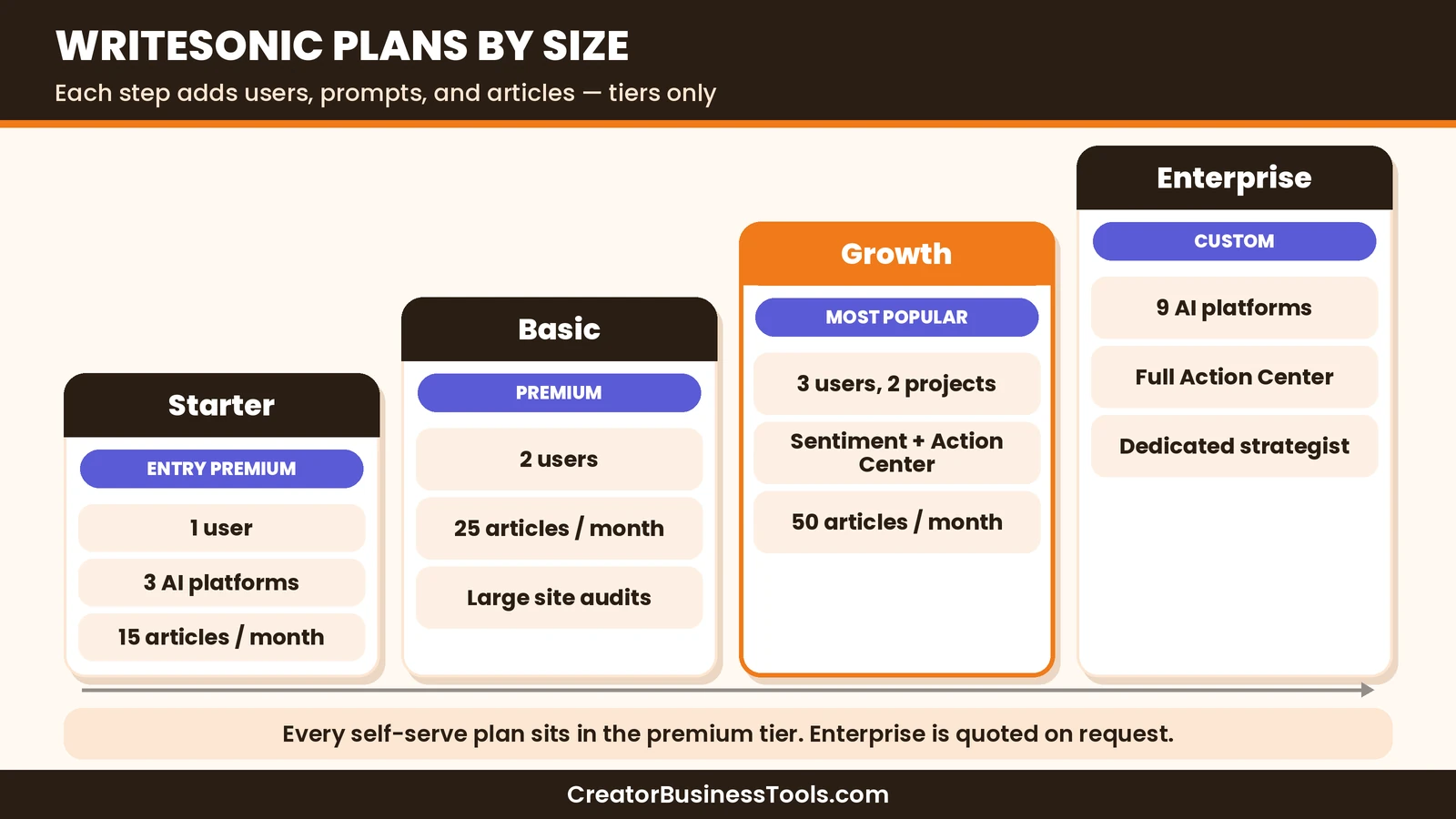
- Starter: entry premium tier. One user and one project, daily tracking on three AI platforms with a small prompt set, ads monitoring, a modest monthly article allowance, and small site audits.
- Basic: higher premium tier. Two users, more prompts and daily answers, more articles, much larger site audits, and more brand voice styles. You can add a few extra users for a monthly fee each.
- Growth: higher premium tier and the most popular plan. Three users and two projects, the largest prompt set, sentiment analysis, the starter Action Center, fifty articles a month, and priority email support.
- Enterprise: custom pricing. Nine AI platforms, custom prompts, regions, and languages, the full Action Center, security features such as SSO, and a dedicated AI search strategist.
You can pay monthly or yearly. Writesonic lets you upgrade at any time, and downgrades or cancellations take effect at the next billing cycle. Check the refund policy and current billing terms on the official site before you commit.
Who Writesonic is best for
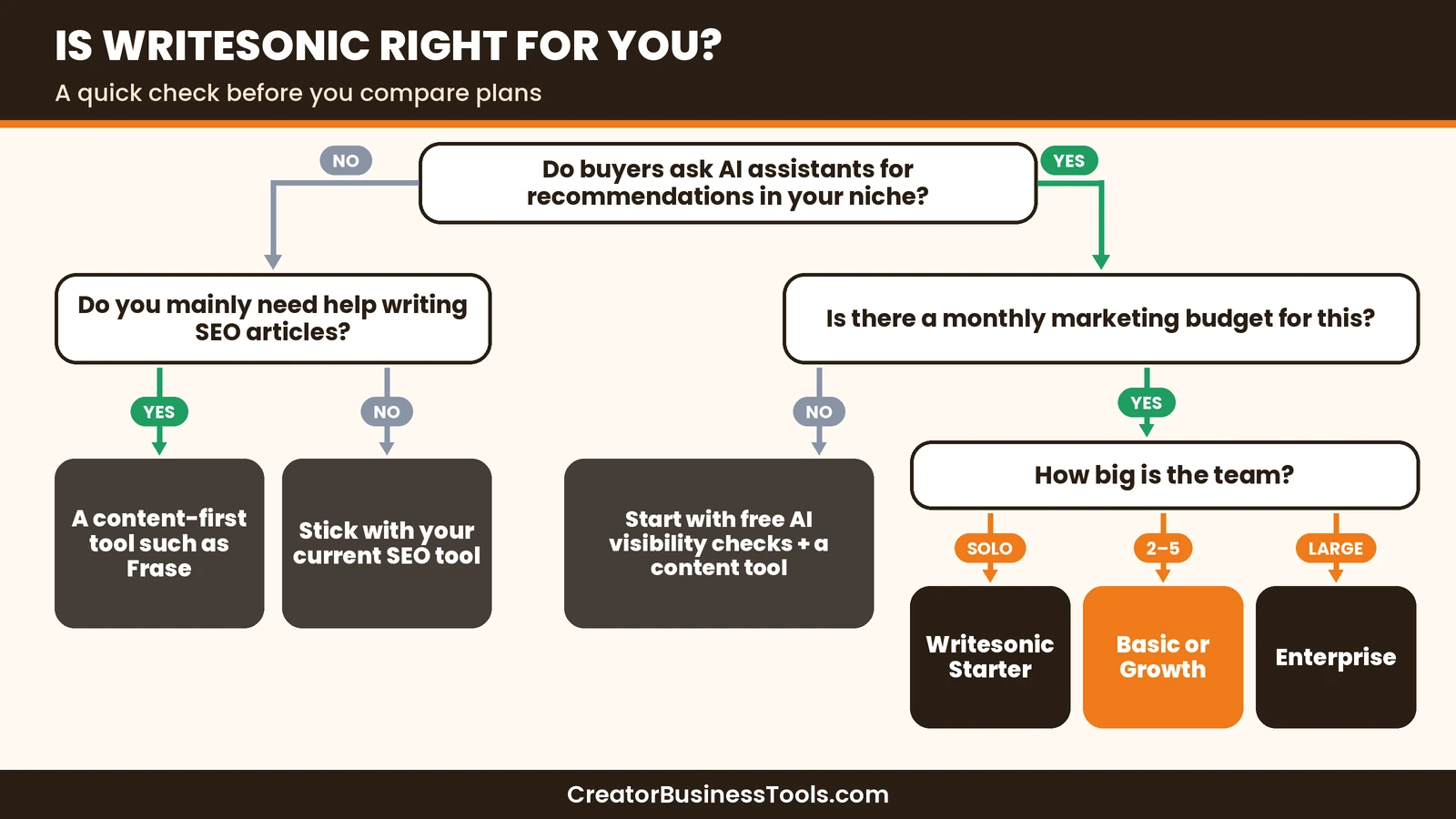
- Software and service brands that know buyers ask AI assistants for recommendations in their category.
- Marketing agencies that want to report AI visibility to clients alongside traditional SEO.
- Content teams publishing several articles a week who want writing, optimization, and audits in one tool.
- Course creators and info-product businesses with a real marketing budget and competitive niches.
- Founders who want to see how ChatGPT and Gemini describe their product compared with rivals.
Who might want something else
- Hobby bloggers and new creators, because every plan sits in the premium tier.
- Writers who only need an AI drafting tool, since much of the value is in visibility tracking they may never use.
- Teams that need Perplexity or Claude tracking without an Enterprise contract, because self-serve plans cover three platforms.
- Small sites with a handful of pages, where site audits and agents add little.
How Writesonic compares with other SEO and content tools
| Tool | Main focus | Price tier | AI search tracking | Best for |
|---|---|---|---|---|
| Writesonic | AI search visibility plus content and audits | Premium | ChatGPT, Gemini, Google AI Overviews; more on Enterprise | Brands and agencies |
| Frase | Content research, writing, and optimization | Mid-range to premium | ChatGPT and Google AI on Starter; more on higher plans | Solo bloggers and content teams |
| Semrush | All-in-one SEO suite | Premium | Varies by plan | SEO professionals |
| Surfer SEO | On-page content optimization | Mid-range to premium | Varies by plan | Writers optimizing articles |
If you are choosing between Writesonic and a content-first tool, our Writesonic vs Frase comparison goes deeper. You can also read our Semrush review if you want a broader SEO suite.
A typical month with Writesonic
To picture how Writesonic fits into real work, imagine a small software company with a two-person marketing team on the Growth plan.
In the first week, the team reviews the daily tracking report. They notice that ChatGPT often recommends two competitors for a high-intent prompt, while their own product appears only in Gemini answers. Sentiment analysis shows that one AI answer describes their onboarding as confusing, based on an old forum thread.
In the second week, they open the Action Center. It suggests a comparison article, an updated feature page, and a few third-party sites where a citation could help. The team uses the article writer to draft the comparison in their brand voice, edits it carefully, and publishes it through the WordPress integration.
In the third week, they run a site audit. Writesonic flags thin pages and missing structured data, and the team applies several automatic fixes. In the final week, they check whether the tracked prompts have changed and share a short report with leadership. Over a few months, that loop of tracking, acting, and measuring is the real product.
Content quality and editing
Like every AI writer, Writesonic produces drafts, not finished articles. The drafts are structured, readable, and informed by search and Reddit data, but they still need a human pass for accuracy, examples, and opinion. That is especially true if you want AI assistants to cite your page, because they tend to favor content with clear facts, original insight, and specific detail. Plan to spend real time editing each article, and treat the monthly allowance as a starting point for your writers rather than a replacement for them.
What we would like to see improved
A fair Writesonic review should mention a few gaps. First, the entry price is high for creators who are just starting, and there is no low-cost plan aimed at solo bloggers. Second, self-serve plans track three AI platforms, so Perplexity and Claude visibility requires Enterprise. Third, the Action Center, one of the most compelling features, is limited on Growth and missing on Starter and Basic. Finally, AI answers change often, so daily tracking can look noisy in the first few weeks. None of these rule it out for the brands Writesonic targets, but they matter for smaller users.
Pros and cons
Pros
- Daily tracking of how ChatGPT, Gemini, and Google AI Overviews mention your brand
- Content creation, optimization, and site audits in the same platform
- Sentiment analysis and a ranked Action Center on Growth
- Brand voice styles and data from search results and Reddit
- Clear plan limits and integrations with Search Console and WordPress
Cons
- Every self-serve plan sits in the premium price tier
- Only three AI platforms tracked below Enterprise
- Action Center limited on Growth and missing on lower plans
- Agentic workflows are capped on self-serve plans
- More than most solo bloggers need
A small story from our team
The moment AI search felt real to us was simple. One evening we asked an AI assistant to recommend tools for selling digital products, a topic we had written about many times. The answer was confident and well organized, and it cited three other websites. Ours was nowhere. We had no idea whether that happened once or every day, and that blind spot is exactly what tools like Writesonic are built to measure.
How to get started with Writesonic
- Write down ten to twenty prompts a real buyer might ask an AI assistant about your niche.
- Sign up for Starter and add those prompts to your first project.
- Watch the daily results for two to three weeks before drawing conclusions.
- Use the article writer and site audits to close the most obvious gaps.
- Move to Basic or Growth when you need more prompts, more users, or the Action Center.
- Share a monthly visibility report with your team or clients.
Tips for using Writesonic well
- Choose buyer prompts, not vanity prompts. Track questions that lead to a purchase decision.
- Include competitor names. Prompts such as “X vs Y” show how AI assistants frame your category.
- Edit every article. Add examples, data, and opinions that an AI cannot invent.
- Fix sentiment sources. If an answer repeats an outdated complaint, update the pages and profiles it comes from.
- Review monthly, not daily. Trends matter more than single answers.
Is Writesonic worth it?
For brands, agencies, and content teams with a marketing budget, yes. Writesonic is one of the few platforms that combines AI search visibility tracking with the content and technical tools to act on it, and the Growth plan in particular gives a team a complete loop. For hobby bloggers and early-stage creators, the premium pricing is hard to justify, and a content-first tool or a broader SEO suite will usually be a better first purchase.
FAQ
What is Writesonic used for? Writesonic tracks how AI assistants such as ChatGPT, Gemini, and Google AI Overviews mention your brand, and it helps you improve that visibility with AI articles, content optimization, and site audits.
Is Writesonic still an AI writer? Yes. Every plan includes a monthly allowance of AI articles, but the product now centers on SEO and AI search visibility.
Which AI platforms does Writesonic track? Self-serve plans track ChatGPT, Gemini, and Google AI Overviews. Enterprise tracks nine platforms, including Perplexity, Claude, Microsoft Copilot, Grok, and Google AI Mode.
Is Writesonic good for beginners? It is easy to use, but every self-serve plan sits in the premium price tier, so it suits businesses more than new hobby bloggers.
Can I add more users? Starter includes one user. Basic and Growth include more users and let you add a few extra seats for a monthly fee each. Enterprise is custom.
Can I cancel or change plans? Yes. You can upgrade at any time, and downgrades or cancellations apply from the next billing cycle.
Conclusion: our Writesonic review in a nutshell
Writesonic is no longer just an AI writer. It is a platform for understanding and improving how AI assistants talk about your brand, with articles, audits, and agents to close the gaps. If AI recommendations already influence your buyers and you have a marketing budget, Starter is a sensible way in, and Growth is the plan where the full loop comes together. If you mainly need help writing better blog posts, start with a content-first tool instead. Check Writesonic
Related guides: Koala AI Review · Koala AI vs Writesonic vs Frase · Writesonic vs Frase · Frase Review
Get our free AI search visibility checklist
Want to know whether AI assistants recommend your brand? Join our email list for a free AI search visibility checklist with twenty prompt ideas, a simple tracking sheet, and quick content fixes you can apply this week. Contact us to request a copy.
Pricing and features from official vendor pages, last checked October 26, 2026.